17th Century | 18th Century | 19th Century | 20th Century
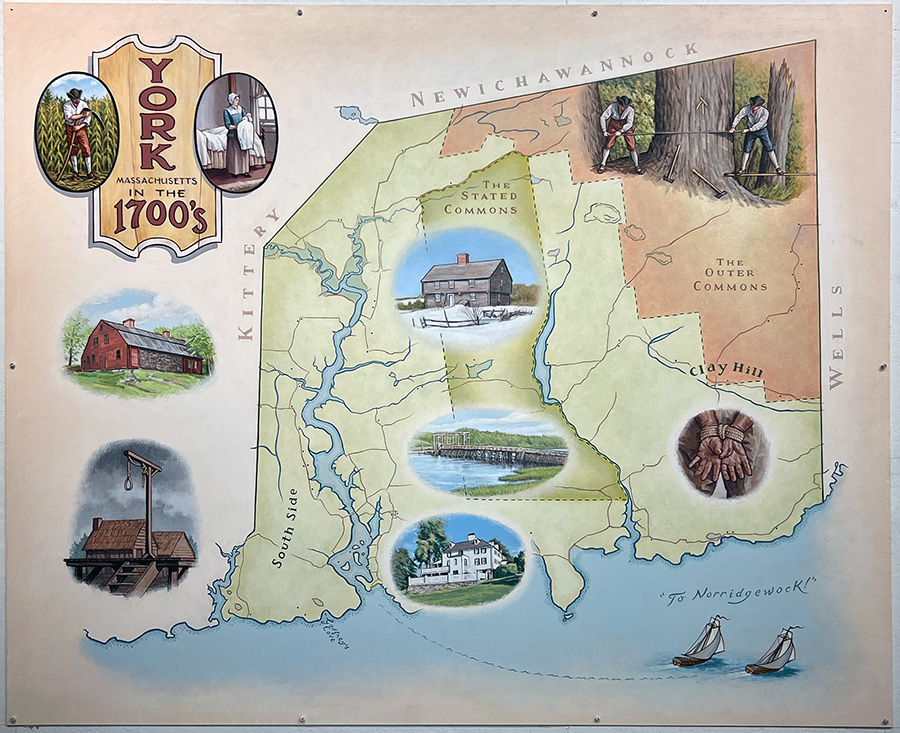
A Note About the Four Maps of York
York continued to suffer from numerous Indian raids during Queen Anne’s War (1702–13), necessitating the building of many garrisons, including the McIntire Garrison, Maine’s oldest scientifically-verified building. The subsequent Dummer’s War (1722–25) saw York men take a leading role in the 1724 raid that destroyed the Wabanaki settlement of Norridgewock on the Kennebec River. The threat of native attacks began to decline as the native population declined. By the middle of the century, York was a prosperous town connected by merchant networks to the expansive British empire in North America and the West Indies. York’s most prosperous merchant was Jonathan Sayward (1713–1797), whose house still stands in York Village33. Under the spiritual leadership of Rev. Samuel Moody (1675–1747), minister of York’s First Parish from 1698 until his death, York experienced an extraordinary religious revival during the Great Awakening of the 1740s. Many York men fought for American independence during the Revolutionary War (1775–83) and were present at some of the war’s most consequential battles, including the Saratoga and Philadelphia campaigns. Contributed by Dr. Danny Bottino
Extended Timeline by James Kences, town historian
April 1701 Nathaniel Freeman hired as schoolmaster.
1702-1703 Outbreak of war between France and England—Queen Anne’s War. September-October
1703 Indian attacks upon coastal settlements—attack upon farmstead of Arthur Bragdon Jr.
1705 Lucy Moody buried—oldest dated stone in the Village Burying Ground.
1710 December 1710 Nottingham Galley wrecked at Boon Island.
1711-1712 Multiple Indian attacks documented.
1713 end of Queen Anne’s War. November 9, 1713, Jonathan Sayward born.
1718 Registry of Deeds and Superior Court ordered to be placed in town.
March 1719 Meetinghouse built in western part of town.
October 1719 Order for construction of county prison—first reference to the Old Gaol.
1720 August 1720 First entry in the surviving diary of Rev. Joseph Moody.
July 1722 Outbreak of Indian war—Dummer’s War.
August 12, 1724 Capt. Johnson Harmon and Jeremiah Moulton commanded attack upon Jesuit mission town of Norridgewock—Father Sebastian Rasle killed.
January 1726 Nineteen men organized for construction of dam and mill complex at Meetinghouse Creek. Four Centuries of York History By: James Kences
1730 1732 Second Parish in western part of town legally established by legislature.
1732 Division of the inner common lands.
1734-1735 Construction of county courthouse.
July 24, 1735, Execution of Patience Boston.
1737 Enlargement of the Gaol—wooden structure added to the stone structure. Autumn
1738 Rev. Joseph Moody experienced a breakdown—the wearing of the handkerchief veil.
1740 May 1740 Earliest reference to future Emerson-Wilcox house in Village.
1741-1742 The town became epicenter of Great Awakening in northern New England.
1745 The Louisbourg Campaign undertaken as action in war with France—King George’s War.
March 1747 Construction fourth meetinghouse.
November 13, 1747, Death of Rev. Samuel Moody. December
1749 Rev. Isaac Lyman ordained as successor to Rev. Moody.
1750 Rev. Joseph Moody died. Estimated population—2511 persons.
Second division of the common lands.
March 20, 1753 1760 January 17, 1760 Jonathan Sayward began diary.
May 12, 1760, Thomas Moody departed on March for New York and the final campaign against French Canada.
1764 Number of houses 272—292 families n First Parish—105 in Second Parish.
1764-1765 Parliament’s revenue measures—Stamp Act violence.
July 20, 1765, Death of Col. Jeremiah Moulton.
1768 The Circular Letter episode—Jonathan Sayward among the ‘Rescinders’—end of his legislative career.
September 27, 1770 Rev. George Whitefield delivered sermon at First Parish meetinghouse—died at Newburyport three days later.
April 15, 1773 David Sewall planted four elms between townhouse and meetinghouse.
June 1774 John Adams in town on circuit—had conversation with Sayward.
September 23-24 York ‘Tea Party’ tea removed from ship Cythia.
April 1775 Outbreak of Revolution—soldiers march in response to Lexington Alarm—Committee of Correspondence, Safety, and Inspection formed.
January 1, 1777, 129 of town’s 607 men were in army.
June 1777 Lt. Josiah Bragdon at Ticonderoga as Burgoyne’s soldiers advanced from Canada.
May 1779 York rejected Massachusetts constitution.
Summer 1779 Penobscot operation.
1780 Inflation escalates as consequence of depreciated currency. Enemy privateers off coast jeopardized fishermen.
September 1783 The end of the war.
[1783 Slavery abolished in Maine under Massachusetts Constitution]
1790 1793 Joseph Tucker appointed Collector of Customs.
1794-1796 Construction of Coventry Hall by David Sewall.
May 8, 1797, Death of Jonathan Sayward.