17th Century | 18th Century | 19th Century | 20th Century
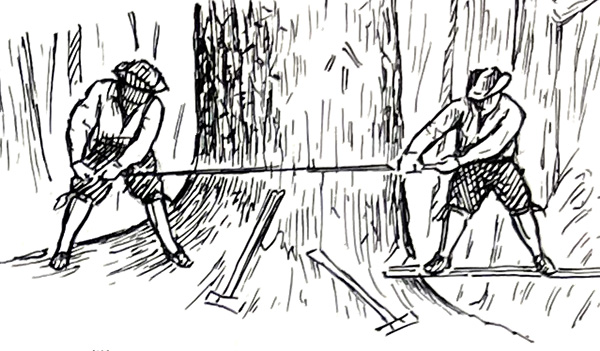
Large white pine trees, abundant in York, were favored for ship masts during the Colonial period. It is estimated that the largest and oldest of the white pine trees were up to 200 feet tall and more than 40 inches in diameter. Such “old growth” white pine trees may only exist now (if at all) in very remote locations in New England. By the early 1600’s, England had depleted its forests of all large trees and had been importing trees for ship’s masts from the Baltic region (Sweden, Finland, Denmark, Poland, Germany, etc). However, wars in the Baltic Region in the 1600’s affected England’s access to the trees. This made the white pine trees of New England a valuable resource. England claimed all rights to the large trees in New England and marked them with the King’s Broad Arrow (by use of three strikes with a hatchet) to identify ownership by the King and reserve them for the Royal Navy. A Massachusetts charter, in 1691, reserved all pines, 24 inches in diameter or more, that were not on private land, to be cut only by royal license. An act was passed providing a £100 fine for felling unauthorized trees. English Parliament passed several subsequent White Pine Acts to enforce this requirement in any colony or province north of New Jersey. As colonialists did not like these Acts, and in order to avoid penalties, wood boards for houses never exceeded a width of 23 inches so that they could not be claimed to come from a King’s Pine.
As the White Pines in New England were among the best in the world for ship masts there was much competition to buy them. The Colonists capitalized on the competing market for the huge trees in other ship building countries and with the burgeoning ship building trade here in New England.
There is an account of a Samuel Sewall, who visited a sawmill at the Salmon Falls River, near Dover, New Hampshire, in 1687. After, he rode to a nearby swamp to see a mast about 26 to 28 inches in diameter. There were two and thirty (thirty two) yoke of oxen before and four yoke by the side of the mast, ”Twas a very notable site.” The mast was slung by chains, according to the usual practice, from two axles, each connecting a pair of immense wheels, large enough to be drawn over rocks, stumps, and gullies—in this case by seventy-two powerful oxen. [Charles E. Clark, University Press of New England, The Eastern Frontier, page 55.]
As we can see, it was an enormous effort to haul a mast from the woods. Person’s of means were most likely to be in charge of this endeavor. The trade of ship masts contributed to the wealth of many prominent families. John Wentworth, Governor of New Hampshire, was one such individual who was also a chief surveyor and Harvard classmate of John Adams who became the second President of the United States. Wentworth hired John Adams, as a lawyer, to prosecute many of those in violation of laws regarding the unlawful taking of white pine trees. In one case, Adams drafted information praying forfeiture of 606 logs and nine masts seized by Wentworth in various locations in York and Cumberland Counties.
On April 14, 1772, a Sheriff had been sent to Weare, New Hampshire to collect fines from several saw mill owners. The angry saw mill owners used soot to disguise their faces and dragged the Sheriff and his deputy from their beds at an Inn and beat them with tree branch switches. This act of defiance of paying the fines became the source for the Pine Tree flag during the American Revolution. English Colonists resented the British Empire laying claim to the much coveted pine trees and historians hypothesize–government policies contributed to the manifestation of the conflicts that brought about the American Revolution.
https://www.masshist.org/publications/adams-papers/index.php/view/ADMS-05-02-02-pb-0247
https://nhpbs.org/wild/karnerwhitepineriot.asp
Submitted by Kevin Freeman and Wayne Martin