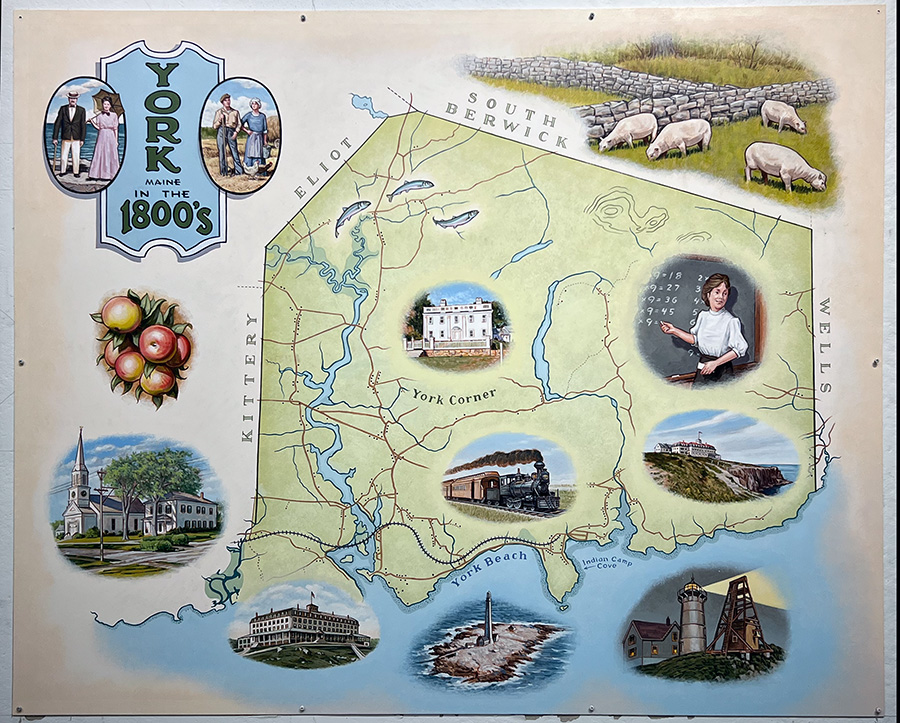
A Note About the Four Maps of York
In 1821, a year after Maine attained statehood, York resident Asa Freeman wrote that “The business of York heretofore has been pretty good for one lawyer, but I think there’s but small prospect of its increasing, the place has been rather on the decline for some years.” A succession of wars from the Revolution to the Napoleonic era damaged York’s maritime economy, and individuals sought better prospects by migrating to population centers in the north. A little over a decade after Freeman’s comment, the town was also to lose its valued status as York County’s shire town or seat of the courts. For thirty years or more, the former courthouse was neglected and used for various functions—a stark, standing reminder of a loss of status. The town did not begin to recover a sense of pride until the Civil War, and then, during the years immediately afterward, witnessed a dramatic transformation into a seacoast resort with the construction of the first of the great hotels. The introduction of a railroad spur in 1887, and the electric rail or trolley ten years later, gave rise to York Beach at their termination point. From May until September, seasonal visitors would take up temporary residence at boarding houses and hotels, initiating a familiar pattern of town life that continues to the present day. Contributed by Dr. Danny Bottino and York town historian James Kences
Extended Timeline by James Kences, town historian
1800 York County population was 34,284 persons. The town’s population, 2776, 1 Banks p. 15; There
were twenty-five Moulton families, twenty Donnell families, and thirteen Bragdon families residing
within the town.
1800 Rev. Rosewell Messenger, “An Oration on the Death of George Washington. . .” Williamson,
Bibliography 2:122
1800 The peak of revenue from Customs in the Piscataqua region, $143,000 Saltonstall, p. 140
1801 Only Joseph Tucker retained from selectmen; Jeremiah Clark, Daniel Raynes, Elihu Bragdon, Capt.
Alexander McIntire, were all new. <>
1801 Twenty-three districts defined for highways, TR p. 301
1802 Elihu Bragdon retained, Maj. Samuel Derby, Joseph Bragdon, Theodore Webber, Moses Lyman,
were new; this group would hold until 1806. <>
1802-1806 Alfred petitioned legislature to have half of court sessions held at town; the first courthouse
built in Alfred; 1808 a small log building built in Alfred as jail, Sloane, Court Houses, pp. 26-27
1803 Controversy over Joseph Tucker: “. . .Tucker has not the confidence of the people in this town;
January 17, 1803 Tucker was to be removed from office, replaced by Jeremiah Clark; 106 voted in
support of Tucker, TR 11,12-14
October 13, 1803 Edward Emerson Jr. died from a self-inflicted gunshot wound. His suicide a reaction to
$50,000 loss of vessels. One decade later, brother Bulkley Emerson would kill himself.c. 1803 County Commissioners laid out road, by-passing Ferry Lane, part of the old Post Road; despite
strong opposition, the project prevailed, Ernst, p. 87
1805 Alexander Rice petitioned for permission to construct toll bridge over river, Rice’s Bridge,2 Banks,
p. 296
1806 The number of selectmen reduced to three; Moses Lyman,? Elihu Bragdon, Theodore Webber; the
same three would be elected the following year; in 1808 there is no reference to election for selectmen in the record.
June 16, 1806 Charles Came: “. . .A very remarkable eclipse of the sun which was total and visible to us.
It was so dark that you could count ten or twelve stars. . .” Came Ledger, Old York Collections
The Embargo
December 22, 1807 The Embargo became effective under the Jefferson administration. American ships prohibited from foreign ports. Coasters and fishing vessels could maintain activity, but closely monitored. January 1809 Enforcement Act enacted to further tighten control. With the succession from
Jefferson to Madison in March 1809, the Embargo came to an end, Wood Empire, p. 656
1808 Joseph Whipple of New Hampshire on violation of Embargo: “. . .At York, Collector Jeremiah Clark
had purposely, or accidentally, lost control of situation. Vessels engaged in trade in contravention of the
law, were using that port as a base. . .” Poubeau, Hancock Warehouse, , citing Nelson Early US Customs
Records, vol 1 p. 7
March 8, 1808 Town Meeting, Three men were instructed to draft law to restrict horses from running at
large during the winter. The law imposed a fine upon violators, Town Records, pp. 70-71
August 8, 1808 Joseph Weare Diary: “. . .went to the launching of Theodore Weare’s vessel. . .”
September 13, 1808 Joseph Weare Diary: “. . .Captain William Avery came home today with 330 quintals
of fish. . .”
1809 A unique circumstance occurred, the three men elected as selectmen Elihu Bragdon, Edward
Simpson, Joseph Weare Jr., declined the office; another election held, and Moses Lyman, Theodore
Webber, and Jeremiah Paul were chosen. <>
1810-1812 Elihu Bragdon, Alexander McIntire, Theodore Webber elected selectmen; in 1811 they were
simultaneously to be selectmen, assessors of taxes, overseers of the poor, and town treasurers; in 1812
the last two offices were separated. <>
June 1, 1810 Schooner Speedwell 40 tons, John Nowell owner, Joseph Lowe master, obtained license for cod fishery, Old York Collections
February 12, 1811 York Cotton Factory Company incorporated under leadership of seven men; the mill site was located “one hundred yards below the outlet of Chase’s Pond”, 2 Banks, pp. 280-281 April 9, 1811 Schooner Exchange32 tons, William D. Moulton and Joseph Kingsbury, licensed for cod
fishery, Old York Collections
November 11, 1811 Town Meeting, Decision to replace swing bridge lost in recent freshet of York
River,TR p. 122
1812 Decision to sell the old court house, and have it removed, once the new court house was
completed, TR p. 131;Candee, Early Republic. P. 45
1812 Nathaniel Grant Marshall born
War of 1812
June 1812 War is declared against Great Britain. Prior to the spring of 1814, the challenges posed by
Napoleon, prevented Britain from making full military commitment to the war. On April 25, 1814, the
naval blockade was extended to the New England coast. A pattern of coastal raids was established.
July 18, 1812 Schooner Clarissa, 68 tons, William D. Moulton, William Simpson, Samuel Averill, licensed
for coasting trade, Old York Collections
1813-1814 The former number of five selectmen restored, possibly because of the current military
emergency; Alexander McIntire, Elihu Bragdon, Theodore Webber, Edward Simpson, Jedediah Blaisdell.
February 5, 1814 Articles of Association of the Volunteer Company of the York Sea Fencibles: “. . .The
subscribers agree to form themselves into a volunteer company of Sea Fencibles for the defense of the
coast from Wells to Kittery. . .” eighty-three men had joined the unit, placed under the command of
Captain Isaac Lyman, Orderly Book, Old York Collections
June 15-16, 1814 The 74 gun HMS Bulwark and the frigate HMS Endymion undertake raiding activities in
southern Maine. At Biddeford Pool, the ships of Capt. Thomas Cutts were damaged or destroyed; at
Kennebunk, when the ships were sighted the militia was called out, though no raiders landed; an
incident occurred at the Nubble. A fishing vessel, Juno, found refuge from enemy pursuit. The militia
were mobilized in anticipation of a landing party, but nothing serious transpired. Banks has made
reference to a landing at Brave Boat Harbor of short duration. Much of this narrative remains
unsubstantiated. Banks 2 pp. 418-419, Rowe, pp. 92-93, Bourne, Wells, p. 603, Daughan, 1812, p. 308
July 25, 1814 Orders from Major-General of militia 6th Division: “. . .eight men and a sergeant to be
drafted from the Sea Fencibles, to be stationed at Fort Edward at the entrance of York Harbor, Orderly
Book, Old York Collections
September 1, 1814 British occupy Castine. The Bulwark and Endymion were among the fleet of warships
which departed from Halifax in late August,
February 13, 1815 Jeremiah Weare Diary: News came to York the war was over.1815 Selectmen again reduced to three men.
March 16, 1813 Town Meeting, Decision to examine town’s cannon and to appeal to Massachusetts
government for support in defense of York Harbor, Town Records, p. 141
June 9, 1813 Reverend Rosewell Messenger was subject of public hearing held at the court house;as
minister of First Parish Church was charged with a number of moral infractions, including the use of
ardent spirits, and “immodest and indecent conversation and immodest and vicious conduct toward the
female sex. . .” 2 Banks pp. 143-145
November 18, 1815 Reverend Moses Dow was ordained as successor of Reverend Messenger, 2 Banks p.
147
August 1, 1816 Uniform of the First Regiment, 1st Brigade: “. . .uniform of regiment shall be coat of dark
blue faced with red. . .pantaloons or small cloths & waistcott to be of yellow buff colored woolen cloth. .
.”Old York Collections
The Movement for Maine Statehood
September 2, 1816 Town Meeting. Vote for delegate to Brunswick convention to consider separation of
Maine from Massachusetts; Rufus McIntire, 146 votes, Jeremiah Bradbury 125, Elihu Bragdon, 120, TR p.
179
September 26, 1816 Charles Came: “. . .the great frost come and killed all the corn and wee did not raise
three bushels fit to grind. . .” Came Ledger, Old York Collections
September 30, 1816 185 delegates assembled at Congregational Meeting House Brunswick, Banks,
Maine, p. 103
October 22, 1816 Isaac Lyman to Leverett Saltonstall: “. . .We shall, at our next session [of the
legislature] give this subject[the separation of Maine] its quietus and I hope an eternal one. . .” Banks,
Maine, p.112 Lyman was member of legislative committee chaired by Harrison Gray Otis, that had been
formed to receive report of Brunswick Convention,
December 4, 1816 Massachusetts legislature passed resolves to dissolve Brunswick convention and
reject separation effort, Banks, Maine, p. 115
1817-1820 Alexander McIntire and Joseph Weare Jr., elected selectmen for consecutive terms; the third
member of the board held only one term until Joseph Junkins Jr. was elected in 1819. <>
July 16, 1817* President James Monroe visited Coventry Hall during tour: “. . .The President and suite
than proceeded with the judge [David Sewall] accompianied by the Committee of Arrangements to his
house where they sat down to an excellent breakfast. . .” 2 Banks, p. 410
1817-1819 Nathaniel Marshall’s maternal grandparents assumed responsibility for his welfare after he
was abandoned by father and his mother died,Ern. 2491819
May 1819 Petition from York to Massachusetts legislature, urged action to be taken, “give assent to
separation” TR pp. 224-225 By June of 1819, 130 petitions with very similar sentiments had been
submitted to the legislature, Banks, Maine, p. 135
May 27, 1819 Two committees created in Massachusetts Senate and House to consider the petitions,
Banks, Maine, p. 135
June 9, 1819 The Senate Committee reported on separation bill, Maine voters were to cast vote on July
26. 1500 vote difference necessary for passage; June 19, 1819 signed by governor, Banks, pp. 136-137
July 6-7, 1819 Baptist Elder Mark Fernald: “. . .preached at Cape Neddick—there was quite a reformation
there. . .7th, visited in the neighborhood of the Factory at York, and preached at 4 oclock. . .A
reformation was in progress there. . .” Fernald, pp. 129-130
July 26, 1819 York vote on separation 151-136, TR p.227 The margin was sufficient for passage.
September 20 1819 Town Meeting. Selection of delegates for state constitutional convention to be held
at Portland in October; Jeremiah Bradbury, Elihu Bragdon, Captain David Wilcox, TR p. 229
October 11, 1819 274 delegates assembled at Cumberland County Courthouse in Portland for
constitutional convention; the following day moved to First Parish Church, Banks, Maine, p. 150
December 6, 1819 Town Meeting. Vote on constitution, 91 in favor, none opposed, TR p. 232
1820
March 15, 1820 Maine became the twenty-third state in the Union.
April 3, 1820 Town Meeting. 229 votes cast for William King as first governor of Maine, TR p.242
13. MAINE STATEHOOD AND THE ECLIPSE OF THE COUNTY SEAT 1820-1832
1820 The probate court and clerk of courts moved to Alfred; the registry of deeds had been transferred
in 1816.
1820 Survey of York Agriculture: 8730 bushels of Indian corn and 4580 bushels of barley produced
annually. York produced more barley then any other town in Maine. Only six towns in Maine produced
8-9000 bushels of Indian corn. 624 oxen, 4 years old and upwards; 1194 cows and steers 3 years old and
upwards. York possessed more oxen then any other Maine town, and was among a small group with1000 or more cows and steers. 342 barns; only 7 towns including York, possessed 300 or more barns in
the entire state, Greenleaf, Survey, p. 187
January 8, 1821 Asa Freeman: “. . .The business of York heretofore has been pretty good for one lawyer,
but I think there is but small prospect of its increasing—the place has been rather on the decline for
some years. . .”Old York Collections
1821-1825 The same three selectmen elected for consecutive years: James Bragdon 3rd, Daniel Bridges
Jr., David Wilcox; Wilcox had assumed the office in 1821 when Joseph Weare Jr., had refused. <>
December 9, 1822 Joseph Weare Diary: “. . .filled 2 barrels of potatoes & coopered and hauled them to
the river to go on board the schooner Enterprise
Spring 1823 Construction of a county prison at Alfred; September[date], York voted 340 strong against
the new prison but was defeated, TR 243-244
1824 Trial of Charles Stevens for murder of his son held at Congregational Church due to public interest
and large crowd, Emery, Gorgeana, pp. 194-195
1824 The date of the annual town meeting, usually held in early March, was changed to the first week of
April.
April-May 1824 Outbreak of smallpox at Cape Neck. The Town Records p. 285 and Jeremiah Weare
Diary, made reference to this incident. The Joseph Weare Diary adds details: May 6, 1824 “. . .Inoculated
with the kine pox by Doc Goddard; May 16, 1824 “. . .very unwell with the kine pox. . .”
December 20, 1824 “Sarah H. Bradbury Book” This is written on the cover of her mathematics work
book, Old York Collections
1825 Survey of York’s maritime commerce: of the 12 districts in Maine, the York District possessed the
smallest amount of total tonnage, 1,093 tons; compared to Portland, 45,693, or Bath, 27, 372,
Greenleaf, Survey, p. 260
November 14, 1825 Reverend Dow consented to return $100 dollars of his salary to the Congregational
Church; this action was taken against a background of over fifty church members having withdrawn
since 1823; Banks 2:147 has attributed the withdrawls to the organization of the Methodist Church,2
Banks, 147-148
1827 Construction begun on widened, straightened, road that was to extend from Kittery to Portland;
the triangular plot at York Corner created, Ernst, p. 218
1827 The number of votes recorded in election for selectmen; James Bragdon 3rd 136, David Wilcox 126,
Theodore Wilson 150; Joseph S. Simpson moved for another election to be held, with candidates voted
for one at a time, but was rejected. <>April 25 , 1827 Joseph Weare Diary: “. . .greatest freshet that’s been a number of years. Chase’s mills &
Col. Webber’s mills swept away. . .both Bridges, and part of the sawmill & lower Gristmill Dams gone. . .”
March 4, 1829 The inauguration of President Andrew Jackson celebrated in the Second Parish: “. . .The
day was ushered in with the discharge of Cannon. At eleven o’clock a federal salute was fired under the
direction of Captain Josiah Chase, commander of the York Artillery Company. . .” a procession to the
meetinghouse, Ern, p. 271 from Eastern Argus, Portland, March 17, 1829
1829 The moderator at town meeting declared the vote for selectmen illegal, because four persons had
majority of votes when only three had been called for; decision to have them voted for one at a time;
Daniel Bridges Jr. for the Center District, William McIntire for Scotland District, George Moody for Cape
Neddick. <>
November 18, 1829 Church council comprised of southern Maine and New Hampshire churches, called
to deliberate over Reverend Dow’s request to resign; the request approved, 2 Banks p. 148
February 17, 1830 Reverend Eber Carpenter ordained as minister of Congregational Church; Reverend
Carpenter presented pessimistic portrait of church; “. . .the parish will experience a fatal shock if
something is not done speedily. . .” 2 Banks p. 149-150
Alfred Designated as Shire Town
1832 Alfred, Maine was formally designated as the shire town of the county, 2Banks p. 229
c. 1830 Nathaniel Marshall employed as clerk at George Lyman Emerson’s store, York Corner, Ern. P. 249
14. TEMPERANCE, ANTI-SLAVERY, PRELUDE TO THE CIVIL WAR 1832-1861
1832-1836 Three selectmen; Theodore Wilson, Solomon Brooks, William McIntire, elected for
consecutive terms. <> <>
July 21, 1832 “. . .Voted that Doctors Gilman and Putnam be requested to correspond with the
physicians in New York & Boston, asking information upon the mode of treatment of the malignant
cholera. . .” ; Tens of thousands of persons had already died in Europe from the disease, which by June
1832 had been present in Canada and New York City, TR p. 22
August 25, 1832 The boundaries of the five militia companies formally defined as required by state law
enacted in March, TR pp. 24-25
January 7, 1833 Three man committee chosen to present protest to legislature against removal of
judicial courts to Alfred, TR, p. 361832 Nathaniel Marshall became proprietor of the York Corner store, Ern, p. 249
1833-1834 Methodist Church in York Village, adjacent to Bank Building. Structure was raised August 31,
1833, and building completed October 1, 1834. October 15, 1834 The building dedicated, Moody
Handbook, p. 231
June 1,1833 Nine member committee chosen to make formal invitation to the president for visit to
town; President Andrew Jackson had planned to include York as part of his tour, but had to cancel while
in Boston,as consequence of illness and fatigue, 2Banks p. 413; TR pp. 47-48
June-September 1833 The town in conflict with the First Parish Church over possession of the Court
House, the church claimed rights as proprietors of the land upon which the building stood; “. . .Not a
shadow of doubt exists, on the minds of your committee, that the right of the soil under and about the
court house is in the town of York. . .” pp. 53,54, 60
1834 A triangular tract of land located at the western boundary was set off to South Berwick; the limits
were fixed by a rock, Solomon’s Rock, “where the towns of South Berwick, York, and Eliot unite in a
corner, and from that point running north fifty eight degrees east to the southwest boundary of Wells, 1
Banks, pp. 12-13;TR p. 69
April 6, 1835 Report of Superintending School Committee on school survey: “. . .[we] discovered a want
of uniformity in the mode of instruction and discipline in the arrangement of the classes, and
particularly in the books which are used. . .” TR pp. 81-84
September 1835 Church council called to formalize departure of Reverend Carpenter, who two years
earlier had indicated his intention to resign, 2 Banks p. 150
April 2, 1836 Five men brought charge against George L. Emerson for violation of act regulating retailers
of spirits—he was deprived of his license, TR p. 93
October 1836 Reverend John Haven accepted position as minister of Congregational Church; November
1840, Reverend Haven requested to resign, a consequence of his health being impaired by the local
climate, 2 Banks, p. 151
1837-1843 A period of little continuity in the chosen selectmen; Edward Simpson Jr. was elected
consecutively from 1837 until 1840; some men served only one year: Joseph Moody(1837), Joseph
Bragdon(1842); Samuel Adams (1839-1840), and Samuel Webber(1841-1842), served for two
consecutive terms. <>
April 3, 1837 Care for the poor: “. . .your committee are firmly of the opinion, that a reform in the
system of supporting our town poor is loudly called for. . .the annual expense of maintaining them will
be very much lessened by the purchase of a farm; a committee was created to obtain a farm, TR
120,121-122November 20, 1837 STM Art. 2 and 3: no part of the surplus revenue shall be appropriated for the
payment of a poor farm, TR 141
December 26, 1837 Sixty-three signatures on a protest against distributing surplus revenue to the
inhabitants: “. . .the purpose for which this meeting is called is both unjust and illegal. . .” TR 146-147
1837 Appropriation of land behind the First Parish Church for a new burying yard; the old yard
continued to be used sporadically into the 1870s.
1838-1839 First Parish Congregational Church remodeled, repositioning of entrance, 2Banks, p. 108;July
3, 1839 Rev. John Haven, formally dedicated the remodeled church, Williamson, Bibliography, 1:557
April 23, 1841 George Putnam: “. . .We had a very large procession last Tuesday, more than ten
thousand persons walk’d in it 8 abreast, and reached as far from your house over to Cape Neddick. We
were 4 hours walking, and I was very much tired, as I had to carry the banner of the Marine Society. . .”
While the purpose of the event is not mentioned in the letter, it is very possible this was an observance
of the death of President William Henry Harrison. President Harrison had died on April 4, only a month
after his inauguration. This marked the first time in national history that a president had died in office,
Putnam Family Letters , Old York Collections
July 20, 1841 York Ledge monument completed; between 1840 and 1841, a thirty foot high cast iron
structure was installed upon York Ledge, a hazardous rock feature about an acre in extent, situated
three miles off shore, and often submerged; Alexander Parris designed the monument and Gridley
Bryant oversaw the construction, Porter, Friendly Edifices, pp. 176-178
1841 Nathaniel Marshall married Sophia Baker Bragdon; 1842 Edward Simpson Marshall born, Ern, p.
250; George Albert Marshall born 1843
February 7, 1842 Joseph Weare Diary: “. . .a Bark cast away at Parson’s Cove—8 men drowned and five
saved. Vessel stove all to pieces. . .”
1844-1848 Three men elected to consecutive terms: Theodore Wilson, William McIntire, Alexander
Dennett; in 1848 Wilson was replaced by Nathaniel Webber. <>April 7, 1845 Town Meeting. Any person who refused to pay poll tax could be arrested and jailed or be
forced to work on poor farm for three days, TR p. 48
April 6, 1846 Town Meeting. Jeremiah Brooks presented four resolves related to temperance; no
licenses for intoxicating liquor to be provided, TR p. 65
August 29, 1846 Town Meeting. Voters approved the sale of the powder house and military stores at
public auction. This action was contemporary with the Mexican War, and may have been symbolic,
perhaps a protest against the conduct of the government under President Polk,
November 29, 1846 Joseph Weare Diary: “. . .Solomon Avery’s house burnt last night & his wife burnt in
it. . .”
April 3, 1848 Town Meeting. Jeremiah Brooks, David Wilcox, seven others, signed temperance
declaration: “. . .matters of public concernment as well as of public notoriety. They effect the vital
interests of our town. They involve the present and future well being of all its inhabitants. [If nothing is
done] idleness, poverty, vice and crime shall stalk our streets. . .and make desolate. . .our quiet homes
and all our cherished institutions. . .”TR 5, pp. 109-111
1849-1855 Three men elected to consecutive terms as selectmen: Charles Came, Joseph Bragdon Jr.
Joseph Weare Jr. <>
1849 Sewall’s Bridge rebuilt, Gordon p. 4
December 25, 1849 Baptist Elder Mark Fernald on Christmas celebration: “. . .some from the east of the
town met a gang in the south of York, and had a shameful riot of drinking, shooting, dancing & all day
and all night. . .” Fernald p. 381
1850 Nathaniel Marshall sold the store; he engaged in the study of law, and held a number of offices,
both in local, county, and even Federal Government; Collector of Customs, 1849-1853, Ern. P. 249
May 6, 1850 Joseph Weare Diary: “. . .great freshet Carried away sawmill, grist mill dam & lower bridge
& upper bridge. . .”
1851
1851 The militia: “. . .Annual Return of the names of all the persons enrolled in the militia. . .the whole
number being enrolled, two hundred and seventy-six. . .”Old York Collections
April 16, 1851 Joseph Moody Diary: “. . .the highest tide today that ever was known by the oldest
inhabitants now living—done much damage to bridges, wharves. . .”
July 13, 1851 Joseph Moody Diary: “. . .thunder shower came up this afternoon attended with hail and
rain. The hail fell as large as musket balls, doing an immense sight of damage to everything growing and
breaking glass. . .cracked some 20 squares in both our houses. . .”
1852February 25, 1852 Joseph Moody Diary: “. . .it is, and has been quite sickly about our town with the
mumps, and many have colds which brings on lung fever. . .”
March 1852 Joseph Moody Diary: “. . .Rufus unwell with the mumps. . .Mary sick with the mumps. .
.Doct. Putnam here today—Mary continued quite sick, Jos. Has them likewise. . .”
March 10, 1852 Joseph Moody Diary: “. . .our school district meeting this PM. . .”
April 1852 Enforcement of Maine Liquor Law—“”expel the demon alcohol from the community” Town
Records p. 181
June 19-21, 1852 Joseph Moody Diary: “. . .Alexander McIntire died this morning, aged 78 years. .
.buried from Congregational meeting house in 2nd parish. . .he will be very much missed in town. . .”
July 2, 1852 Joseph Weare Diary: “. . .Schooner cast away on Parson’s Cove this morning, 109 tons, in
the fog. Our folks helped to save the sails and wrecking. The crew, 5 are here. . .”
August 14, 1852 Joseph Moody Diary: “. . .its very sickly down on cider hill, they have the dysentery. .
.Jonathan Moulton has lost 2 children, both have died within a week. . .”
September 5, 1852 Joseph Moody Diary: “. . .2 more children buried down on cider hill today. . .”
November 2, 1852 Joseph Moody Diary: “Presidential election. . .[Franklin] Pierce & King [Democrats]
had 297 votes in this town, [Winfield} Scott [Whig candidate] 132, and John P. Hale[Free-Soil] 4 votes. .
.”
September 11, 1854 Joseph Moody Diary: “State Election. . .there are so many parties at this time it
creates quite an excitement. . .”; Moody seemed unfamiliar with the word abolitionist, he supplied a
spelling, “aboligionist”
1853-1854 “. . .There never has been a year in the history of our schools in which so radical a change of
textbooks has been effected as the one last past. . .”TRp p. 16
1856 Only Josiah D. Bragdon possessed sufficient votes necessary for selectman; of the six candidates
offered, Theodore Wilson and Rufus A. Moody chosen for office. <>
May 9, 1856 Joseph Weare Diary: “. . .Schooner cast away on the other side of near Barn Point, 40 tons
from Kennebunk, 8 in number fishermen, all here. . .; May 10, 1856 “. . .all over the wreck saving what
they can. 7 [of the crew]went home in afternoon. [The] captain here. . .”
1857-1859 Three men elected to consecutive terms for two year period: John A. Swett, Samuel E. Payne,
Sylvester Mc Intire. <>
1857 Two brothers,John and Samuel Goddard boarded at the home of Stephen Grant; this was the semi-
mythic beginnings of the seaside resort described by Edward C. Moody, p. 174March 22, 1858 Tumultuous town meeting: “. . .we view the course pursued by N.G. Marshall and his
accomplices as factious; not designed for the best interests of the Town, but exhibiting a determination
on their part to ‘Rule or ruin’. . .” Marshall and his allies had not accepted the auditor’s report, and they
had interfered with procedure.
May 5-8 1858 Fishing voyage of the Wonder Harmon Varrell: May 5, sailed for the Grounds. . .May 6,
moderate breeze. . .May 7 moderate and cloudy. . .May 8 fresh breeze—returned to York. . . Old York
Collections
1859 Conditions of the District 1 Primary School: “. . .within the partition walls of the hearse house. .
.unlighted, cold and dreary. . .the benches are so rickety that they are constantly jostling and disturbing
the scholars. . .” 1859 school report pp. 28-29; 11 male teachers, 15 female teachers; 8 good school
houses and 7 poor school houses, pp. 14-15
September 25, 1859 Charles O. Clark Journal: “. . .attended a concert in the evening at the court house.
. .” p. 35
1860
March 8, 1860 Schooner Gold Hunter launched; April 30, 1860 ship departed on voyage from Cape
Neddick to Newburyport with cargo of cord wood; the schooner was built by John Brewster, and was 66
feet in length, 21 feet in breadth, and 6 feet in depth, 76 ton burden, Old York Collections
March 22, 1860 Clark Journal: “. . .attended a caucus to nominate candidates for town offices. . .”p. 55
March 26, 1860 TM Clark Journal: “. .the Loco Foco as usual was predominant. . .”p. 55
1860 Hiram Perkins “. . .Ringing bell for town meetings. . .” Ledger 1857-1895 p. 21; Perkins held this
position throughout the period of the Civil War
1860-1863 Samuel W. Norton, Edmund N. Goodwin elected selectmen to consecutive terms; Norton
would continue in office until 1866; Charles Junkins was elected in 1862 and 1863. <>
May 15, 1860 Clark Journal: “. . .The Ladies Industrial Society met here. . .”p. 61
September 10, 1860 Clark Journal: “State Election. . .about 600 voters out. . .state gone Republican—all
through—complete sweep. . .” p. 75
November 6, 1860 Clark Journal: “Presidential Election. . .515 votes thrown, Republican majority over
Douglas, Breckinridge & Bell tickets—the first time for 28 years that the Democrat ticket has not had the
majority—God grant it may never rise again. . .”p. 83
November 21, 1860 Clark Journal: “. . .making preparations for torch light procession, came off in the
evening, had a grand time. . .”p. 84
“. . .The Presidential campaign in the fall of 1860 was conducted with spectacular features. . .I can
remember seeing the torchlight parade crossing Sewall’s Bridge. . .our house was illuminated withcandles. . .Father was marshal of the parade mounted on a high stepping horse. . .” Dennett Memoirs, p.
29
15. THE REBELLION: FOUR YEARS OF WAR 1861-1865
1861
April 23, 1861 Clark Journal: “. . .great excitement all over the country, troops marching and
rendezvousing at Washington. . .”p. 3
1861 Charles Came, Edmund N. Goodwin “enrolling militia” Ledger p. 31
September 9, 1861 Clark Journal “Town Meeting [for state election of governor]. . .whole number of
votes thrown 542. Washburn 261 Dana 274 Jameson 7. . .”p. 21
October 1,1861 Reverend Rufus M. Sawyer took position as minister of Congregational Church; he was
to serve as minister throughout the period of the Civil War, and was remembered for his patriotic
fervor,2 Banks p. 153
November 3, 1861 Clark Journal: “. . .the highest tide ever known in the Harbor. . .the store on Bulkley
Donnell’s wharf went adrift and in its course up river, took of vessels lying at Dennett’s wharf , with
wharf also and fetched up against Sewall’s Bridge. . .R. Varrell Jrs. Boat Victoria lies on top the wharf. .
.”p. 28
1861 Nathaniel Grant Marshall elected State Senator, Banks 2, p. 365
1862
Charles Junkins, Samuel W. Norton, Edmund N. Goodwin received payment for “enrolling militia and
defining boundaries to companies. . .”Ledger p. 40
March 11, 1862 Clark Journal: “. . .had the ‘Annual Town Meeting’ Loco Foco reign triumphant as usual. .
.”p. 42; the Loco Foco reference is derogative label for Democrats, and is derived from a contemporary
brand of friction match; according to Ralph Waldo Emerson Loco Foco’s “. . .hate tolls, taxes, turnpikes,
banks. . .”
August 4, 1862 “. . .Call of the President. . .” ; the town was required to fill a quota for soldiers; the
names of fifteen men are written upon a page of the Ledger, p. 50
August 7, 1862 Special town meeting, decision made for $3100 dollars to be raised for soldier’s bounty
payment; August 30, 1862 Bounty was raised to $300 per soldier, 2 Banks p. 424
August 9, 1862 Clark Journal: “. . .held a caucus in the evening at E.A. Bragdon’s to choose delegates for
convention at Portland to nominate a candidate for Representative to Congress. . .” Clark was one of the
four delegates selected, p. 59August 14, 1862 Clark Journal: “. . .had a war meeting in the court house. . .Mr. Prescott speaker. . .”p.
60
September 8, 1862 Clark Journal: “. . .attended Town Meeting, election of governor etc., Loco Foco
majority as usual. . .” p?
September 15, 1862 Town Meeting. $200 dollars to be offered as bounty “to fill the quota of sixty-seven
enlisted men. . .” TR vol. 5, pp. 424-425
1863
1863 Smallpox outbreak:”. . .Dr. Caleb Eastman for medical attendance on the families of [William
L.]Armstrong & the widow Abbott in case of smallpox. . .”Ledger p. 49
March 28, 1863 Town Meeting. The $5000 dollars intended for bounty payments, was to be raised as
tax, “kept separate from all other taxes. . .”TR 5, p. 433 Clark Journal: “. . .attended an adjourned town
meeting for the purpose of raising money--$2000 dollars for ordinary expenses and $5000 toward the
war tax. . .” p. 85
July 25, 1863 Town Meeting. George A. Freeman presented resolves; $300 was to be offered as bounty
both for three year volunteers and also for drafted soldiers who entered the service under the recent
Conscription Act. TR 5, p. 437
September 11, 1863 USS Seminole captured British ship Sir William Peel off the mouth of the Rio
Grande;Capt. John Dennett participated in this incident, which occurred when the ship was assigned to
the West Gulf Blockading Squadron, 2 Banks 422
September 28, 1863 Town Meeting. Disagreement over bounty payment for drafted soldiers, TR 5,p.
445
October 17, 1863 “. . .Quota under the Call. . .” Ledger p. 52
December 1, 1863 Town Meeting. $300 dollars as bounty for soldiers to fill quota following the call for
soldiers of October 17, TR 5, p. 447
December 16, 1863 Clark Journal: “. . .Steamer Warnack Morse from Portland for Fortress Monroe. . .”
The ship may have sought protected shelter within harbor in stormy weather; Fortress Monroe is
located near Washington[check this]p. 114
December 19, 1863 Town Meeting. “. . .On motion of G. E. Staples, $400 dollar bounty. . .”TR 5, p. 449
1864
January 4, 1864 Declaration of Recruit: “. . .I Franklin M. Littlefield desiring to volunteer as a soldier in
the army of the United States for the term of three years. . .Do declare that I am twenty-one years and
nine months of age. . .”Old York CollectionsJanuary 23, 1864 Clark Journal: “. . .rode over to the Navy Yard with wife to see the launching of 74
gunship New Hampshire formerly the Alabama. . .she went off in fine style, a great concourse of people.
. .”p. 118
February 13, 1864 Town Meeting. Actions to be taken in response to February 1, 1864 call for soldiers,
TR 5, p. 452
February 28, 1864 Albert R. Walker participated in the Dahlgren raid upon Richmond, Virginia; March 2,
1864 Walker captured during an engagement with the enemy.
March 14, 1864 Harriet Emerson Diary: “. . .spoke with Mr. Walker about Albert,whom they fear is kill’d
or taken prisoner—My heart bleeds for them. . .” Harriet Emerson was the recent widow of Charles O.
Emerson, son of Edward Emerson Jr., who had committed suicide in 1803. She lived in the Emerson
homestead in York Village.
March 22, 1864 Clark Journal: “Town Meeting. . .the election passed off rather quiet. . .the Copperhead
ticket was defeated with a trifling exception, and they passed out of office. . .”p. 125
July 4, 1864 Harriet Emerson Diary: “. . .Sad news has come on the electric wires to dear Fannie and to
us all. Dear Wallstein has given his life for his country—shot June 24. . .”
July 7, 1864 Harriet Emerson Diary: “. . .Had a letter from Eliza. Oh so sad is the record her son F. sends
from the war. . .”
August 1, 1864 Town Meeting. Actions to be taken in response to July 18, 1864 call for soldiers, TR 5, p.
467; “. . .Bounties and Bills paid in filling the town’s quota. . .” This page in the Ledger supplies the
names of the men who entered the service in response to the call, p. 63
August 4, 1864 Harriet Emerson Diary: “. . .A fast proclaimed by President Lincoln has been observed
today. We attended services in the Methodist Chapel. . .”
August 5, 1864 Battle of Mobile Bay: Admiral David G. Farragut in command of warships in attack upon
fleet under Confederate Admiral Franklin Buchanan; this was the moment Farragut was credited with
the declaration, “Damn the torpedoes full speed ahead!” ; an ironclad the Tecumseh had struck one of
the mines and quickly sunk; Capt. John Dennett of York participated in the rescue of survivors; Andrew L.
Emerson, also York, was an ensign who served under Farragut, Banks 2, p. 422
August 23, 1864 Harriet Emerson Diary: “. . .Had a letter from dear Edward. He has been kindly
preserved from being wounded, tho’ a Minnie bullet struck his shoulder. He has his second time lost all
his clothing, the first by rebels, now by a freshet. . .”
August 27, 1864 Town Meeting. The men who were currently serving in the navy should be included in
town’s quota for soldiers, TR 5, p. 471
August 29, 1864 Sergeant Albert R. Walker succumbed to disease at the Confederate prison camp at
Andersonville, Georgia.September 5, 1864 Clark Journal: “. . .attended a lecture, delivered by Genl Gantt from Arkansas,
formerly a Rebel Genl. House full. He delivered a scathing address to the Peace men and Copperhead
faction, called the Democracy, some wholesome advice for them to sleep on. . .” p. 144; General Edward
W. Gantt had surrendered to General Grant at Vicksburg in June of 1863, and was pardoned by
President Lincoln, six months later in December. He went on a speaking tour in the fall of 1864, to
Northern states as prelude to the presidential election, James H. Tuten New York Times February 11,
2014
September 12, 1864 Harriet Emerson Diary: “. . .It is town meeting, the Republicans have gain’d the day
handsomely. . .” The meeting is recorded in TR 1864-1877 p. 4; Clark Journal: “. . .a good turnout for the
election of state officers. The Union voters were triumphant. . .out of a vote cast of 581, Union 293 and
Copperhead, 288. . .”p. 145
September 17, 1864 Harriet Emerson Diary: “. . .Frank, Abbie & Randie went to the Navy Yard Kittery, to
see the warship Franklin launched. Had letter from my dear sons Edward and Leonard. It relieves my
anxiety to hear that they are well. . .”
November 8, 1864 Harriet Emerson Diary: “. . .Presidential Election day. . .Mild but a little foggy &
damp—the Republicans have five more votes than the Democrats. . .”; Clark Journal: “Presidential
election. . .619 votes thrown—312 for the Union and 307 for the Copperhead faction. . .”p. 151
November 15, 1864 Harriet Emerson Diary: “. . .Had a letter from dear E who is now at the front. I feel
very anxious. . .”
December 1864 “. . .Quota under call of the President. . .” Ledger, p. 73
1865
March 10, 1865 “. . .All the officers having charge of the business of the town during the past year, have
performed a task very arduous, as may be seen by the vastness of the receipts and expenditures. . .the
total of their accounts now being over $50,000. . .It must be obvious to everyone that something must
be done to place the debt of the town on a basis different from the present, TRp pp. 28-29
April 3, 1865 Jeremiah Linscott McIntire, son of Joseph McIntire, as soldier in 13th New Hampshire
Regiment, one of first men in Union Army to enter Richmond, Virginia, McIntire, Descendents, pp. 83-84
April 3, 1865 Clark Journal: “. . .news come of the fall of Richmond, the Rebel stronghold gone at last,
great rejoicing over the country. . .”p. 165
April 14, 1865 Clark Journal: “. . .President Abraham Lincoln was shot through the head by an assassin in
the theatre at Washington at 10PM. . .”p. 166
April 17, 1865 Town Meeting. “. . .to raise ten thousand dollars for the payment of town’s indebtedness.
. .”TR 1864-1877, p. 3416. SEASIDE RESORT: THE EARLIEST OF THE BEACH HOTELS 1865-1887
October 1865 Lord House commenced construction; 1867 Kittery House, located at eastern end of Long
Sands Beach;1869-1870 Sea Cottage at Long Sands, Bardwell York Harbor, pp. 25-28
1866-1868 Josiah D. Bragdon, Rufus A. Moody, John A. Swett, elected to consecutive terms; in 1868,
David Moulton replaced Moody. <>
1867 George A. Marshall purchased the buildings of Alexander Dennett at the York River
1867 George F. Plaisted, General Merchandise, established, York Corner, 1896 pamphlet
The Town Hall
March 22, 1869 Town Meeting The town purchased the County court house building and the jail from
Washington Junkins, who had first obtained the property from the County; from this point forward, the
building was formally referred to as the town house, TR p. 107
1869-1872 Three men elected to consecutive terms as selectmen: David Moulton, Charles Junkins,
Octavius Weare.
April 11, 1871 Town Meeting. Articles 2 and 3 Voters approved the widening and straightening of road
at Long Sands Beach; the work was to offered to the lowest bidder,TR p. 149-150
1871 Nathaniel Grant Marshall built the Marshall House on Stage Neck,
May 19 1871 Harriet Emerson: “. . .Abbie and I have been down to see the new hotel “The Marshall
House”. It is a splendid affair for this place. . .”; June 20 1871 Harriet Emerson:”. . .I have been with quite
a large company of ladies and gentlemen down to the new Marshall House. . .” Old York Collections
March 18, 1872 Town Meeting. Article 12, proposed by John Chase, a ten year exemption upon any
money, up to $5000, for the development of manufacturing; this became a source of conflict, TR
162,166
1872 “. . .of the 16 teachers employed in our summer schools, but 3 have a record of experience and
success. . .of the 13 others 6 had taught but one term. . .the other 7 were youthful females about 16
years of age. . .” TRp p. 30
1872 “. . .The school houses in Districts No. 4,5, and 6, are far behind the age in which we live. The
internal arrangement of these houses appear like the relics of a former age. . .”TRp p. 31
April 16, 1873 Town Meeting Any discussion over a high school “indefinitely postponed” TR p. 196
April 29, 1873 Town Meeting. Article 3 “remove the town house to some desireable site near York
Corner”;Article 5 “all schools shall be excluded from the town house forever”TR, p. 1991873-1875 Samuel P. Young and Joseph H. Moody elected selectmen for consecutive terms; in 1874
Almon H. Merrow replaced Octavius Weare. <>
1873 The structure above the piles of Sewall’s Bridge rebuilt, Gordon, p. 4
February 23, 1874 Dedication of new Town Hall, 2 Banks, pp. 408-409 Address delivered by Nathaniel G.
Marshall; 1875-1879 Marshall assumed office of town clerk, invested energy in copying and ordering
town’s early records, Ern, p. 250
March 23, 1874 Town Meeting Article 10, “leasing out upper hall in town house ’Article 11, teams being
hitched at town house; action taken, stone posts fitted with rods or chains to be placed at town house,
and horses are prohibited, TR p. 208
March 22, 1875 Town Meeting. Article 10, sale of town farm approved, except for “house field” and
buildings situated on field, TR p. 222
September 13, 1875 Town Meeting. Vote on nine amendments to state constitution, TR p. 227
1876-1879 James A. Bragdon and Josiah D. Bragdon elected selectmen for consecutive terms; in 1877
George W. Currier replaced Merrow. <>
March 18, 1878 Town Meeting. John B. Fernald was elected as chief of police; the old Gaol was to be
used “for the safe keeping of disorderly and turbulent persons. . .”TR p. 3
March 24, 1879 Town Meeting. Policemen also chosen as tythingmen, Town Records, p. 30
September 8, 1879 Town Meeting. Votes taken on amendments to state constituition, Town Records, p.
39
1879 Village school house was built; prior to the 1978 construction of present fire station on the site,
the school was used as a station house, Ern, p. 148 >1978
Nubble Lighthouse
June-July 1879 Nubble Lighthouse began operation, 2 Banks, p. 361
March 22, 1880 Town Meeting. Regulations drafted for police; a chief officer and twelve members,
Town Records, p. 45
1880-1883 George W. Currier and Rufus Moody, David Moulton elected selectmen for consecutive
terms; in 1883, Currier and Moody were elected, five other men who were candidates for office lacked
sufficient votes. <>
September 10, 1880 Votes on amendments to state constitution, TR pp. 56-57
1880 Forty-five men listed in Census with maritime occupation, 2 Banks p. 287
1880 Nathaniel Marshall assumed position as Enumerator of Federal Census.1881 Hobson’s Market established in York Village, advertisement in 1896 pamphlet
1881 Portsmouth, New Hampshire merchant Hartley W. Mason purchased Donnell land on bluff at York
Harbor, Bardwell p. 33
1881-1882 Modifications to Congregational Church; Joshua Chamberlain delivered address at ceremony
upon completion of project, 2Banks p. 109
1882 Telephone service first introduced, 350, p. 144
October 26, 1882 Mary Ann Marshall Diary: “. . .Afternoon went to the dedication of the York church.
Gov. Chamberlain delivered the address. . .”
February 17, 1882 Death of Nathaniel Grant Marshall.
September 1882 Harper’s Magazine published description of York Village: “. . .Here meet four roads,
with the usual adjuncts of a country village—post office, variety store, town hall, and school house, with
the smithy lighting by the dusky glow of its forge. . .” p. 97, York Then and Now
Autumn 1882 Edward S. Marshall, John C. Stewart and others conferred with President of Eastern
Railroad, for possible branch from Portsmouth to York 2 Banks, p. 316
March 26, 1883 Town Meeting. Voters endorsed the plan of Augustus Stevenson to maintain a steam
ferry across the Piscataqua River, TR p. 99
1883 York Harbor and Beach Railroad Company incorporated by Maine legislature; Marshall was chosen
president, and Stewart, clerk, Banks 2, p. 316
1884 Jotham P. Norton brickyard on the York River is publicized for capacity reached to produce 80,000
bricks per day, Ernst p. 191
1884-1896 George W. S. Putnam elected selectman for consecutive terms; A.H. Merrow, C.W. Junkins,
served with him until March of 1890, when they were replaced by Benjamin F. Rogers and Arminius H.
Bowden.
1885 Current portion of Rt 1A from Stage Neck to Long Sands road became public road, Ern p.221
March 22, 1886 Town Meeting. The auditor’s report was in future to be printed and distributed four
days before annual town meeting, TR p. 136
1886 S.H. Williams and Son established blacksmith shop York Village. He remained in business until
February 1913, UH 1/25/1995
1886 Agreement negotiated with Boston and Maine Railroad to use railroad and terminal facilities for
existing portion of track from Kittery to Portsmouth, 2 Banks, p. 31817. SEASIDE RESORT: TOURISTS BY TRAINS AND TROLLEYS 1887-1925
August 8, 1887 Boston and Maine Railroad spur into York was first used by summer visitors, 2Banks pp.
317-318
1887 Ellis Park created; Ellen B. Ellis made available the grounds in front of Ocean House as public
park,Bardwell, York Beach, p. 19
March 12, 1888 Town Meeting. Voters approved W.W. Walker’s plan [Article 11] for ten year tax
exemption to any manufacturing corporation with 100 or more employees that became established,
with additional incentive of a donation of five acres possessed by town to that business, TR 175-176
June 14, 1888 The Atlantic House opened, corner of Atlantic Avenue and Cape Neddick Street; operated
by Clifton B. Hildreth, Bardwell, p. 22
December 3, 1888 Special Town Meeting. Voters approved plan presented by state Board of Health for a
sewer at York Beach,TR pp. 202-203
January 23, 1889 STM Voters approved a five hundred dollar reward for arrest of arsonist responsible
for setting fire to four barns; three of the barns were owned by Moultons, a fourth by a McIntire, TR pp.
203-204
March 11, 1889 TM Art. 12 Sewer at York Beach: “. . .We find several large hotels, boarding houses and
cottages in close proximity to each other, which are filled to overflowing during the summer season, and
if the health of the residents and guests are to be preserved, a system of sewerage has become a
necessity. . .”; one thousand dollars was appropriated towards the project, TR pp. 211-212
June 1889 Junkins Garrison building struck by lightning and destroyed, 350, p. 45
September 4, 1891 George F. Plaisted commenced publication of The York Courant, newspaper, Moody
Handbook, p. 123
October 9, 1891 Flag raising ceremony at the Village school house at half past two oclock in afternoon;
Stewart address made reference to the 399th anniversary of Columbus, and of patriotism and the
memory of the Civil War: “. . .Boys and girls! Remember that less than thirty years ago, half a million
men laid down their lives for the ideas symbolized in that flag. . .” Stewart Scrapbk
October 28, 1891 The town farm opened on Long Sands Road, UH 4/26/1995
1892 Saint Aspinquid Lodge #198 AF & AM established by Dr. Frank Smith and a group of eighteen
masons, 350, p. 414
October 1892 Ceremony at the town hall to mark the anniversary of Columbus landing; school students
presented a dramatic tableau of “Columbus before Ferdinand and Isabella” Stewart ScapbkFebruary 6, 1893 York County Trust Bank established, Moody Handbook, p. 120
March 13, 1893 TM Art. 8 town bonds; debate on proposal, but voters approved; “. . .the Town of York
hereby votes to issue bonds to the amount of 20,000 dollars, in denominations of 50, 100, and 500
dollars. . .”TR pp. 301-302
March 27, 1893 electric railroad incorporated. Extensions were granted to the company in 1895 and
again in 1897; February 1, 1897 The name of company changed to Portsmouth, Kittery and York Electric
Railroad,
August 24, 1893 Bicycle Club organized by several men who met in front of town hall, UH 12/27/1995
August 25, 1893 Cole’s Colossal Circus conducted performances at York Beach, UH 1/24/1996
September 1893 Construction of York County Trust Bank building. Currently the main offices of the
historical society, Viele ed. p. 7
February 22, 1894 Rededication of the town hall; Edward C. Moody address to observe the twentieth
anniversary of the creation of York Association on January 10, 1874 Moody and Stewart Scrapbks
March 12, 1894 TM. Art. 34 “To see if the town will pass an ordnance establishing police regulations”;
two policemen were to be employed, paid 20 cents an hour, during the summer, TR pp. 321-323,331
April 3, 1894 Fire destroyed Bartlett Hotel, York Beach, UH 11/8/1995
1895 Stackpole Building or Lancaster Block, York Harbor
Water and Electricity
February 2, 1895 Selectmen approved Edward S. Marshall’s request for installation of poles for his
electric plant to extend from York Corner to Norwood Farms; the poles were to be of cedar and 25 ft.
above ground, TR p. 350
May 7, 1895 York Shore Water Company organized by Josiah Chase. Water from Chase’s Pond to be
carried into town with system of pipes, Bardwell, Water,
May 28, 1895 Cornerstone laid for Union Church, York Beach, UH 12/7/1994
August 1, 1895 Edward S. Marshall organized electric plant.
September 2, 1895 Knights? of Pythias, a fraternal organization, held field day at York Beach, UH
1/11/1995
March 9, 1896 Town Meeting. Article 22 “. . .To see if the town will build sidewalks from the York
Harbor Railroad Station to York Harbor, Sewall’s Bridge and York Corner. . .” TR p. 372
1896-1897 The transition from the traditional office of Highway Surveyor(52 men), to a single Road
Commissioner; this was an appointed office, first entrusted to Josiah N. Norton, TR pp. 376, 399,425May 21, 1896 Water through pipes made available to York Beach; May 22, 1896 as far as Sea Cottage;
May 23, 1896 as far as York Harbor, Bardwell, Water, p. 15
1897
January 26, 1897 News report of explosion: “. . .some way east of Cape Neddick and York Beach”
fourteen mines were detonated. Those responsible, were described as Cuban rebels testing
experimental explosives. Stewart Scapbk
March 8, 1897 Town Meeting. Article 8. A high school at York Corner; Article 22. Fire hydrants, a
contract with York Shore Water Company for installation of hydrants from York Corner to York Harbor
and York Beach; Article 27. Three firewards appointed for York Beach, TR p. 399
Electric Railroad
April 10, 1897 Voters approved electric railroad at special town meeting; April 23, selectmen approved
the proposed route of railroad,
May 7, 1897 News report: “. . .Five carloads of ties and six carloads of rails for the electric road have
arrived at the York Harbor station. . .” Bardwell, p. 29
July 4, 1897 Official opening of clubhouse, a small cottage on Mason’s Hill in York Harbor, by York
Harbor Reading Room; Summer 1898 constitution and bylaws drafted, Bardwell, p. 101
August 28, 1897 Portsmouth Herald: “. . .When the car reached York Beach. . .a small cannon sent out its
sounds of welcome from the steps of the Ocean House. . .” Cummings, p. 15
September 3, 1897 News Report: “. . .The first electric car crossed Sewall’s Bridge Thursday afternoon at
about 4:15 PM. . .”Bardwell, p. 57
September 29, 1897 Contract negotiated with New England Telephone and Telegraph Company for
installation of posts, “hard pine, eight square and painted. . .” Bowden Street between Long Beach Ave.
and York Harbor and Beach Railroad, TR p. 415
October 30, 1897 York Association of Veterans and Sons formally organized, 2 Banks, p. 425
1898
1898 Lucas Home for Children established by Emily Francis Lucas, at Long Sands Road; Edith A. Lucas
maintained the facility from 1904 until 1940 UH?
1898 Spanish-American War. At the outbreak of war, concern existed that the Atlantic seaboard was
vulnerable to attack by Spanish warships. Those concerns were the subject of this commentary: “. . .If
the Spaniards should come up this way with their gunboats, they will do well to give old York a wide
berth, as Hon. E.C. Moody’s battery is already in position [two brass six pound cannon]” Moody ScapbkMay 9, 1898 News report of the body of a baby girl recovered from a well at Asa Goodwin’s farm at
Cape Neddick: “Children make the gruesome discovery—Inquest now being held—Great excitement
prevailing—No clue yet” Stewart Scrapbook
October 1898 The Marshall House on Stage Neck enlarged to provide one hundred additional rooms for
guests, Viele ed. p. 24
1899
1899 Brixham Grange Hall constructed, 350, p. 45
1899 Arthur E. Bragdon opened market at York Village, p. 34
March 30, 1899 Fire destroyed York Harbor train station. Heavy winds spread fire to neighboring freight
house, UH 12/20/1995
June 15, 1899 Newspaper published list of the 62 current telephone subscribers, Viele ed.,p. 37
July 6, 1899 Newspaper report of a fire in the woods at Sewall’s Bridge accidentally ignited by fireworks,
Viele ed. pp. 37-38
July 14, 1899 Fire destroyed 300 acres of woods behind Iduna Springs Hotel, Viele ed. p. 40
July 27, 1899 News report of meeting organized by several summer residents to protest town’s neglect
of such essential services as firefighting and road maintenance; a commitment was made for purchase
of fire engine on basis of matching contribution, Viele ed., pp. 43-44
September 14, 1899 News report on construction of George L. Cheney cottage, 14 sleeping rooms, the
largest yet constructed in York Harbor, Viele ed. p. 53
September 1899 News report on construction: “There is $200,000 worth of building now in process of
construction. . .”Viele ed., p. 54
November 2, 1899 News report: the new hose wagon purchased by York Harbor Improvement
Association, will be housed in the front hallway of Lancaster, Viele ed., p. 58
1899-1900 The Old York Historical and Improvement Society organized; Summer 1900 The Gaol
Museum opened to the public,ND, p. 195-206