17th Century | 18th Century | 19th Century | 20th Century
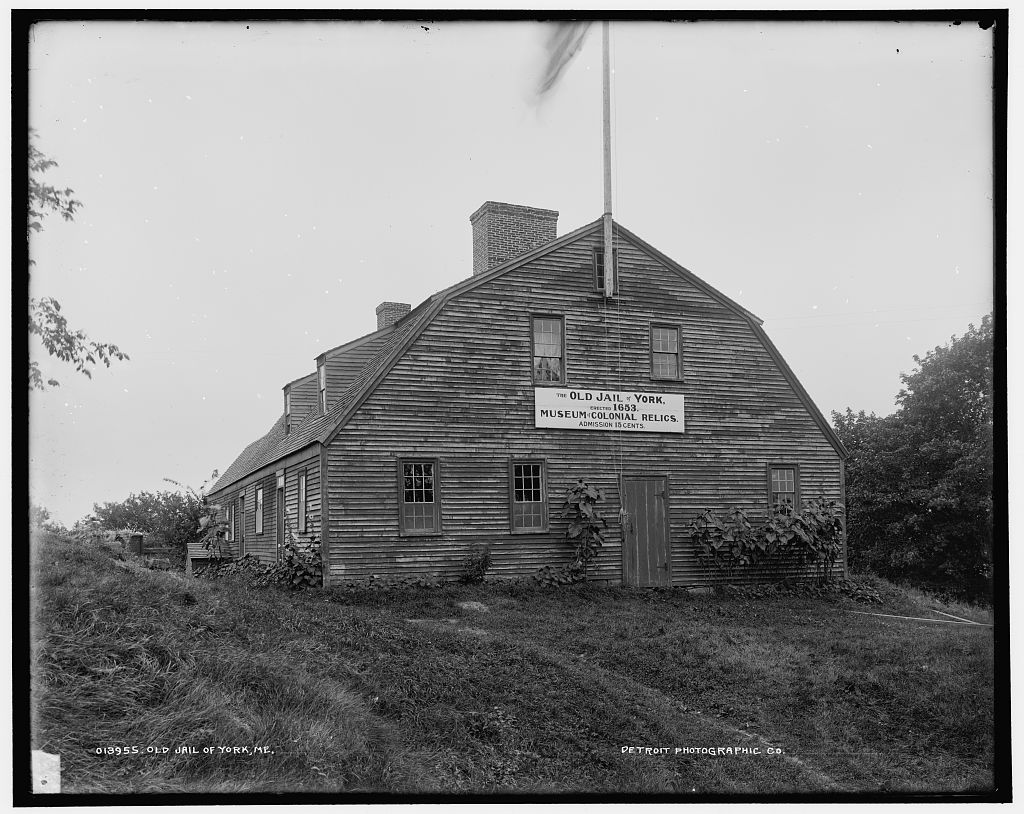
A General Court of the Province held December 30, 1651, it was ordered “that the towns of Gorgeana and Kittery are to build each of them a prison. In answer to a petition from the inhabitants of Saco, Cape Porpus (Cape Porpoise now) and Wells, the General Court of Massachusetts in November 1654 appointed residents of Kittery, York, Wells, Cape Porpus and Saco to make a “just and equall levy on each of the towns named and that they shall also take an account of the late Treasurer about the rate of the two late Courts and rectify the same, chargeing to each toune theire due proportion, according to the custome of the countrie rates”.
From subsequent records it would seem that these amounts were for the estimated cost of a prison, not yet built, certainly not completed. It appears from the record of the Court proceedings in 1667 that the gaol was far from satisfactory.
In April 1669 John Bray of Kittery was committed to York Gaol by a Kittery Constable, from which it is possible to deduce that Kittery had no jail, and that the one here had been made “more convenient,” for the new one had not yet been completed. At the same time, the towns in the western part of the Province in arrears for their share of expenses in erecting the new jail were directed to fulfill their obligations so that the committee could “take speedie & effectual Course for the building of a new Jayle att Yorke, or maintaine that which is there.” In 1671 another resident of Kittery was committed to the gaol at Falmouth, presumably because the one here was not completed or insecure, and in 1673, the Overseers of the Prison, Capt. John Wincoll, Richard Banks and Edward Rishworth were fined five pounds apiece, “for not finishing it” as ordered by the court. This fine was remitted the next year. It would thus appear that, twenty years after the original order, the gaol at York had not been completed. It was, however, in use, but owing to the “defectiveness”, a prisoner in 1673 made his escape and the county was obliged to pay the creditor the amount of his bill against this escaped debtor. Either the responsible officials were continually amiss in this particular, or did not know how to build a structure that would hold its inmates, as in 1695 it was again reported as “much out of repair,” and the Sheriff was authorized to designate any house convenient for a “common county Goale for the present.” The next year Samuel Donnell, Abraham Preble and James Plaisted were directed to “forthwith view the Prison at York & see whats amiss in it, and cause it to be repaired.” In April 1707 the Court ordered the county to build a small prison in York as “the Gaol in Kittery is out of repair” and in October of that year Peter Nowell and Francis Raynes were employed to build it. The dimensions were specified as 24 x 16 and 7 feet between the floors, indicating a structure of two stories. As the dimensions of this “ small prison” are not those of the foundations of the present one it is probable that this was the “House of Correction” referred to in the records of the next year when the prisonkeeper was also designated as “Master of the House of Correction. ” The House of Correction serving as a workhouse for minor criminals and the poor of York County. Inmates in York’s House of Correction repaired shoes and processed flax to pay debts and court-ordered fines.
Operating a gaol brought its own problems. In 1750, a case of such gaol operation was the basis of a long suit against the Sheriff for damages in allowing a debtor, through negligence, to escape. The verdict was in favor of the creditor and the case was finally taken to the General Court of Massachusetts on appeal. The prisoner was a shoemaker and allowed to work at his trade in the prison, having “his Tools and Billets of Wood for his fire by which he cut away the wood and wrenched out the Grates in the window of the Room in which he was confined at which Window he made his Escape.”