17th Century | 18th Century | 19th Century | 20th Century
Almost from the first, York held the judicial system to the Province. It was more frequently used as the place where Provincial and County Courts were held than any other. In 1640 it was ordered that three sessions of the Quarterly Courts should sit at Agamenticus and one at Saco. After Massachusetts took over the government the sessions were held alternately at Kittery and York, but the presence of the County records, then kept by Rishworth, who resided in York, automatically made York the shire town in practice. In 1668 the famous “military” court assembled here when Massachusetts used armed force to reassert her authority. The extent of the Province, however, with settlements miles apart, made it necessary to hold court sessions elsewhere, occasionally, to accommodate inhabitants living between Kittery and the Sagadahoc (Kennebec River).
Sir Ferdinando Gorges planned to build a Court House is certain from his letter of “Instructions” dated March 10, 1639, in which he directed “that there may be a place appointed for the hearing & determining of causes, I have thought to assigne the same to be as nere as may be in the midst of that parte of the Province which is most inhabited, and that there be a house builte for that purpose at my one chardge if it cannot otherwise be setled.”
It was typical at the time that matters of the court were held in meeting houses but population growth made a building designated as a Courthouse necessary. At a town meeting held December 5, 1733 the sum of £100 was voted towards building a courthouse and on the 20th of the same month, a committee was formed to execute that construction. On January 28, 1734, the town took additional action as expressed in the following vote:
“That this Town will Joyn with the County in building of a Court House in this Town which House shall be for the use of sd County to hold Courts in & for a Town House for the use of this Town to meet in on all Publick Times if they see cause: The Dementions of sd House to be as followeth viz: Thirty Five Foot Long & Twenty Eight Foot Wide: Twenty Foot Stud: the lower Story Eight Feet & a Half high: the upper Eleven Feet and a Half, and the Beames of the Upper Story to be Crowning Eighteen Inches & to have a Pitched Roofe: both Rooms to be Plaistered & whitewashed and well Glaized with Sash Glass, and to be Finished with Joynery Work according to the directions of the Committee that are & shall be appointed by the County & Town, and that the One Half of the Charges arrising in building & Finishing sd House shall be bourne by this Town.”
In 1734, York citizens voted to bear half of the charge of building provided that the
town might have use of it for holding town meetings and for keeping the grammar school. The Court House was built on parish land, a few feet westerly of the roadway to the east of the present town hall. The description of the location implies an area across from the Old Gaol behind the Bulman House (the house directly across from Old Gaol). The town paid a hundred pounds and the court charged seven other towns to make up the other half. The first Court House (called a Town House) was completed before December 26, 1735, as a parish meeting was held on that date. The use continued until the beginning of the next century when dilapidations from age rendered it unsuitable for holding courts and the lack of accommodations for the bench and bar resulted in a transfer in 1800 and 1801 of the sessions of the Supreme Court to Kennebunk.
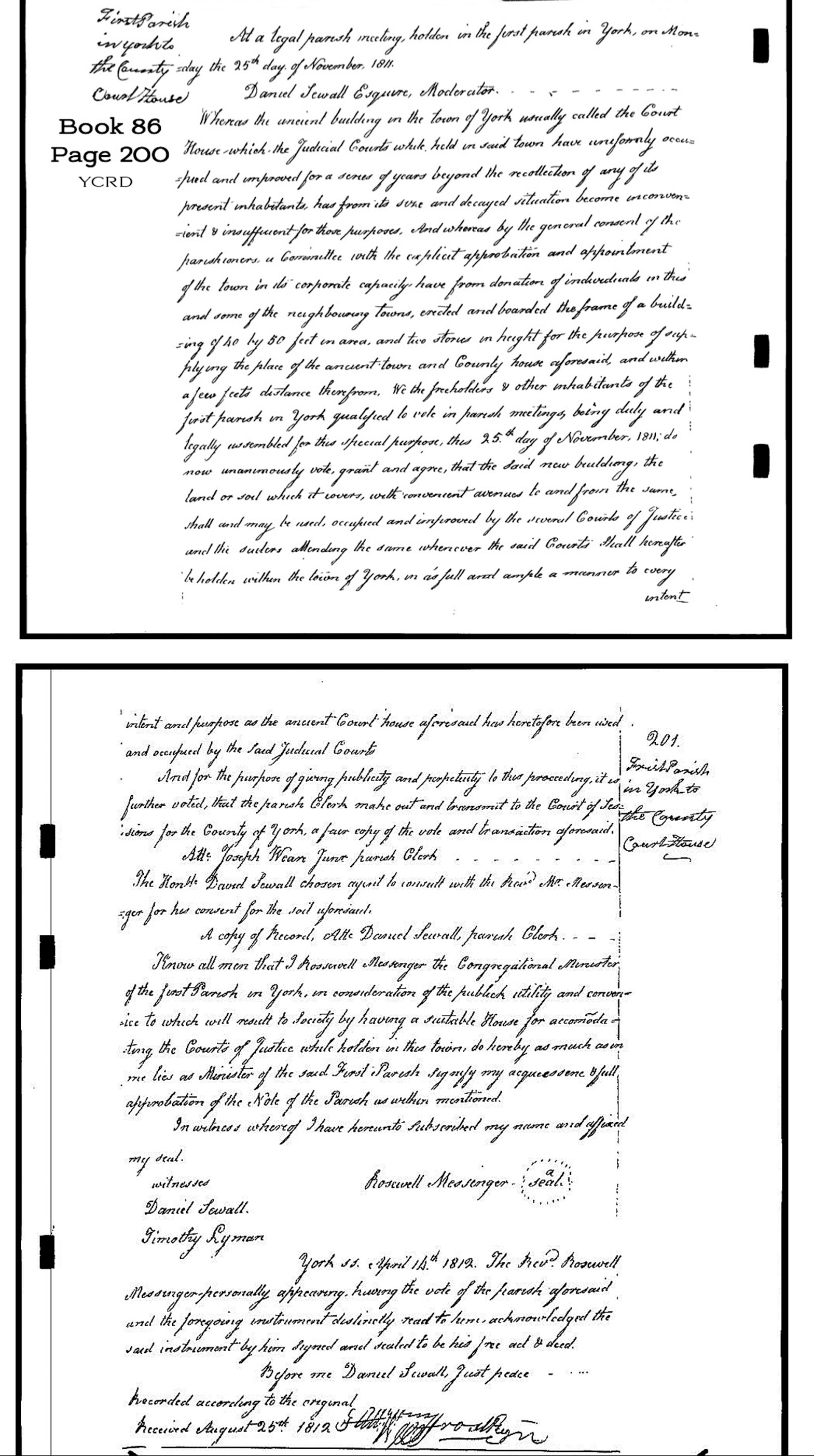
In 1811, the building of a new courthouse was begun (which is now the Town Hall). At a meeting of the First Parish on November 25, 1811, it was unanimously voted:
“Whereas the ancient building. called the Court House which the Judicial Courts while held in said town have uniformly occupied and improved for a series of years beyond the recollection of any of the present inhabitants has from its size and decayed situation become inconvenient and insufficient for those purposes, And whereas by the general consent of the parishioners a Committee with the explicit approbation and appointment of the town in its corporate capacity have from donations of individuals in this and some of the neighboring towns erected and boarded the frame of a building of 40×50 feet in area and two stories in height for the purpose of supplying the place of the ancient town and county house aforesaid and with a feet's distance therefrom, We do now unanimously vote, grant and agree
that the said new building, the land or soil which it covers with convenient avenues to and from the same shall and may be used, occupied and improved by the several Courts of Justice and the suitors attending the same whenever the said
Courts shall be holden within the town of York .”
In a town meeting held on May 6, 1812, Elihu Bragdon as agent was instructed "to sell the old court house and have it removed as soon as the new Court house shall become so far finished as that the Courts can be conveniently held in it and that
the money from the sale be appropriated towards finishing the new Court House". According to George Alexander Emery, the Old building was moved to the low land belonging to the parish on the other side of the street by its new owner, Josephus Howard, who occupied it as a dwelling house and harness and saddlery shop.
During renovation of the Town Hall in 2023-2024, archaeological monitoring was performed in the event that remnants of the 1734 Court House or any privies were disturbed/located.
Here is a deed from Pastor Roswell Messenger to the Town of York for the all ready underway Court House.