17th Century | 18th Century | 19th Century | 20th Century
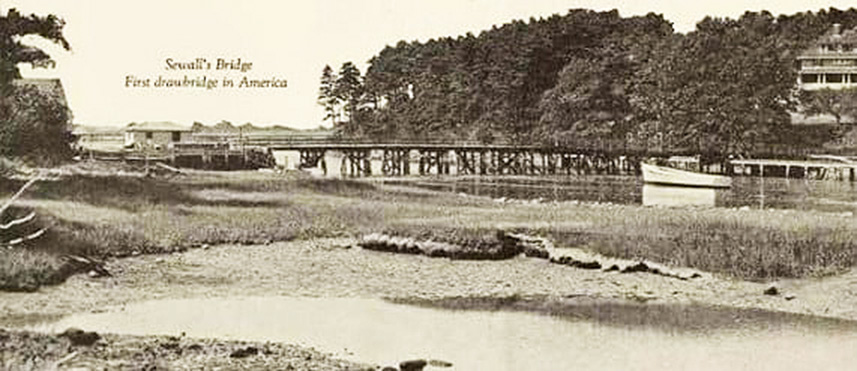
Sewall’s Bridge, York Maine Major Samuel Sewall, after whom the bridge is named, both designed and oversaw the building of the original bridge. Samuel was a local landowner and judge that saw value in connecting the two sides of York.
Before the bridge the Sewall family ran a ferry used to cross that section of the York River and operated the bridge as a draw bridge until the 1930’s. My great grandfather, Paul Sewall was the last Sewall to operate the bridge. The family lore was that Paul was late to his own wedding because he had to let a ship through.
Sewall’s Bridge was first built in 1761 and has historical significance being the first wood piling bridge built in America. It connected the harbor and the town center over the York River. York at the time was a ship building and trading port, the bridge was an important part of the growing infrastructure of the area. It was an essential link between coastal shipping routes and inland settlements.
The original structure was a wooden pile bridge—a new approach to engineering in colonial America. Wooden piles, or large vertical posts, were driven into the riverbed to support the bridge deck. These piles provided a stable foundation in the soft, marshy soil near the York river. A technique most likely inspired by European bridge construction methods. The structure was composed of timber, and the deck was designed to support both pedestrian and wagon traffic. The use of local timber and labor made the bridge an economical yet effective solution to the region’s transportation needs.
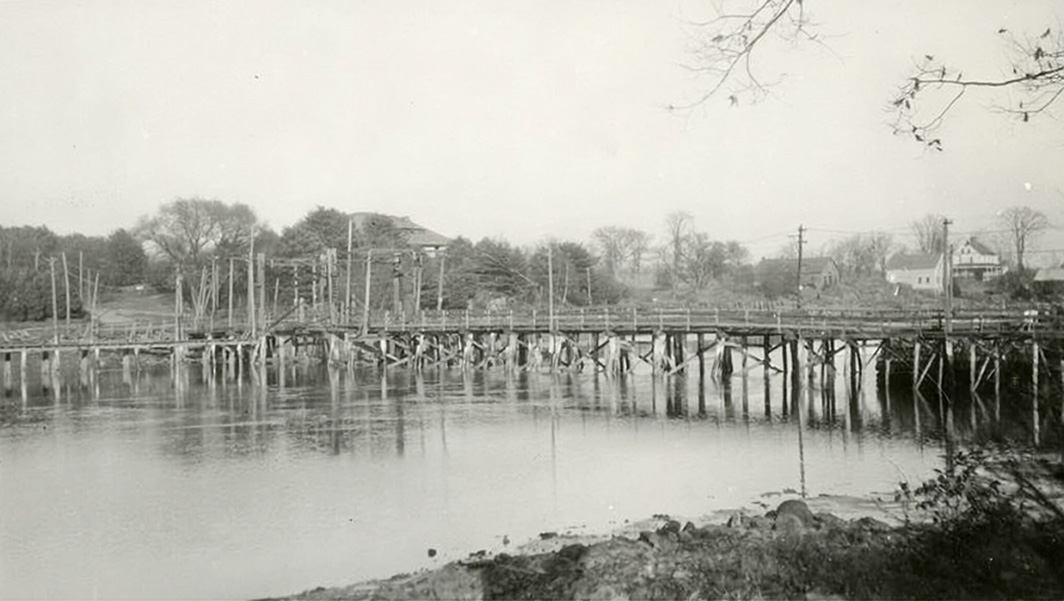
Over the years, Sewall's Bridge has undergone several renovations and reconstructions due to the wear and tear of tides, weather, and increased use. The most significant restoration took place in 1934 when the original 18th-century structure was replaced by a replica that maintained the historical look and materials of the original bridge. This reconstruction preserved the classic New England look, using wooden trusses and railings. The bridge's most recent update was in 2013 using modern materials and standards to accommodate the heavy traffic and vehicles that now frequently cross the York River.
A few descendants of Samuel Sewall still live within a few miles of the bridge and my first cousin Mark Sewall; a local lobsterman docks his boat next to the bridge. Sewall’s Bridge stands today not just as a piece of transportation infrastructure, but as a reminder and living monument to early American engineering and the historical development of coastal Maine. In 1986 it was designated a National Civil Engineering landmark.
Jeremy Sewall
As York began to grow, along with the surrounding area, a bridge to span the York river began to be talked of as a possibility as early as 1740, but it was a novel as well as formidable undertaking to erect one over this tidal stream. The townsmen evidently did not care to tax themselves for its construction, and the discussion led to the scheme of private ownership and franchise for charging tolls for a specified period. It may be supposed that Samuel Sewall was the moving spirit in the preliminary debates, in view of his son’s later connection with its construction, and perhaps Jonathan Sayward, who is known to have been one of its principal promoters financially. At the Town Meeting of March 8, 1742-43, it was:
“Voted that there be and hereby is Granted unto such Persons as will accept & undertake it, the Liberty to Build a Bridge at their own Cost over York River, some where between Colo: Harmons Wharfe and Mr. Donnell’s Point of Rocks, above the Ferry: Provided there be a Sofficient way left for Sloops to Pass & Repass, and the Inhabitants to have free liberty to Pass over the same without any thing to Pay.”
This is the first action taken by the Town towards accomplishing this great step forward in facilitating travel. Francis Raynes entered his “desent” against this vote. At the same meeting this supplementary vote was passed :
“Voted that if said Bridge shall be bult over said River it shall be by Capt. Samuel Sewall’s wharfe.”
No further action was taken by the town, nor was any necessary. It only remained for the promoters to organize their company, secure the funds and carry out the engineering plans devised by Major Samuel Sewall and his assistant Capt. John Stone. The original draft of this pioneer pile drawbridge, the first built in the country, is now preserved in the Old Gaol and the sectional drawing is here shown. The method of construction was of a primitive kind, as pile driving machines had not been invented. Soundings having been made by probing the river bottom with a long pole tipped with a pointed piece of iron, the logs were cut to the various lengths required, and sections of four joined by a cap piece and braced were floated into position. Then this section was set upright for the improvised driver to sink it in the bed of the river. A heavy oak log, rigged as a sort of trip hammer, slowly drove it into the mud. It included a 30 foot drawspan that allowed passage of ships. The success of Major Sewall in this engineering venture secured for him some years later the contract for building the first bridge over the Charles River.
Subscriptions payable in installments were raised in town by Sewall and Stone, and in 1757 the first traffic went over this famous bridge.
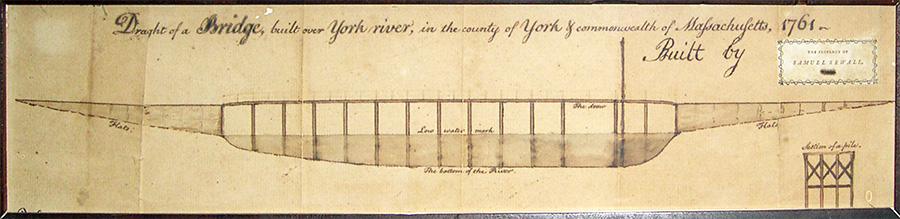
It was operated as a toll bridge, excepting residents of York from payment. It was two hundred seventy feet long and twenty-five feet wide. Nothing further appears upon the records about the bridge until 1770, when it was brought to the General court to increase the tolls for repair and improvements. The court voted the following rates:
“For every footman who shall pass the said Bridge two thirds of a penny for every Man and Horse two pence, for every two Wheel chaize, chair or Sleigh & Horse with the Travellers therewith the sum of Four pence for every four Wheel carriage including the Passengers six pence for every Man with Team Cart or Sled the Sum of four pence , for all horse kine or neat cattle two Thirds of a Penny, for Sheep or Swine four Pence a Dozen and so in proportion for a greater or lesser Number.”
The Act provided that a toll-keeper should be in attendance “at all Times between the Hours of five in the morning & Nine in the evening.” and it also provided that:
“that the passage of said Bridge shall be kept open and free for all Persons travelling to or from public worship on Lords Days— for the Inhabitants of the Town of York going to or from Public meetings of the Town or Parish Post riders ministers of the Gospell on all Occasions, Constables and collectors of Taxes & all other officers of the said Town and Parish, while doing the Town or Parish business & members of the general Court going to or returning from the same.”
The original bridge was so well built that it remained in use until 1934, when it was replaced with a wood pile bridge of a design very similar to that of the original. That replacement bridge is in regular use today. This bridge was dedicated as a historic civil engineering landmark on July 24, 1986.