17th Century | 18th Century | 19th Century | 20th Century
Headnote: Although Norridgewock, Maine is over 100 miles from York, the massacre incurred upon Native Norridgewock People from York soldiers was pivotal in Maine History. The vessels depicted on the mural represent the departure of an offensive party of York and surrounding area men, embarking on a cruisade of genocide. This final attack significantly reduced future conflicts with Natives, severly diminishing their population in this region.
by James Kences
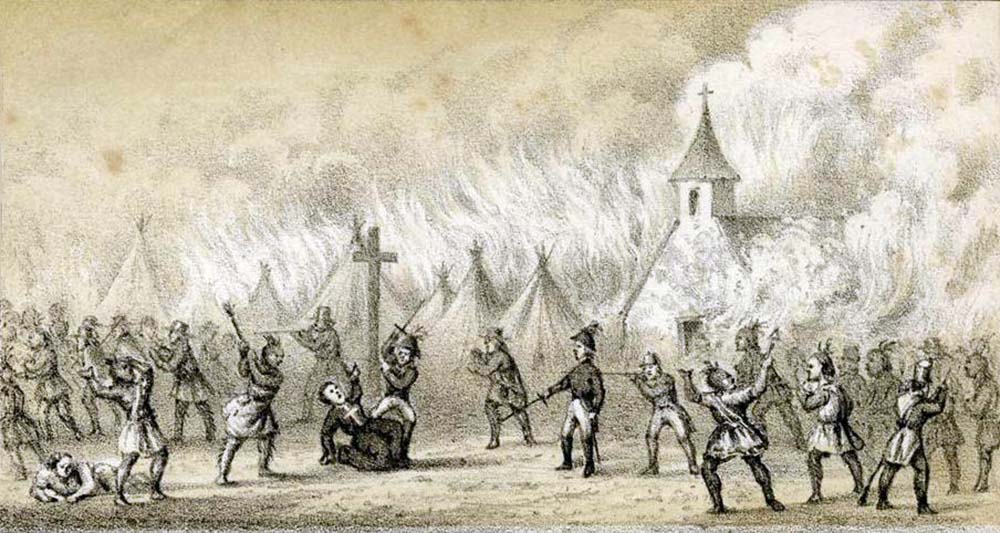
"Full eight and twenty scalps our valiant lads obtain'd." On Aug. 22, 1724, the arrival of Captain Johnson Harmon to Boston was met with "shouts and trembling." Harmon proudly brandished the "Norridgewock scalps." "The greatest victory we have obtained in the three or four last wars" concluded Samuel Penhallow in 1726, "and it may be as noble an exploit (all things considered) as ever happened in the time of King Philip." That victory was Norridgewock, a successful surprise attack upon the Indian mission village infamous for its association with the despised Jesuit, Sebastian Rasle. That attack occurred in the early afternoon of Aug. 12, 1724 which was 48 years to the day after the Indian war leader Philip, or Metacomet, was killed at Mount Hope in native tribal territory within Rhode Island in 1676.
The two memorable days in August, almost 50 years apart, serve symbolically as bookends for the long era of Indian wars for much of New England, and especially for York, as the vulnerable frontier conditions rapidly receded, and the garrison houses, once so vital as refuge in an emergency, ceased to be such a prominent feature of the landscape.
A middle-aged man or woman who were inhabitants of this town during the 1720s, had experienced four episodes of Indian war over their lifetime, and they were also more than likely kin to casualties or captives. The Candlemas raid of January 1692, the best known of the attacks, and the costliest in human life, was but one in a series that extends as far back as September 1676 – just weeks after Indian Philip's death – with the destruction of the Cape Neddick farmsteads.
The war declared against the tribes in July 1722, was a consequence of the resettlement of the abandoned towns of the northern region, and of the activities of proprietors of large tracts in proximity to the natives in the decade following the end of Queen Anne's War in 1713. It was known alternately as "Rasle's War" in recognition of father Sebastian Rasle, the Jesuit priest who was the most celebrated of those killed at Norridgewock, or "Dummer's War" taking on the name of Lieutenant Governor William Dummer who presided over the government at Boston. The conflict would be over by 1725, and represented one of the final efforts at resistance by the aboriginal population.
Since the middle of the previous century, the English in Maine and the natives had been steadily growing apart, and war was to be the tragic end result. The alienation of the different Indian tribes had many causes. The values and worldview of the two cultures was vastly different. Multiple instances of miscommunication and misunderstanding had so distanced the two that they were close to being irreconcilable. As the natives withdrew from the English held region, they were physically brought closer to the domain of the French in Canada and to the Catholic faith. The first contacts had occurred as early as the 1640s. Unfortunately, to be associated with the French or with Catholicism instantly made the natives suspect to the New England colonists, and the situation worsened as the era of the French and Indian wars commenced, and the first of the devastating raids were visited upon the frontier settlements.
Father Rasle was close to 70 years old – he was first assigned to Norridgewock in 1694. "During the more than 30 years that I have spent in the midst of the forest with the savages," he wrote in 1722, "I have been so occupied in instructing them and training them in Christian virtues" that I have had little time for anything else. He went on to describe his daily routine. "After Mass I catechize the children and the young people. I hold meetings with men and women in need of advice, and in the afternoon, I visit the sick."
The Jesuit lived among the natives, expended great effort in learning their language. He cared for the welfare of the persons entrusted to his care. The final decade of his life was consumed by a futile running battle with the Massachusetts government as he championed continued native independence against rapid English encroachment. "What is our own we will be masters of. . ." This was the position taken by Massachusetts — words actually spoken to the Indians in 1717.
Rasle's fatal error was in the tactics he employed: bellicose language, threats of violence, which had become so provocative that by the summer of 1720 a price of 100 pounds was put upon his head. Though he eluded capture in three prior attempts by provincial militia to raid the village, incriminating papers were found which brought to light communications with the government in Canada, an appeal for military assistance. The correspondence led to his doom as concrete evidence of treason.
Guilt by association, an atmosphere of suspicion, rumors, misinformation, and an exaggerated perception of his influence upon the warring tribes — all of this contributed to his downfall. Strong emotions and prejudice have created so many distortions, that it has become difficult to see Rasle as he really was. This applies even to the narratives of his death, including the French version that portrayed him making a heroic last stand in which he ‘dropped dead at the foot of a large cross located the middle of the village.' The English have him instead being shot while he was still in his house, injuring a boy with a knife in his final moments.
The York men who undertook the raid at Norridgewock had like everyone else so demonized the Jesuit, that his death had become a necessity. For the political and military leaders of this town in the early eighteenth century, an important source of affinity was the experience of loss in the Indian wars. York men, Lewis Bane and Abraham Preble, who died in 1721 and 1723, respectively, had both played a role in supervising post-war resettlement. Both men had lost their fathers to the Indians – Bane in 1677, Preble in 1692 – and the members of their immediate families were either taken into captivity or killed. Joseph Bane, Lewis's brother, among the captives of 1692, was redeemed in 1699, and as a consequence of his long period of contact became an interpreter, a required participant of many conferences.
At the conference held with the Norridgewock Indians at Georgetown in November of 1720, Bane was the interpreter, and Johnson Harmon one of the four representatives from Massachusetts. Harmon was another man who had known the experience of captivity, taken to Canada in 1710. The Indians insisted repeatedly that the cluster of farmsteads at Merry Meeting Bay, a site on the Kennebec beyond the limit of acceptable settlement be removed. This became the focus of contention, a cause of the war in 1722. When Father Rasle interceded as the defender of native rights, he inevitably became engulfed by the strong emotions of those in opposition, who possessed firsthand experience to justify their hatreds. This was to be the path which ultimately led to the raid of Aug. 12, and to the death of Sebastian Rasle.