17th Century | 18th Century | 19th Century | 20th Century
McIntire Garrison
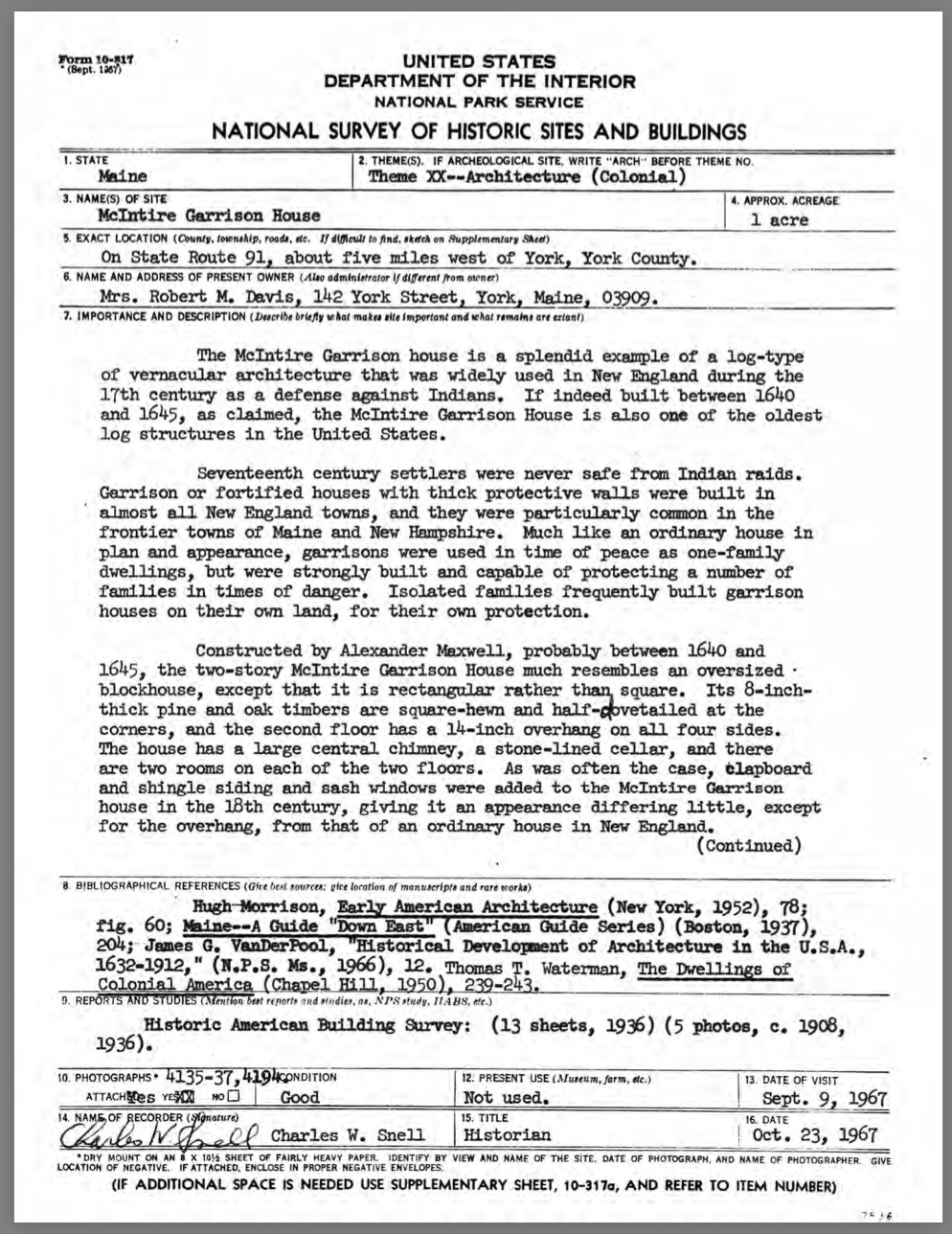
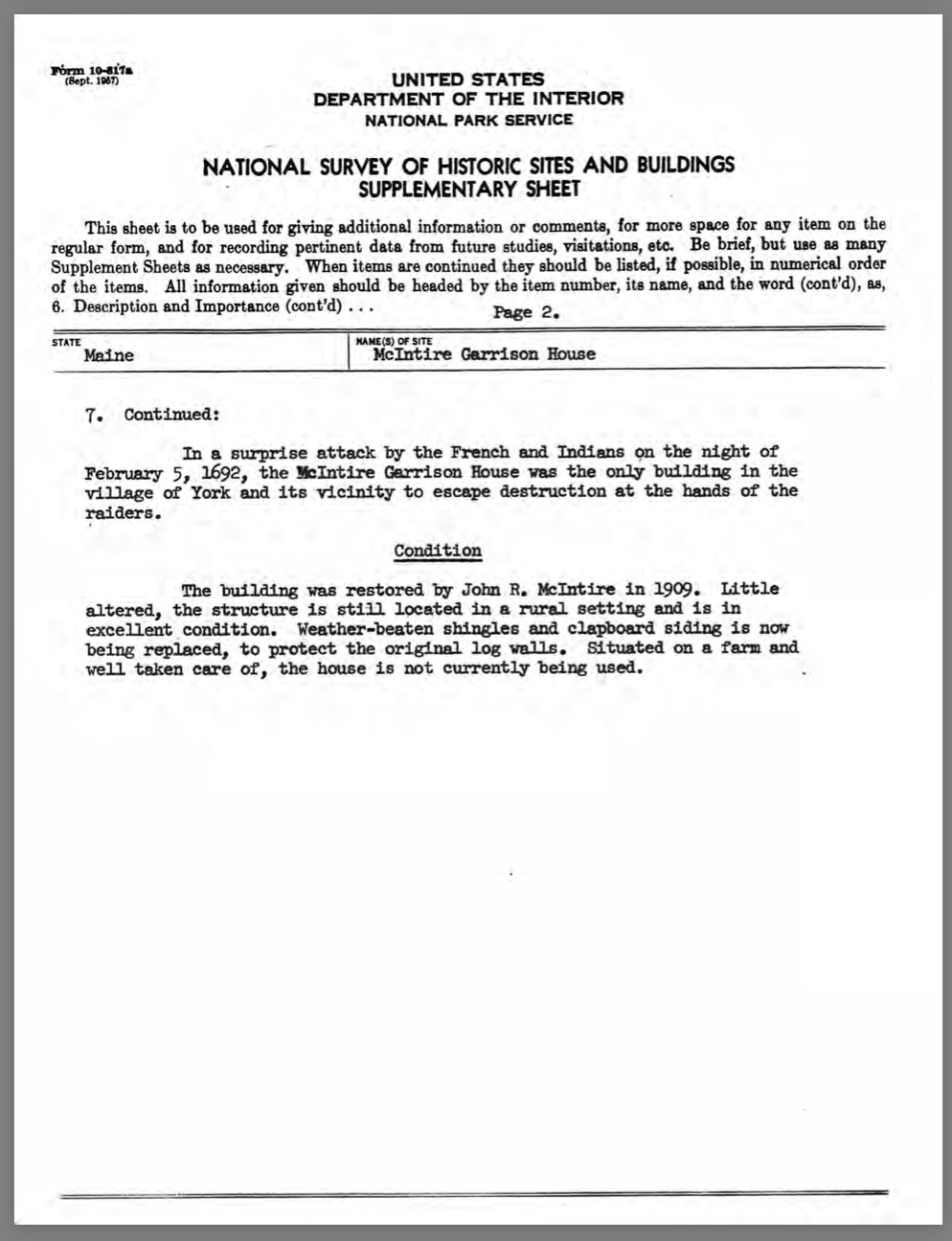
According to a recent Dendrochronology analysis, the McIntire Garrison dates from 1712-1713. The history of the Garrison has been carefully documented, establishing the building as an extraordinary example of Colonial architecture. The family initially recorded the building as being built by Alexander Maxwell in the first half of the 17th century, as can be seen in National Historic Landmark documents (see below).

During this time period a garrison was a fortified private home built for protection against hostile attacks, typically by Native Americans or French forces. These fortified houses were often built on elevated ground, featured thick walls made of heavy logs, and included defensive features like trapdoors, overhangs on the second floor to provide better firing positions, and "portholes" for shooting at attackers or dropping scalding water or molten lead on attackers. One-story garrisons were for individual families, while two-story ones could serve as a community stronghold.

Garrison houses came into use as a result of the experiences of York during King Phillip’s War (1675-1678). York had twenty one garrison houses. Each was selected for their convenience as a rallying point for groups of settlers in different localities throughout York during conflict. As only four garrisons were known to be used during the 1692 Candelmas Massacre (Alcock, Harmon’s, Treble’s and Stover’s but there may have been others), it is likely that the Maxwell garrison was built as a result of the Second Indian War of 1689 to protect the families in the Scotland area of York. In 1692, only one garrison was noted in the Scotland area by Capt. John Floyd directly after the massacre, which was the Maxwell garrison.

Alexander Maxwell, the first Scottish settler in the Scotland area of York, sold part of his land to John McIntire, whose land adjoined Maxwell’s, in June 1707, and it included “the orchard or garden of sd Maxwell where the Garison now stands”. In 1711, per order of the Governor to report all garrisons in Maine, the garrison became known as the Scotland Garrison. It is unknown if that garrison is now the one called the McIntire Garrison. However, the McIntire Garrison is considered the oldest building in Maine.
Additional reading…https://www.loc.gov/pictures/collection/hh/item/me0083/
A Timeline
• 1656 – Former Scots prisoner of war Alexander Maxwell, while still working off his compelled indenture in South Berwick, acquired a land grant in York in what would become Scotland District. He acquired or purchased land there again in 1657 and 1662. Maxwell was one of the first of nearly a dozen Scottish prisoners of war from the battles of Dunbar (1650) and Worcester (1651) who settled in Scotland District in York. It is not known where Maxwell built his own home, an early garrison, but he owned most of the land on which the earliest McIntires built their own homes.
• 1668-1670 – Micum McIntire acquired his first land grant in York on the south side of the York River. He had worked off his indenture in Oyster River (Durham) and Dover, had worked at mills in South Berwick, and was relocating from South Berwick to Scotland District. It is likely that in York he boarded at first with one or more of the several Scots already settled there, possibly Alexander Maxwell and/or Micum’s purported cousin, Alexander Mechanere (MacNair).
• 1670 – Alexander MacNair, a disabled former Scots prisoner said to be a distant cousin of Micum’s, died before December 1670, bequeathing his land (his frontier cabin, a 40 acre woodlot, and possibly other land) to Micum. In his last days, MacNair asked Micum to care for his wife Dorothy Pierce. MacNair had been permitted to build his cabin—probably with assistance from other former Scots prisoners—on property owned by Alexander Maxwell.
• 1671 – In late summer, Micum McIntire married Dorothy Pierce, widow of Alexander MacNair. On September 4, 1671, Alexander Maxwell deeded what had been MacNair’s five acre home lot to Micum and Dorothy, now married, possibly as a wedding present. That land consisted of “Upland whereon the sd Mackentyre’s house now standeth, formerly built by his predecessor, Allexander Mackanere, whose relict or Widdow hee since married.” (York Deeds, ii, 104) So far as is known, Micum and Dorothy lived on that property for the rest of their lives.
• 1675-76 – King Philip’s War began, sparking generations of New England regional warfare and sporadic local raids, and spurring the need for secure fortifications in York. King William’s War (1689-1697), the first of a series of regional proxy wars between Britain and France, followed.
• 1677 – Micum and Dorothy’s first son, John, was born. In April, an Abenaki raiding party killed six men out planting their fields. One was John McIntire’s uncle, former Scots prisoner John Carmichael, husband of Anne Pierce (Dorothy’s sister).
• 1692 – Following the deadly January 24 Candlemas Raid, militia leaders from Portsmouth billeted troops in homes in various parts of York, including Scotland District, locating the troops where they could quickly respond to attacks and defend the community using the three standing garrisons in town, one of which was Maxwell’s garrison in Scotland District.
• 1700 – It is likely that Dorothy (Pierce) McIntire died early in the year, inspiring Micum McIntire to made his own will on April 17, 1700.
• 1702 – Queen Anne’s War (1702-1713) began.
• 1705 – Micum McIntire died in September, at about the age of 80. He died in his own bed, in his own house, on his own land, surrounded by his three sons, for whom his will provided substantial land and goods. None of those things would have been possible for him in Scotland. Micum’s estate was probated on October 2, 1705. The estate’s inventory, valued at 199 pounds, was delivered by the appraisers on November 8, 1705.
• 1707-1710 – In his own last illness, Alexander Maxwell conveyed property including the future McIntire garrison site to John McIntire, Micum’s eldest son—no deed for that transfer has been found. On June 27, 1707, Maxwell sold another three acres adjacent to his own (Maxwell’s) home to John McIntire, as well. It was bounded on the south-east by “the orchard or garden of sd. Maxwell where the Garrison now stands.” (Deed, vi, 87). The garrison being referred to was Maxwell’s, as the McIntire garrison had not yet been built. It is possible that Maxwell’s garrison was located where the Victorian farmhouse now sits at 273 Cider Hill Road (Rte. 91), but that has not been confirmed. From John McIntire onward, the McIntire Garrison property, as well as surrounding farmland acquired and expanded over the years, was continuously in the ownership of the McIntire/Davis family until 2024.
• 1794 – The McIntire Garrison appears on the David Sewall map of York.
• 1806-1807 – Timbers (white pine and oak) were cut for the construction of a cider house/barn built immediately south of the Garrison. It was probably erected in 1808.
• At some point in the early to mid-19th century, a two-story addition was added to the western end of the Garrison, to accommodate the large McIntire farm families. Archeology professor Emerson ‘Tad’ Baker has speculated that the addition was part of another building moved to the site and reused.
• 1854 – On the 1854 York county atlas map, no house appears on the site of what is now the large Victorian farmhouse east of the Garrison.
• 1872 – On the 1872 York county atlas map, a house labelled “J. McIntire” appears on the site of the large Victorian farmhouse. “J. McIntire” is also shown as the owner of the adjacent Garrison. This was likely John Randolph McIntire (1812-1875), son of John and Eleanor (Junkins) McIntire. John Randolph McIntire may have built the new farmhouse around 1865, when he married his wife Helen Gertrude McIntire (1844-1934, a Micum McIntire descendant in her own right).
• 1875 – John Randolph McIntire’s sister Sarah, the last McIntire family member permanently residing in the Garrison, died there on December 20, 1875. The Garrison may thereafter been used as a family summer vacation home.
• 1890 – The barn/cider house first appears in photographs of the property immediately south of the Garrison.
• 1909-1910 – John Randolph McIntire renovated and ‘restored’ the Garrison, removing the deteriorated western addition, shoring up the foundation and structure, taking down and rebuilding the central chimney, and replacing much of the secondary wooden components (siding, window/door frames, etc.). Interior renovations replicated an ‘improved’ version of the rustic Victorian décor John probably remembered from his childhood.
• 1922 – A fire extensively damaged the 1865 Victorian farmhouse east of the Garrison, burning some sections to the ground. Major restoration and renovations were undertaken to rebuild and restore the farmhouse as it had been, and included plans for modern improvements like a fire suppression system (which was never installed).
• 1936-1937 – A National Park Service (NPS) study of and plans for the Garrison erroneously estimated that, based on the architecture and then-available documentary evidence, it was likely built between 1660 and 1692.
• 1942 – Another fire damaged the Victorian farmhouse. It was once again restored and renovated.
• 1943 – John Randolph McIntire died and was buried in the small McIntire family cemetery in the tree line east of the Garrison and farmhouse. The cemetery itself shows signs of having been restored and improved, with 20th century headstones marking some 18th century graves. The Garrison and other McIntire properties were bequeathed to John’s sister Alice Randolph McIntire. Upon her death, they were in turn bequeathed to Alice’s niece Mary Bragdon (McIntire) Davis, and remained thereafter in the hands of the Davis family, who carefully preserved and stewarded the Garrison and the McIntire properties.
• 1970 – The National Park Service designated the Maxwell-McIntire Garrison a National Historic Landmark.
• 1998 – Mary McIntire Davis sold a significant portion of the McIntire farm and woodland properties to the York Land Trust.
• 2004 – Mary McIntire Davis sold another 300 acres of McIntire farm and woodland properties to the York Land Trust.
• 2005 – The Davis family sold 240 acres of York River watershed land to the York Land Trust.
• 2008-2009 – The Victorian farmhouse was once again restored and renovated.
• 2024 – The remaining two-acre property including the McIntire Garrison and the cider house (275 Cider Hill Road) was sold by the Davis family to the Old York Historical Society, resulting in the preservation of a unique surviving 18th century garrison house in its original preserved setting.
Special thanks to Jon Tucker for the McIntire family timeline.
Sources:
Robert Harry McIntire, “The Descendants of Micum McIntire,” 1983, Bookcrafters, Chelsea, Michigan.
Harry Alexander Davis, “The McIntire Family: Descendants of Micum Mecantire of York County, Maine,” 1939, published by McIntire Clan, York, County, Maine.
Edward S. Stackpole, “The First Permanent Settlement in Maine,” 1926, excerpted from Sprague’s Journal of Maine History,” Volume XIV, No. 4.
Edward S. Stackpole, “Old Kittery and Her Families,” Lewiston Journal Company Press, Lewiston, Maine, 1903.
Charles Edward Banks, “History of York, Maine,” Volume I, Regional Publishing Company, Baltimore, Maryland, 1967 [reprint, originally published, Boston, MA, 1931-35.]
Edward S. Stackpole and Lucien Thomson, “History of the Town of Durham, New Hampshire,” Volume I, published by vote of the Town, 1913-14.