17th Century | 18th Century | 19th Century | 20th Century
The development of travel by a machine using steam as its force found its usefulness in furnishing power to a carriage fitted to run on permanent tracks, invented by Stephenson, an Englishman. In 1830 this strange iron monster made its appearance in America and the first railroad operated by steam power was built in this country to run from Baltimore.
In 1837 the first railroad line was projected to connect Boston and Portland, and in the survey for its roadbed, York was left out of the calculations of the promoters. Whether any effort was made by the people of this town to be accommodated in the new scheme is unknown. York was thus condemned to remain off this new highway of travel for years, until the growth of the town, especially after i860, when the first ripples of the stream of summer tourists began to develop into an annual tidal flow, required the facilities enjoyed by other seacoast towns. These annual visitors demanded better facilities for reaching our famous beaches than was possible by the antique method long since abandoned by other towns.
In the fall of 1882 a meeting was called at the instigation of public-spirited citizens of York to discuss the problem of securing better facilities for transportation of persons and freight. As a result Edward S. Marshall, John E. Staples, Henry E. Evans and John C. Stewart were chosen for a committee to confer with the President of the Eastern Railroad and present facts relating to the increasing business of the town and urge upon him the advantages of constructing a branch of that railroad from Portsmouth to York. As no encouragement was obtained from the president, these four gentlemen decided to become independent railroad magnates and build the necessary connecting line. In 1883 the state legislature granted a charter of incorporation to the York Harbor and Beach Railroad Company.
At this time, the old Eastern Railroad was slowly being driven by its competitor, the Boston & Maine, and its shares of stock were peddled around for a few dollars each. The Boston & Maine Railroad acquired control, and the Hon. Frank Jones of Portsmouth, one of its most active directors, became interested in this proposed line to York. Surveys only had been made for its construction. Extension of the franchise was effected in 1885 by filing plans of location, but nothing was done towards grading the roadbed or exhibiting other visible evidences of progress. The town refused to give any aid in financing the venture either by direct appropriation or by endorsing bonds with the road as security. The persistence of Mr. Marshall and his willingness to lend his private funds kept the scheme alive, and when specifications and bids were called for in October 1886, Mr. Jones, evidently finding that a narrow-gauge road was proposed, and considering that such an irregular trackage, which did not permit of interchange of freight and passenger cars with the Boston & Maine, would cause inconvenience and added expense in transporting passengers and freight. This proposed a suspension of the building program pending a conference of the directors of the two roads. As a result of this the Boston & Maine agreed to complete a standard gauge road, provide the rolling stock and equipment and furnish the balance of funds necessary to complete it when the local corporation should take fifty thousand dollars of stock in the York Harbor and Beach Railroad Co. Reciprocal privileges were granted the branch company to use the road of the Boston & Maine from Kittery to Portsmouth with all terminal facilities, and in December 1886, the work of construction was begun. On August 8, 1887, summer visitors were landed, for the first time, by this modern method of travel at Long Beach, and soon after at the terminal, which was called Union Bluff. The cost of construction was over three hundred thousand dollars, and for the first time York was put on the railroad map of the United States.
For nearly forty years this modern style of travel, supplemented for a time by the electric railroad, served the town and its annual guests, until a new competitor entered the field. Discovery of petroleum was followed by the invention of the internal combustion engine, and eventually the “horseless carriage,” perfected in the first decade of the 1900’s, began to draw travel from the iron road to the macadam and asphalt surfaced highways.
Against this latest rival in transportation the protest against the isolation of York succumbed to the inevitable. The Boston & Maine System was obliged to discontinue service on all such local spur tracks and in June 1925, the last passenger train screeched its farewell to the Harbor and Beach.
The electric railroad of York was started in 1897 and put in operation in 1898, being built by Gerald and Libby. Like all new things, it was fought by certain elements of the town, particularly in York Harbor, where it was thought this common form of travel would ruin the exclusiveness of this popular resort.
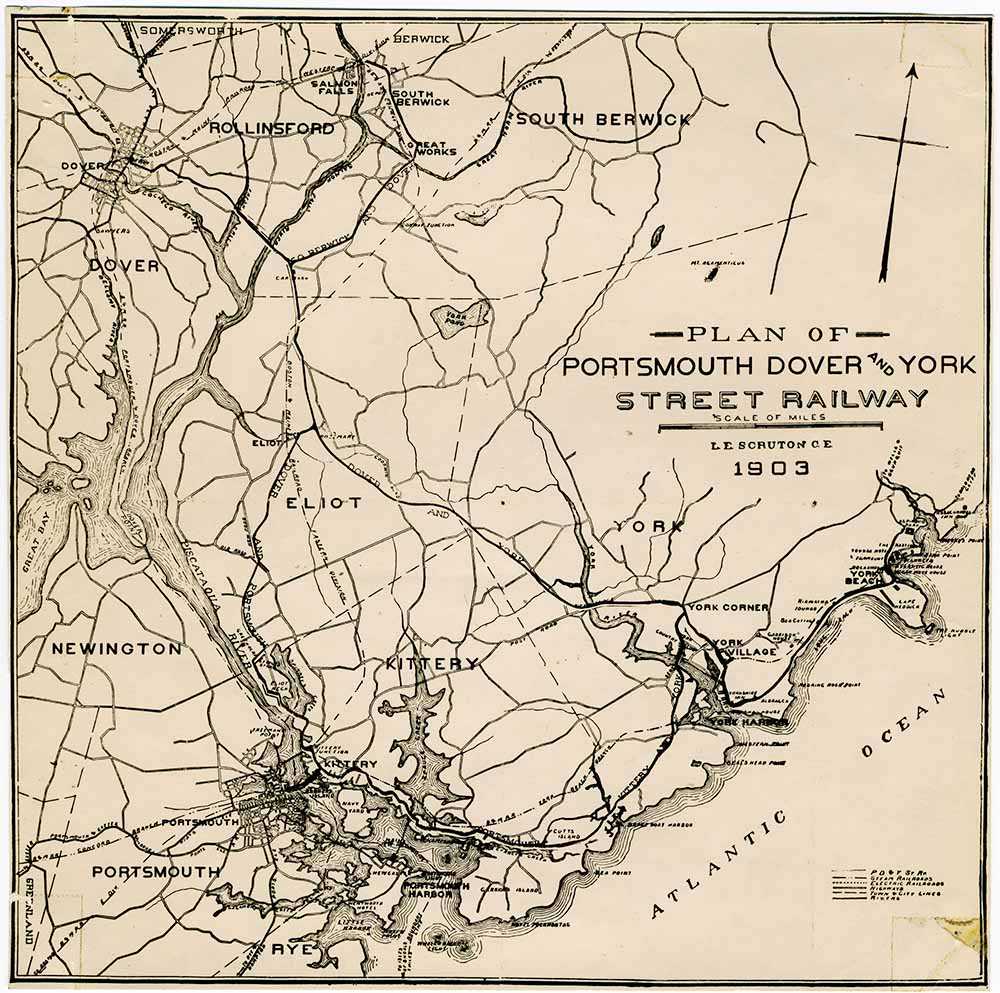
This railroad was known as the Portsmouth, Kittery and York Street Railway. It ran from Badger’s Island in Kittery via Kittery Point, across Brave Boat Harbor to Seabury, Sewall’s Bridge and York Corner, then through York Village and Harbor, following the highway across Long Beach to York Beach. The connection to Portsmouth was made via ferry from Badger’s Island.
Shortly after this railroad was started, a branch was run up into Eliot. This line was extended to Dover and South Berwick, and then a cross-country line was built from “Rosemary,” in Eliot, to York Corner to join the original line. The road name was now, after these extensions, known as the Portsmouth, Dover and York Street Railway.
The railroad was operated in this form for a few years, when a line was built from York Beach to Kennebunk, via Ogunquit and Wells, to connect with the existing line which operated from Springvale to Sanford to Biddeford, with branches to Cape Porpoise and Kennebunkport. When this connecting link was completed the different lines were consolidated under one head, and known as The Atlantic Shore Line Railway.
This railroad operated for a few years, went into a receivership, and was reorganized as the Atlantic Shore Railroad. This was the time of the decline of electric railroads, and the advance of the automobile. It was only a short time before another receivership occurred. The railroad was divided at York Beach, in April 1917, and the western division went back to its original name of Portsmouth, Dover and York Street Railway, commonly known as the P. D. & Y., which the public said stood for Pull, Drag & Yank.
This P. D. & Y. Street Railway operated under a receivership until 1920, at which time it closed up, was discontinued and sold for junk. The carbarn at South Berwick burned, the one at Kittery Point was torn down, the rotary station at York Corner was made into a house and the carbarn at York Beach into a dance hall.