17th Century | 18th Century | 19th Century | 20th Century
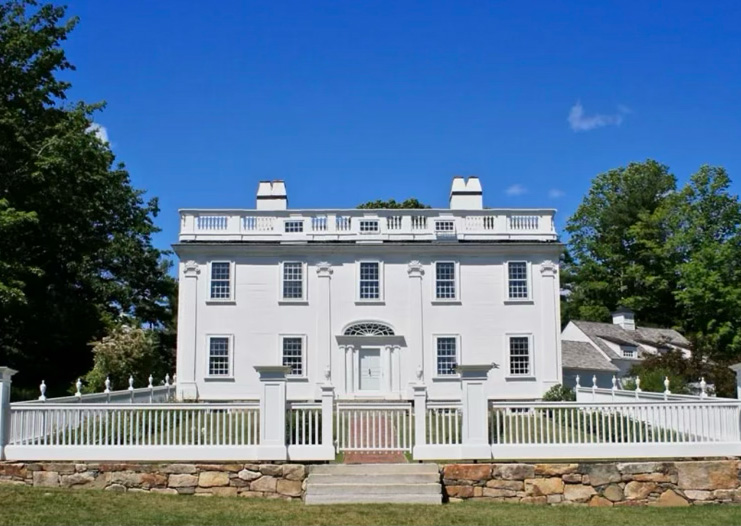
In the late-18th century, Federal homes with high-style details were all the rage in cities like Boston, but rare in Maine. Judge David Sewall was among the first locals to embrace the genre, erecting Coventry Hall — named for the English city his ancestors hailed from — in York Village in 1794. With its sleek Ionic pilasters, intricate door surrounds, and massive rooftop balustrade, the grand home befit Sewall’s station — he was a classmate of John Adams at Harvard Law School and was appointed judge for the United States Court of the District of Maine by George Washington in 1789 — and the company he kept. (President James Monroe visited in 1817.) Likely designed by architect Thomas Eaton, and extensively restored by preservation-minded owners in 2007, the pearly white home remains (quite literally) a shining example of the Federal style in Maine.
David Sewall was the son of Samuel and Sarah (Batchelor) Sewall, his father’s second wife, and he was born October 7, 1735 in York. His family was descended from one of the earliest as well as officially distinguished families of Newbury, Mass, and he carried on during his active lifetime the best traditions of his ancestors. He entered Harvard College at the age of sixteen and was graduated in the class of 1755. In 1760 he was admitted to the Bar and he rapidly rose to leadership in legal circles in the Province. He entered official life early and was a Councillor of the Province 1776-1778-1780 and under the government of the United States was a Presidential Elector in 1788. He was appointed to the Provincial Court in 1777 and in 1789 President Washington appointed him Judge of the United States Court for the District of Maine, the first to receive this honor. During the twelve years that he held the office of Judge in the local court, he usually traveled his circuits on horseback. He was easily the first citizen of York in his maturer years and by general consent distinguished visitors to the State coming to York were always his guests. In town affairs he was actively interested in all matters for the advancement of its prosperity and his counsel in public concerns was always powerful during the sixty years of his adult life. He was deeply interested in the history of his native town and not only transcribed parts of the Province and Town Records but prepared an account of the Indian Massacre at the Centenary of the tragedy. He also left a large collection of original letters from prominent persons of his time, including a number from George Washington, and reminiscences of his long experience in the Courts and with members of his profession. Jonathan Sayward wrote in his Diary under date of July 31, 1794: “Judge Sewall, his grand new house was raised it will when finished be one of the grandest billt in the county.” This beautiful Colonial mansion stands today as one of the finest examples of that type of architecture and is a visible monument to his successful career. In memory of his ancestors who came from Warwickshire he gave it the name of Coventry Hall.
The fifth President of the United States (James Monroe) and the sponsor for the famous Doctrine which has become a national policy, was the first chief executive to visit York. Accompanied by a suite he left Washington in June 1817 for a visit to the northeastern states. He reached Portsmouth in the middle of July and on the fifteenth he crossed the Piscataqua into Maine. At his arrival on the east bank of the river he was met by a committee, of which a son of York, William Pitt Preble, Esq., was a member, and was by them welcomed with an address of “classical elegance.” The President replied to this extemporaneously, and was then conducted to his carriage and proceeded to York under an escort of cavalry, followed by officers of the militia in uniform and citizens on horseback and in carriages. President Monroe was also met by the Committee of Arrangements at the head of which was the venerable and respectable Judge Sewall of the United States District Court, now in the eighty-second year of his age. The Venerable Judge in a short and appropriate address, for himself and in behalf of the citizens of York bade him a hearty welcome, to which the President made an affectionate reply. The President and suite then proceeded with the Judge, accompanied by the Committee of Arrangements, to his house where they sat down to an excellent breakfast. At nine o’clock the President again commenced his tour, preceded by cavalry and general officers of the division and followed by a large cavalcade of officers and citizens on horseback and in carriages.
Judge Sewall also played a role in the location of the current Town Hall - see #48.