17th Century | 18th Century | 19th Century | 20th Century
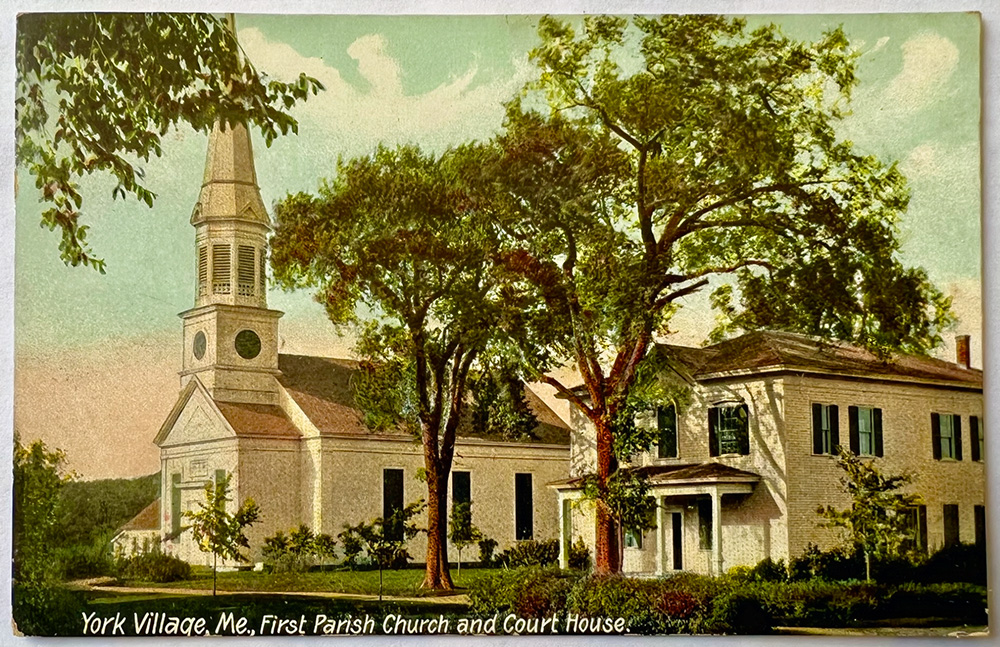
The location of the first building erected for church purposes in York in 1636 was probably on the land now covered by the Emerson-Wilcox house across from Town Hall. These were typically called “Meeting Houses” where church was conducted but also town business. The second Meeting House of 1667 was located near Meeting House Creek. The third Meeting House was built in 1712 and thought to be where the First parish Church is now located. It lasted thirty five years.
At a parish meeting held on April 19, 1744, it was “Voted that there be a Meeting House built in this parish, by subscription, of seventy feet long and fifty feet wide, and twenty-five feet stud, and be set in the same place where the old Meeting House now stands becoming the fourth Meeting House. As Parson Moody was part of the Louisburg Expedition (a failed British attempt to capture the French Fortress of Louisburg, now known as Cape Breton Island), the construction lagged. Again on March 25, 174 7, the parish voted to build a new meeting house, adding to the former vote “that there shall be a Steeple Built at one End of the same.” At the same meeting they voted to tear down the old meeting house and use “such of the stuff and materials as will answer” in constructing the new building. T he oversight of this work was probably the last important labor undertaken by Parson Moody, as he was then 70 years old, but he lived to see its completion, a few months before his death.
In 1838 and 1839 the building was remodeled within and without. The galleries, elders’ seats, high pulpit and higher sounding board were removed, and more modern furniture substituted. The entrance, which had been on the street side, was changed to the end facing the court house (current Town Hall).
For over forty years this renovated building answered the purposes of the parishioners, but in that period the younger generation had outgrown the severe simplicity of its appearance and demanded further modernization. In 1881, a committee was appointed to remodel exterior and interior to meet these views. The building was turned at right angles to its former position so that the tower and steeple faced the road, along with being moved back twenty feet. The main entrance was constructed through the tower, and the one in the opposite end reserved for the minister. This movement and new orientation was accomplished without accident, but it was deemed wise to reconstruct the old tower and steeple. A new design for the steeple by a Boston architect was adopted, calling for a greater height, about twenty feet, than the old one. The interior underwent as great an alteration. The pulpit was transferred to the end farthest from the main entrance to the north end, with the organ and choir seats to the left. The old singers’ gallery was among the missing relics of former days, when the rejuvenation was finished. At the rededication which occurred shortly after, General Joshua L. Chamberlain, ex-Governor of Maine, delivered the historical address.
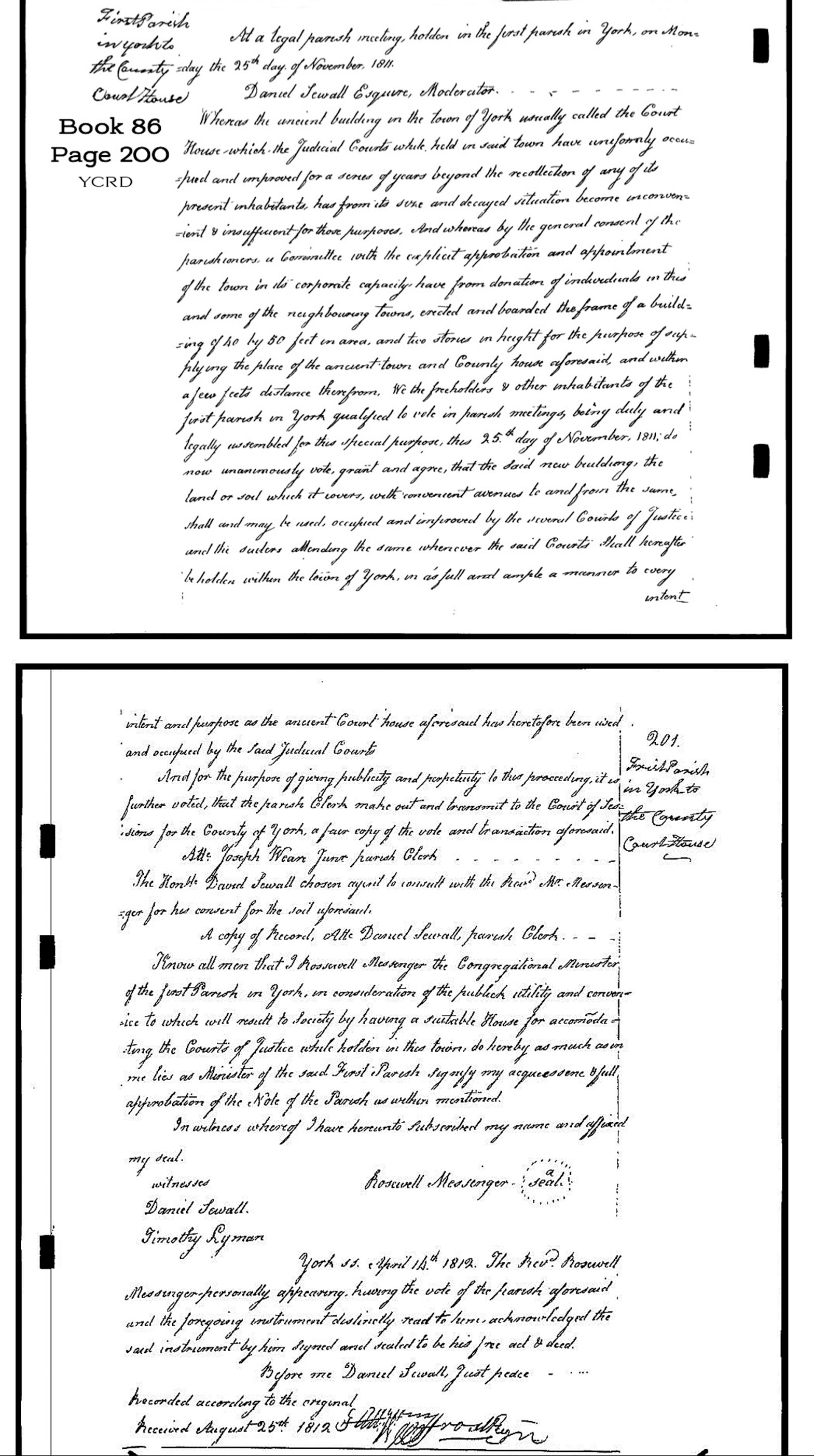
In 1811, the building of a new courthouse was begun (which is now the Town Hall) to replace the decaying 1734 Court House. At a meeting of the First Parish on November 25, 1811, it was unanimously voted: “Whereas the ancient building. called the Court House which the Judicial Courts while held in said town have uniformly occupied and improved for a series of years beyond the recollection of any of the present inhabitants has from its size and decayed situation become inconvenient and insufficient for those purposes, And whereas by the general consent of the parishioners a Committee with the explicit approbation and appointment of the town in its corporate capacity have from donations of individuals in this and some of the neighboring towns erected and boarded the frame of a building of 40×50 feet in area and two stories in height for the purpose of supplying the place of the ancient town and county house aforesaid and with a feet's distance therefrom, We do now unanimously vote, grant and agree that the said new building, the land or soil which it covers with convenient avenues to and from the same shall and may be used, occupied and improved by the several Courts of Justice and the suitors attending the same whenever the said Courts shall be holden within the town of York .”
In a town meeting held on May 6, 1812, Elihu Bragdon as agent was instructed "to sell the old court house and have it removed as soon as the new Court house shall become so far finished as that the Courts can be conveniently held in it and that the money from the sale be appropriated towards finishing the new Court House". According to George Alexander Emery, the Old building was moved to the low land belonging to the parish on the other side of the street by its new owner, Josephus Howard, who occupied it as a dwelling house and harness and saddlery shop.
Judge David Sewall in the late 1700's wanted the new Court House (now the Town Hall) to be where it is today. In trying to make the new Court House happen, he had elm trees planted before the building was ever started to indicate where he thought the Court House should be located. About 30 years later after planting, the building that is now the Town Hall was built. The elm trees stood in front of Town Hall for centuries and likely succumbed to Dutch Elm disease sometime after 1930.
In 1832, the Court House was moved to Alfred and York was no longer the shire town (seat of government). From 1832 to 1872, the building had a tenuous existence as a hearse house and a school house. By March of 1869, the building was falling into disrepair and the town purchases the Court House to become the Town Hall. In 1873 - February 23, 1874, Nathaniel Marshall dedicates the refurbished Town Hall. Marshall helped to raise money for the refurbishment via the York Association. The first floor was raised two feet, added a stage to the second floor and added a portico to the front of the building. This led to numerous social events at Town Hall including plays and basketball games on the second floor.
Once again in 1894, the Town Hall was modified. February 22, 1894, rededication of Town Hall after 20 feet was added to the back of town hall and a brick fire proof vault was added.
On Aug 5, 1902, for the 250th celebration of York, a stage is placed behind the town hall and Samuel Clemens (aka Mark Twain) is one of the speakers at the gathering. He had summered in York that year.
Dec 13, 1929, the town hall was falling into disrepair and condemned in the fall. An article in the paper complains about what will they have for entertainment for the winter. No movies, no plays, no basketball. Feb 7, 1930, an editorial was written about where the town hall should be located, however, it is apparent the start of the Great Depression in 1929 impacted the plans to build a new town hall. On Nov 30, 1934, the main hall buttressed and strengthened with steel beams and the brick vault removed. Money to refurbish came from the Federal Emergency Relief Administration (established by FDR in 1933) to contribute $2000 and the town $1000. It was expected to employ 8 men. In 1994, the Long Range Planning Committee determines that replacement or renovation of Town Hall is seen as a priority. Multiple attempts at a new Town Hall are proposed over the decades, with all being located elsewhere than the current location and each time is voted down by the citizens. A new location was thought to be needed due to the belief that the Town Hall was on First Parish Church property. A review of old records indicated that this was not true and in 2020, a new deed that showed the property around Town Hall now belonged to the town. Voters approved the renovation and addition to the Town Hall in May 2022. One of the challenges of renovation was to relocate Town Hall offices during construction and renovation to a temporary town hall. In January 2023, a temporary town hall was set up at #4 Marketplace Drive. Construction began on April 13, 2023 and the new Town Hall opened on June 26, 2024.During renovation of the Town Hall in 2023-2024, archaeological monitoring was performed in the event that remnants of the 1734 Court House or any privies were disturbed/located. Small artifacts were found during digging the foundation (unrelated to the aforementioned but related to the school house) for the addition. Additionally, two canon bases were found while digging the storm drain line in front of the Town Hall. These were canons received from the shipyard in the late 1800’s and their eventual fate was to be turned in for scrap metal for the World War II effort.
 Who was Rev. Joseph Moody? Look closer at the 18th Century preacher behind the handkerchief
By James Kences
"He was a Person very remarkable for a publick spirit. He had an uncommon concern for the whole World." This was how Joseph Moody was described by those who knew him, words written shortly after his death in March 1753. "School Master, Clerk, Register, Magistrate, and Minister," the list of offices he held during his lifetime, inscribed upon his gravestone in the Second Parish Cemetery does indeed reflect a man who was possessed of a public spirit, and reveals to us an individual who is deserving of an appreciation far beyond what the unfortunate caricature "Handkerchief Moody" would ever suggest.
The incident of the autumn of 1738, in which Moody appeared before the congregation with his face concealed by a kerchief, and the period of withdrawal that followed, has over time become the basis of historical memory and local mythology. Different explanations have been offered for why this occurred and range from grief over the death of his wife two years earlier, to overwork, and what moderns might term as burnout. Regardless of the immediate causes, Moody had faced multiple stresses from early childhood. Some of these will now be briefly outlined here as a start at a reappraisal of his story.
He was the son of the Rev. Samuel Moody and his wife, Hannah Sewall, and was born in the opening years of the 18th Century, on May 15, 1700. Samuel Sewall, the uncle of his mother, recorded the event in his diary on that day: "Cousin Moody comes thither and tells me of his son born that morn when the sun about 2 hours high." Strangely, Sewall's own father died at the very same time.
In 1708, in the midst of the decade-long war, Joseph Moody accidentally shot and killed 11-year-old Ebenezer Preble with a pistol. Though it may only be a coincidence, but still curious, the two oldest dated gravestones in the Old Burying Ground in York Village are those of Lucy Moody, Joseph's infant sister, from 1705, and Ebenezer's father, Abraham Preble, dated 1714.
How does a child deal with such a trauma, especially the child of a minister who would be urged constantly to struggle with his conscience? At age 11, Moody left the town to attend school in Cambridge near Boston, and next, was admitted to Harvard College, where he graduated in 1718. Two years later in 1720, after his return to town, because of the survival of the diary that he kept, a unique window into his world exists that provides insights into his personality.
Another Indian war threatened in August 1720, but this conflict would not be formally declared until the summer of 1722. Popularly known as Dummer's War, fighting would continue for more than three years. This was the time of the famed Norridgewock expedition of August 1724, formed predominantly by York soldiers under the command of Johnson Harmon and Jeremiah Moulton.
"Capt. Harmon recovered near 30 scalps among which the Fryar's," Moody reported. The friar he mentioned was the French Jesuit Sebastian Rasle, who was widely believed to have provoked the war through his encouragement of violence. But Indian war was only one of the dangers the town confronted, the other, was smallpox, as an outbreak struck numerous households, including Subella Bragdon's, who died.
"I lived for more than a month [in her house] until her sickness," Moody wrote in his diary in early June of 1722. She was buried in the Old Burying Ground and represents one of a handful of persons there for whom the cause of death can be determined with a degree of certainty. Only a few feet from the Bragdon grave are situated the burial places of Capt. Lewis Bane and Capt. Abraham Preble.
"Capt. Bane was buried with military honors, many people being present," Moody wrote on June 26, 1721. During the days prior to the captain's death, the young minister had helped him prepare his will, and with two other men, fixed his signature to the document. Bane was a town leader, who had been elected to the Massachusetts legislature as recently as 1718. The man who was often chosen as an alternate candidate to represent York in Boston, elected in 1719, was in fact Capt. Preble.
Preble had died in March of 1724, rather suddenly it seems, and only days after being elected as one of the five selectmen at the annual town meeting. He was, what might be termed a plural office holder, and that meant, that all at once, the multiple offices he held became vacant. This situation would have been serious at any time, but especially at the height of a military emergency.
Two offices, that of town clerk and York County Register of Deeds, were taken up by Joseph Moody. This was in addition to the other responsibilities he then held as school master and as assistant to his father in the ministry – and he assumed all of this work when only in his mid-20s. The demands placed upon him, and how he felt conflicted by the experience, was expressed in a diary entry of May 18, 1724.
"I got up early and copied one document before school. I am too much elated by my office, and therefore in the midst of my writing, I go miserably astray (from God)." The son of Reverend Samuel Moody was compelled to meet all of his father's expectations but lacked his father's temperament. The diary reveals a man who enjoyed socializing, but who always felt guilty over his behavior, as if somehow being who he genuinely was, must have been wrong. There perhaps lies the source of his personal tragedy.
York historian James Kences writes "York in American History," a monthly column that appears in The York Weekly.
Used with permission of James Kences