17th Century | 18th Century | 19th Century | 20th Century
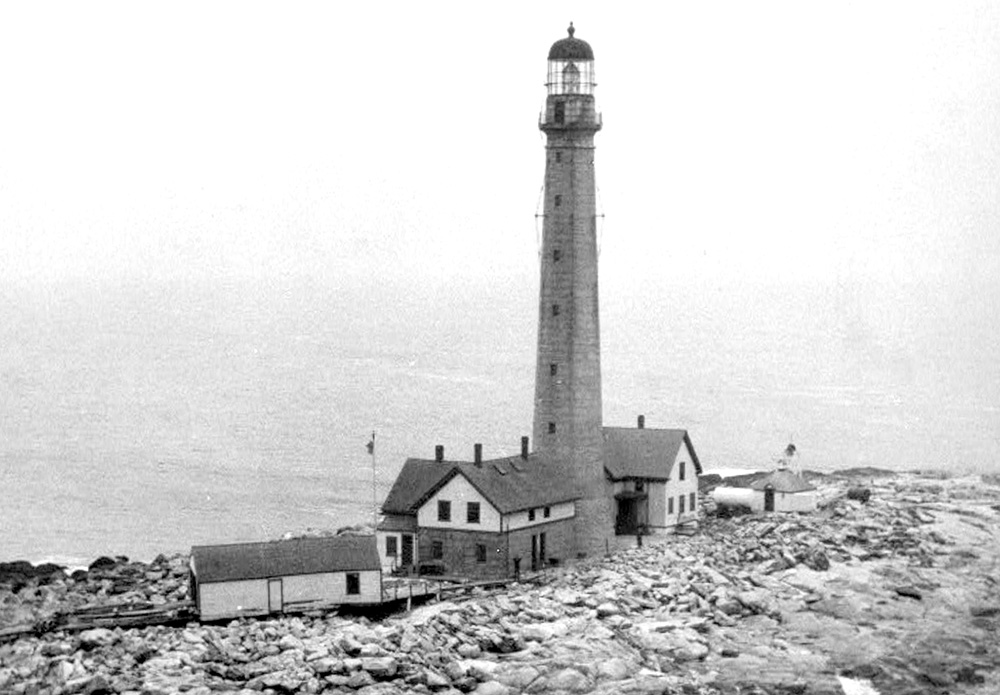
Boon Island is one of the most isolated stations off the Maine coast, located six and one-half miles from York. The lighthouse was built here in 1811, having been authorized by President Madison. The tower is constructed of granite, of a conical design, to a height of one hundred and thirty-three feet. Boon Island has been the scene of many shipwrecks.
The tallest lighthouse in Maine, Boon Island Lighthouse stands at 133 feet tall on a barren, storm-washed rock pile off the coast of York. Its first granite tower was built in 1811, however it was destroyed in a storm in 1832. The current version was built in 1855 and features a dome-covered beacon.
In the summer of 1682, a coastal trading vessel, the Increase, was wrecked on the rocky ledges of barren Boon Island. The four survivors—three white men and one Indian—spent a month on the island, living on fish and gulls’ eggs. One day the men saw smoke rising from Mount Agamenticus several miles away, so they built a fire in response. The Indians at Mount Agamenticus saw the smoke from the island, and the stranded men were soon rescued.
The most famous incident in the island's history was the wreck of the British ship Nottingham Galley on December 11, 1710. The survivors struggled to stay alive for over three weeks, finally resorting to cannibalism. The harrowing story was fictionalized by Kenneth Roberts in his novel Boon Island. In recent years cannons have been located in about 25 feet of water that are believed to have been on board the Nottingham Galley.
In 1797, General Benjamin Lincoln, local lighthouse superintendent, met with the Boston Marine Society to discuss the building of an unlighted beacon on Boon Island for the safety of local fishermen and coastal traders. Construction began the following July. The first wooden tower was finished in 1799. It survived until 1804, when it was destroyed by a tremendous storm. A stone day beacon was erected in the summer of 1805. Three of the workers involved in erecting the tower drowned when their boat capsized as they left the island.
In June 1811, General Lincoln recommended a lighthouse on Boon Island. The tower, completed by that winter, exhibited a fixed light 32 feet above the water. The first keeper, after witnessing the vulnerability of the low island (14 feet above sea level at its highest point ) to storms, left after only a few weeks.
Capt. Nathaniel Baker became keeper in 1846. The schooner Caroline was wrecked on the island in the same year, and Baker rescued the crew. Despite his heroism, Baker was dismissed as keeper in 1849 and replaced by John Thompson, who had been dismissed earlier. In those days lighthouse keeping jobs were frequently given as political favors.
The present lighthouse was constructed in 1854, along with a new dwelling. The stone tower, built of granite supplied by Joseph W. Coburn of Boston, is 133 feet high -- the tallest lighthouse in New England. It is 25 feet in diameter at its base and 12 feet in diameter at the top. An additional $19,973 was appropriated in 1854 for "procuring illuminating apparatus, and completing the light-house tower and buildings..." The new second-order Fresnel lens went into operation on January 1, 1855.
A Boon Island legend concerns a keeper of the nineteenth century who arrived at the island with his new bride. After a few happy months the keeper fell ill and died during a gale. His wife realized the importance of keeping the light and, despite her grief, managed to climb the tower's 168 stairs and light the lamp for the duration of the storm, which lasted several days. Soon after the storm ended local mariners noticed the lack of a light at Boon Island. They landed to investigate and found the young woman wandering the rocks aimlessly, driven mad by grief and exhaustion. The young woman supposedly died a few weeks later.
According to Robert Ellis Cahill's book, Lighthouse Mysteries of the North Atlantic, a ghost has been seen by many people on Boon Island. The ghost is described as "a sad faced young woman shrouded in white." This phantom has been seen by keepers and fishermen, wrote Cahill. Some say the woman in white is the ghost of the mistress of the captain of the Nottingham Galley, while others claim she is the young bride whose husband died on the island one winter.
Bob Roberts, a Coast Guard keeper in the early 1970s, says the other keepers asked him if he believed in ghosts when he first went to Boon Island. Roberts laughed at the time, but strange events on the island soon had him thinking differently. One time, he and fellow crewman Bob Edwards were off the island fishing, and they drifted too far from the island to make it back in time to turn the light on before dark. There wasn't a person on the island, but somehow the light was glowing brightly by the time the keepers returned.
The great blizzard of 1978, an early February storm, one of the worst in New England history, flooded the 1899 keeper's house to the ceiling of the first floor and scattered boulders around like they were pebbles. A large fuel talk floated right through the house from east to west.
The Coast Guard keepers (Kirby Eldridge and Leo Berry) were forced to take refuge in the tower. The following day the keepers were removed by helicopter. It was estimated that $100,000 worth of damage was done at Boon Island by the blizzard of ’78. Shortly after the blizzard of '78, the light was automated. In 1993, the second-order Fresnel lens was removed and replaced by a modern optic.
The origin of the name of the island is unknown. However, according to some writers, including the popular New England historian Edward Rowe Snow, the island’s name stemmed from the practice of local fishermen, who left barrels of provisions on the island for the benefit of shipwrecked sailors. That would certainly have been a “boon” in such circumstances.