17th Century | 18th Century | 19th Century | 20th Century
The placement of a lighthouse on the Nubble had been recommended by many local mariners since 1807. An 1837 proposal was rejected on the grounds that there were already enough lights in the vicinity. Even after the wreck of the bark Isidore in 1842, north of the Nubble near Bald Head Cliff, it still took nearly four more decades before the lighthouse was established.
By act of Congress, March 3, 1837, $5,000 was appropriated for a lighthouse on “York Knubble,” but this fund was not used. In 1854, $1,065 out of a second appropriation of $5,000 was expended at this site. On July 31, 1876, $15,000 was appropriated, the greater part of which was expended. The buildings were completed in June, 1879, and on July 1, 1879, a fourth-order fixed red light was in operation.
The 41 foot cast iron tower is lined with brick. At first, the lighthouse was painted reddish-brown, showing a fixed red light through a fourth-order Fresnel lens. The lighthouse still exhibits a red light, but the tower has been painted white since 1902. The distinctive red oil house was built in 1902, and the walkway connecting the lighthouse to the keeper's house was added in 1911. The station originally had a fog bell operated by automatic striking machinery. The skeleton frame bell tower was replaced in 1911 by a white pyramidal tower, itself torn down in 1961.
Nathaniel Otterson was the first keeper. His replacement, Brackett Lewis, formerly assistant keeper of Whaleback Light, was keeper from 1885 to 1904, the longest stint of any keeper at the Nubble. While Lewis was keeper, his daughter, Hattie, married Charles Billings in the lantern room. The next keeper, William Brooks, previously at Boon Island and White Island, picked up extra cash by ferrying sightseers and fishermen to the island for ten cents apiece. This was not appreciated by Brooks' superiors, and the keeper soon “resigned."
Like many lighthouse families, they kept a cow and chickens on the island. They also went duck hunting and fishing to supplement his family’s food supply. Lobsters, crabs, and mussels were also plentiful near the island.
During World War I, the keepers were joined on the Nubble by military personnel who kept watch for enemy submarines. The light was dimmed on some nights and extinguished on others, to confuse “possible submersibles" in the vicinity.
The first indoor toilet was installed, and electricity came to the Nubble in 1938. During World War II, the light was extinguished and a lookout tower was built on the island. A contingent of Coast Guardsmen kept a 24-hour eye out for German U-boats. A U-boat sighted in 1943 just to the east of the Nubble was subsequently sunk by a depth charge southwest of Boon Island.
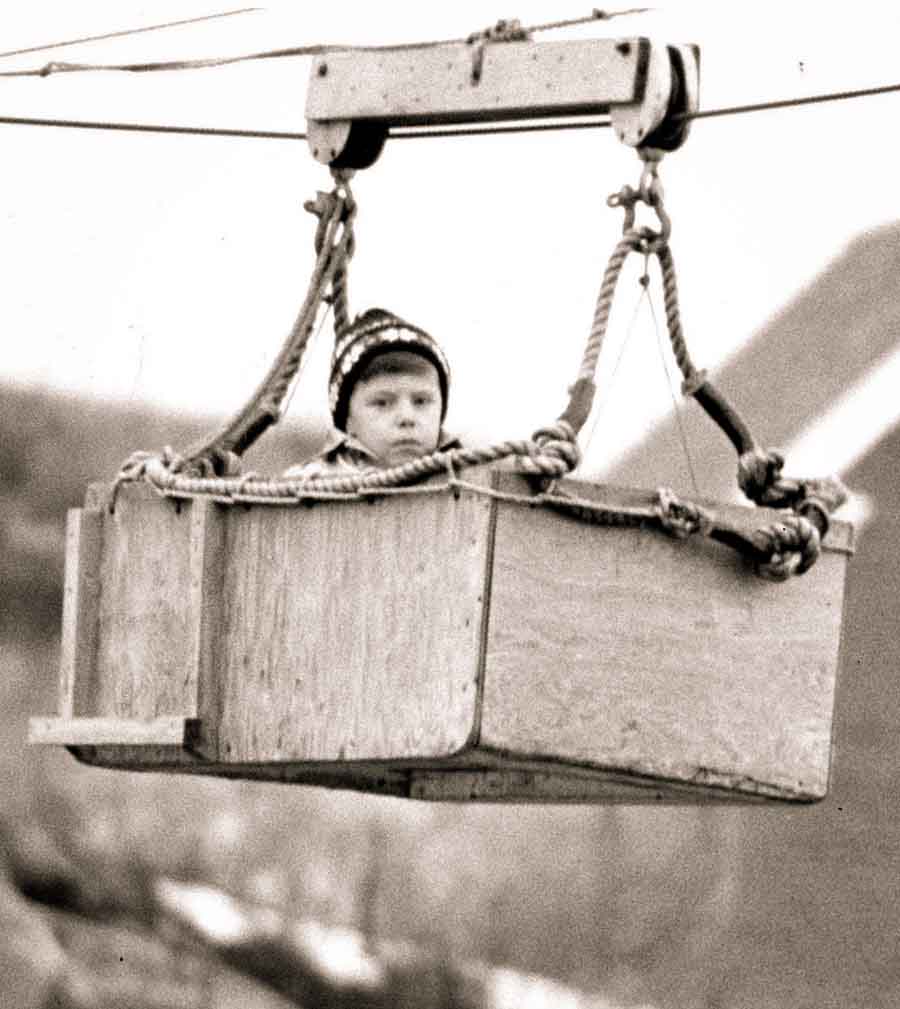
The bucket suspended from a cable from the mainland to the island, installed in the 1950s, was not intended for the transport of people; it was intended for the transportation of supplies. The keepers at the time, the Winchesters, used it creatively. When they returned to the island after Wendianne was born, P. Jaye and her baby went across in the bucket.
David and P. Jaye Winchester got into the habit of putting their son Ricky in the bucket each morning to send him on his way to school. P. Jaye later said that she thought the bucket was safer than the boat. "There were a lot of mornings Rick would not have been able to go to school in that boat (because of) the swell. You needed to bring the boat in at a slant. You had to count the waves to get up on those rocks. Otherwise, you would have been swamped. I felt very safe (in the bucket)," she said.
In 1977, when NASA sent Voyager II into space to photograph the outer solar system, it was also loaded with artifacts designed to teach possible extraterrestrial civilizations about our planet. One of the images it carried was a picture of the Nubble Light.
The light was automated in 1987 and the last Coast Guard keeper, Russell Ahlgren, was removed. A crowd of more than 300 spectators witnessed the automation ceremonies on July 13 in dense fog. The station was leased to the town of York in 1989.
In 1989, the town received a grant from the Maine Historic Preservation Committee for restoration work on the keeper's house. Two second story windows were removed and replaced by a larger window resembling the one originally installed.
In November 1997, the people of York voted overwhelmingly to allow the town's selectmen to "adopt" the lighthouse. Under the Maine Lights Program coordinated by the Island Institute, the lighthouse officially became the property of the town in 1998.