17th Century | 18th Century | 19th Century | 20th Century
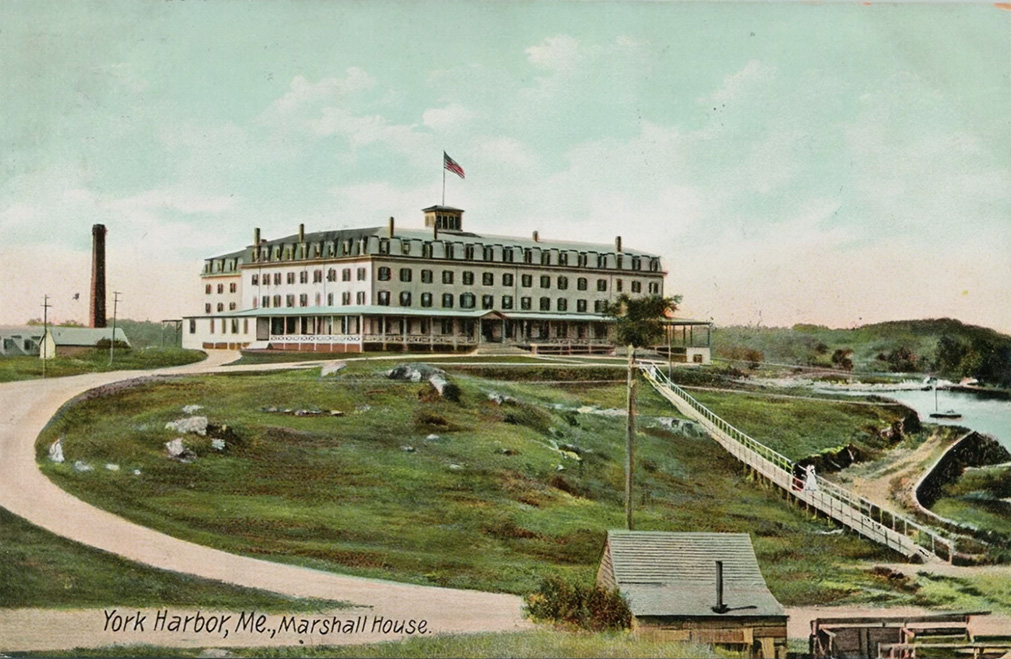
The first Marshall House was built by Nathanial G. Marshall in 1871. Nathanial was born in 1812, the son of John and Eunice Marshall. His early life was one of tragedy. His father mysteriously disappeared when he was five years old and his mother died just two years later. He was raised by his maternal grandparents, the Grants, until the age of fifteen when, following their death, he was forced to go out on his own. Handicapped by the lack of a hand, he was unable to compete successfully with others in manual labor and thus, was forced to seek advancement in other ways that led to the development of his natural mental abilities. In early life he had been employed as a clerk in local stores, and when he had reached manhood went into business for himself. He taught school and clerked at a store in York Village during the summer months until he had acquired sufficient capital and credit to go into business for himself. For most of his life he was active in local government holding no less than ten different positions over a 38 year period including Town Sheriff, Town Treasurer, Maine State Senator and Town Clerk.
With all the burden of the Marshall House project, he took upon himself the clerical drudgery of the office of Town Clerk as a means of securing to the town an orderly compilation of its scattered records and their preservation for future generations. In the few years that he held this office he transcribed the early town books, which had been written without sequence on any convenient page. He restored them to their proper places in a beautiful copy filling two large folio volumes of over five hundred pages each, a task which must have taken several years to complete. Nathaniel G. Marshall passed away on February 17, 1882.
The Marshall House was a grand hotel built on Stage Neck at the mouth of the York River. Local resident Nathaniel Grant Marshall acquired Stage Neck in 1871 and built the hotel on the cliffs. The Marshall House attracted many summer tourists and began an area of hotel development and summer resorts in York Harbor. The first Marshall House was a four story frame building with wonderful verandas overlooking the harbor and York harbor Beach. This was an era of great hotels in York. York’s unique summer tourist business was flourishing. Marshall doubled the size of the hotel in 1881.
Over the years, the first Marshall House was enlarged three times until it could accommodate 325 guests. An 1876 brochure describes the House as offering : “spacious parlors, a large cool dining room, reception and reading rooms. Suites and single rooms are perfect in themselves, carpeted and furnished tastefully. The bathing facilities are excellent.”
The rates were $2.50 to $3.00 per day for rooms ($3 being the equivalent of about $91 in 2025) and $10.00 to $18.00 per week for board. In 1876, unskilled or common laborer earned about $1 per day and skilled labor about $500 per year so the Marshall House was really only for the wealthy. It was the largest hotel complex in York. Its facilities included a telephone and telegraph office, a livery stable, a barber shop, billiard room and dance hall. The Marshall House’s own four horse drawn “bus” made two round trips daily to Portsmouth.
On January 25th, 1918 the first Marshall House burned to the ground in a fire that was said to have been visible from as far away as Portland, Maine. This led to the development of the York Fire Department. The building burned flat, though only the caretaker was inside at the time of the fire, as the hotel was preparing for the summer season. The hotel was originally a four-story wooden resort but was replaced with a red brick building in 1918. After the fire, Frank D. Marshall built a “fireproof” four story brick hotel on the same site.
The second Marshall House was larger and more opulent in its style and appointments. The complex included the hotel, cottages, a beach, heated pool, bath houses, two tennis courts and boat docking facilities. There were also large garages to house the guests’ limousines and facilities for the chauffeurs. The closing and sale of the second Marshall House complex marked the end of the era of grand hotels in York. The Marshall family operated the hotel until 1958 before selling it to the Tufts family of North Carolina.
In 1971, a group of York Harbor residents led by Alexander Warwick, raised $616,000 and obtained a bank loan of $1,250,000. Known as the “Stage Neck, Inc.”, the group bought the Marshall House Complex except for the tip of the island which was retained by Richard Tufts, who was the last owner of the Marshall House. Stage Neck, Inc., led later by Charles L. Harding, demolished the complex and conceived a plan for forty condominium units and the Stage Neck Inn as we see them today. The Inn was owned by the Warwick family until 1981 when it was sold to Hal Field and Mark Foster.