17th Century | 18th Century | 19th Century | 20th Century
In 1673, York was counseled by the Court for not providing a school and schoolmaster for the education of youth according to law. However, providing education when when significant walking distance exists for the children is challenging.
The architecture and construction of the schoolhouses of Colonial days were small, barnlike affairs of one story and contained only one room. At first they were rarely finished inside and the open fireplace and log fire were the only means of rendering them habitable. The furnishings would hardly be recognized at the present time as belonging to a school. The teacher usually sat in the middle of the room and the children were supplied with a sort of shelf or ledge attached to the wall and sat facing it with their backs to the teacher. The lighting, of course, came through window openings, rarely glazed at first and often covered with oiled paper through which a dull light filtered and made the schoolroom a gloomy place. At first the scholars were mostly young boys, as it was not considered desirable or necessary that the girls should receive an education or if it were conceded they scarcely ever proceeded beyond the elementary reading, writing and arithmetic.
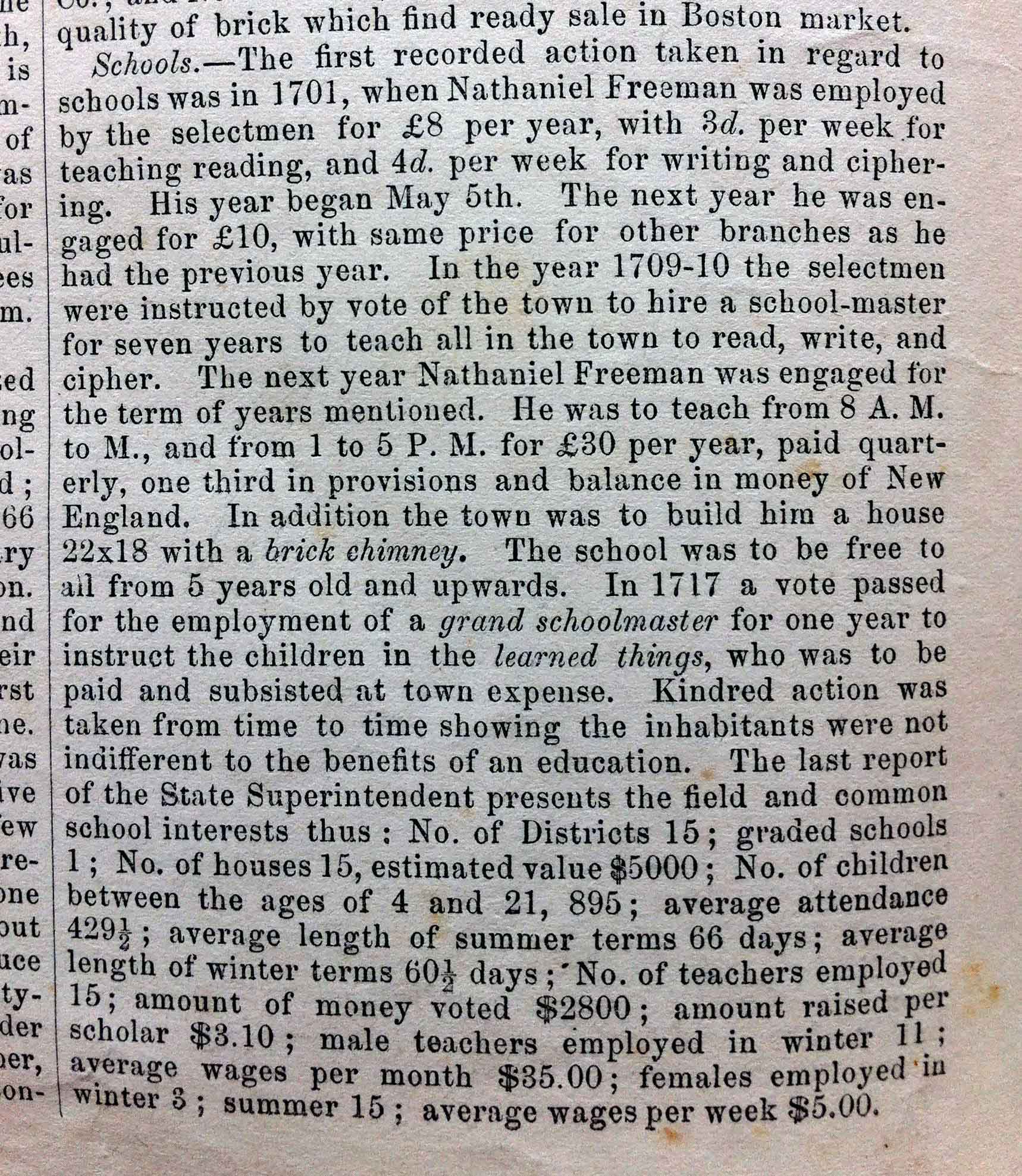
Women were an important element in the teaching the children of York. School teachers were a sort of public servants who went from town to town, as opportunity offered, and rarely were residents of the place where they were employed. In the early part of the 1800’s it was the custom to employ women teachers for the Summer terms and men for the Winter. Up to the middle of the 1800’s, the school districts, varying in number from seven in 1785 to fifteen in 1850, were under the direct supervision of local “agents,” residents of their district, and as a result there was no uniformity in methods of conducting the educational affairs of the town. In 1857 the schools had grown to accommodate over a thousand pupils and the necessity of some more efficient management over the fifteen districts was met by the election of Col. Luther Junkins as Supervisor of the Schools at a yearly salary of thirty dollars. He was a seasoned educator, having taught in one of the district schools for a number of years, and was interested in the subject of public education. In his first report, 1858, he stated that three hundred and seven out of eleven hundred children of school age, “never enter the portals of the school room,” and in the next year he gave a probable reason for this condition of affairs. He described the forbidding character and appearance of the schoolhouses, mentioning District No. 1 (York Village), in particular. “It is surrounded by everything that is gloomy,” he wrote, “within the partition walls of the hearse house, unlighted, cold and dreary, shut out from the light of the free sun.” Junkins was likely referring the current Town Hall which in the time after the move of the Court House in 1832, the building had several uses including a hearse house and a school.
Throughout the 1800’s, the school system in York gradually improved. Since 1890, York has had a Superintendent of Schools with direct charge of the entire educational system, under the town officials. As roads and transportation improved, the need for one room school houses declined and schools became centralized.