17th Century | 18th Century | 19th Century | 20th Century
by Nicole Waldron
The apple has become so closely associated with New England that many mistakenly believe it is native to the region. In reality, the familiar apple originated in Asia and made its way to Europe along early trade routes. When the Mayflower arrived in 1620, there were no sweet, round apples awaiting the hungry settlers in the meadows along Cape Cod Bay. Instead, the Pilgrims found only the small, sour American crabapple, which offered them little comfort. To remedy this, apple seeds and cuttings from England were requested, which were brought over on subsequent voyages of the Mayflower. Little fruit was produced, however, until the English settlers began to introduce hives of European honeybees to America in the 1630s.
The combination of imported honeybees and the rich marine soil along the rivers and coastline of Maine proved to be very productive for growing apples. By the late 1700s, varieties like the Black Oxford and the Baldwin had originated in Maine, and in the 1800s private and commercial orchards were a common sight in York and throughout the state.
George Emery, in his 1873 book, Ancient City of Gorgeana and modern Town of York, Maine'' explained of Cider Hill Road (Route 91): The apple-tree flourishes well, and bears bountifully in this town; so much so, that Cider-Hill has long been a name applied to a section in the northerly portion of the town.
Besides providing fresh fruit, the autumn bounty of apples was taken to local cider presses, to be processed into both non-alcoholic and alcoholic (hard) cider. Apples were even the source of popular social gatherings! Peelers were taken to neighbors houses for paring bees, where men operated the hand-cranked machines, and women sliced apples for drying. Dried apple slices were used to make applesauce or pies or for other culinary uses throughout the winter.
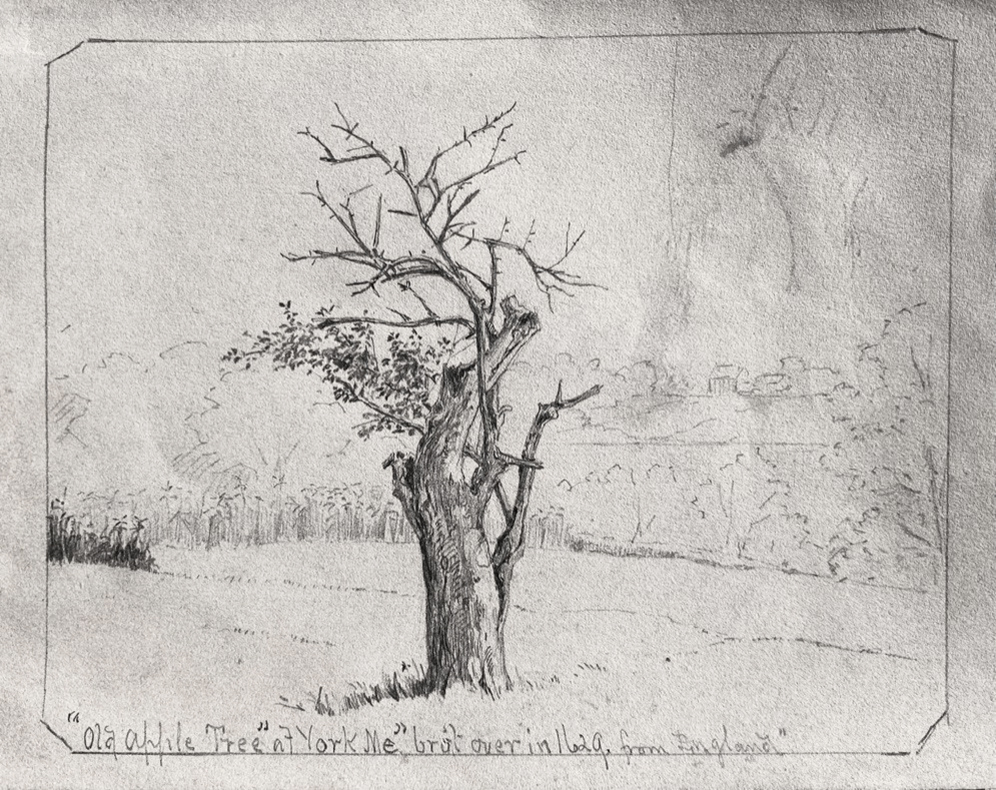
One particular early American apple tree was a famous living landmark in York well into the 19th century. Brought across the Atlantic and likely planted in the 1630s by Arthur Bragdon, admirers would travel over Cider Hill Road to a farm on the south side of Bass Cove to see it.
One such admirer was Sybil Warburton, who wrote in her 1897 paean to York, The Silent Watcher…
When I was a little girl my father brought some of its apples home to us. I remember him well as he stood there smiling and taking the apples, one by one, from his pocket, while he told us the story of the apple tree and answered our wondering questions. After that he took us to ride and showed us the tree with its half decayed trunk, and I wondered then if it knew that it had come so far and did not belong to the soil as did the other trees.
It’s uncertain whether the deteriorating tree met its end from a storm, or when the farmer who owned it tired of tree-tourists trampling his hayfield and chopped it down. Either way, the demise of York’s ancient apple made the national news, with articles appearing in newspapers as far away as Michigan and Colorado. The Old York Historical Society acquired a piece of the trunk of that famous old apple tree, where it is currently on display in the Remick Barn across the street from York town hall, centuries after its arrival here as a young English sapling.
Frederick Stuart Church, an illustrator based in New York City, and well known for his work with Harper’s Bazaar and Frank Leslie’s Weekly, visited York, Maine, in 1873. Church had been commissioned by George Alexander Emery (1821–1894) to illustrate his book, Ancient City of Gorgeana and Modern Town of York (Maine), published the same year.
Emery’s little volume served a sort of guide to the folklore of York, and was popular with the many summer residents visiting coastal Maine in the 1870s. Among the book’s sensational narratives about ghosts, shipwrecks, and murders, was the illustrated story of a very old apple tree that grew on the north side of the York River at Bass Cove. Church made a sketch of the tree (see fig.), and a woodcut version of the drawing appears in Emery’s book.
The "Old Apple Tree" had been planted in the 1600s by English immigrant Arthur Bragdon (1597–1678) on the farm he purchased at Bass Cove in 1637. Edible apples (as opposed to crabapples) are not native to North America, but the northern New England soil and climate are conducive to their growth. This lead Bragdon and other settlers to plant apple orchards that provided a valuable staple crop. The vicinity of Cider Hill Road, near Bass Cove, was known for the abundance of apples produced each year.
By 1873, when Emery’s book was published, the old apple tree was more than 200 years old. It had become a popular stop for visitors curious to see American colonial relics in the years leading up to the United States’ centennial celebration of 1876. The tree’s popularity with tourists, however, ultimately proved to be its demise. The fate of the tree was reported by newspapers around the country, including the Colorado Banner in Boulder on October 5, 1875: “An old apple tree at York, Maine, which was brought over from England in a tub in 1629 [but more likely after 1637, ed.], was cut down the other day by its owner, because the people trampled down his grass in going to see it.”
All that remains now of the famous tree is Church’s drawing, and a large section of the trunk preserved by Old York.