17th Century | 18th Century | 19th Century | 20th Century
A garrison house in the 1600s was a fortified private home built for protection against hostile attacks, typically by Native Americans or French forces. These fortified houses were often built on elevated ground, featured thick walls made of heavy logs, and included defensive features like trapdoors, overhangs on the second floor to provide better firing positions, and “portholes” for shooting at attackers or dropping scalding water or molten lead on attackers. One-story garrisons were for individual families, while two-story ones could serve as a community stronghold.
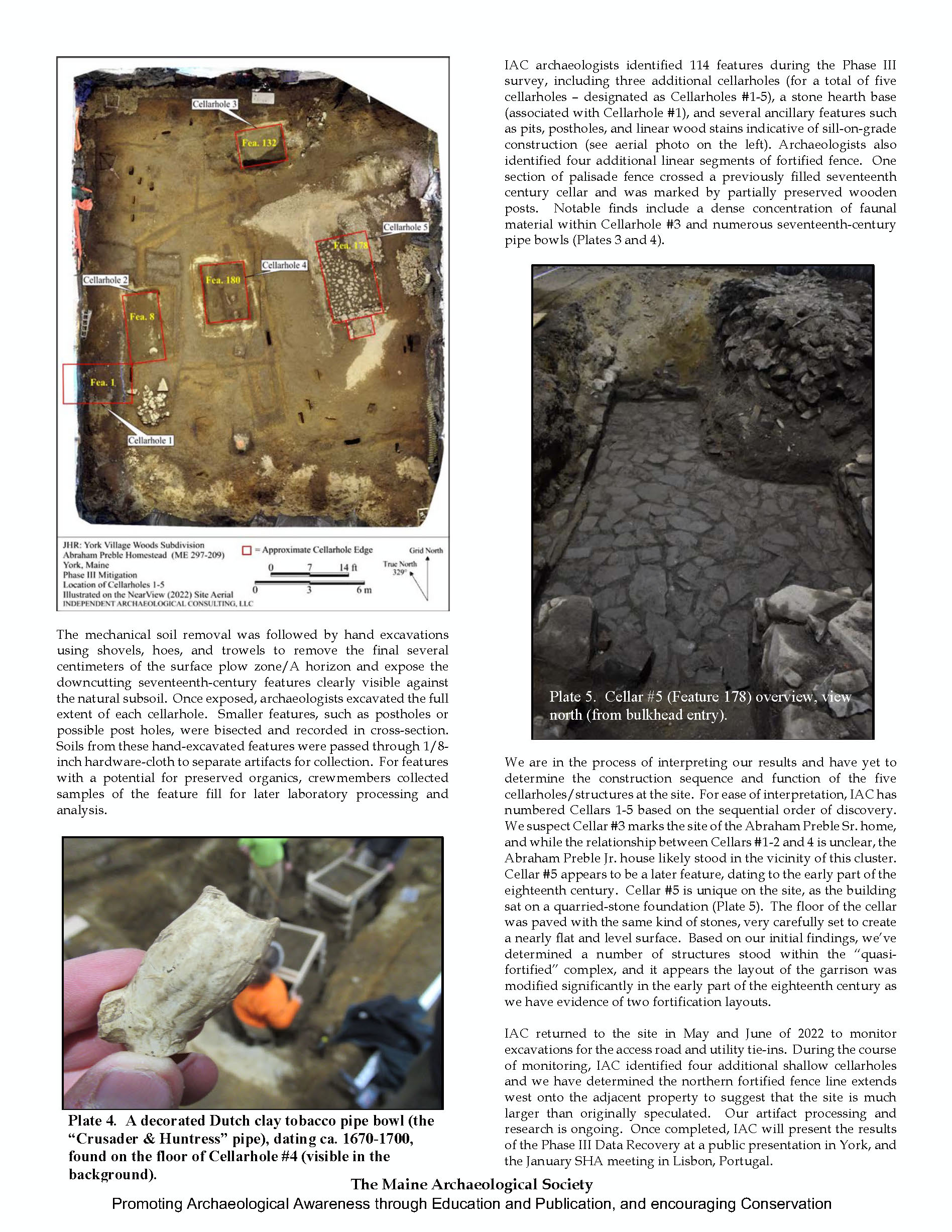
Garrison houses came into use as a result of the experiences of York during King Phillip’s War (1675-1678). York had twenty one garrison houses. Each was selected for their convenience as a rallying point for groups of settlers in different localities throughout York during conflict. In 1711, Governor Dudley of Massachusetts, directed a survey of all of the frontier garrison houses in Maine. The above is the list including how many families were to be in each garrison, how many were men, how many were soldiers and the total number of people.
The Preble garrison is number 8 on the above list and was located less than 1/4 mile west of Town Hall on York Street. An archaeological dig was conducted there and a marker shows it location. Abraham and Judith would become leading citizens of the town. Abraham was mayor of Gorgeanna in 1652, when the residents agreed to become part of Massachusetts and the community was renamed York.
Extensive archaeological excavations were carried out in the fall of 2021 and winter of 2022, prior to breaking ground for Woodstone at York Village. The work focused on the section of the property next to York Street. In one of the largest and most important excavations of a colonial site in Maine, archaeologists discovered the remains of the homes lived in by Abraham and Judith Preble and several generations of their descendants.
Archaeologists recovered thousands of artifacts – fragments of pottery and tobacco pipes, rusty nails, and other broken and discarded bits of the past. Abraham and Judith’s son, Captain Abraham Preble Jr. and his wife Hannah Sayward Preble and their family lived on the property during King William’s War (1688-1697) a destructive frontier conflict that pitted the English against the French and their Wabanaki allies. In 1692 the Wabanaki raided York. Archaeologists found traces of Abraham and Hannah’s home, as well as the palisade – the fortified wall that helped protect their family and neighbors from an attack that resulted in the death or captivity of many York residents and the destruction of most houses on the north side of the York River.
The last of the garrisons still existing is the McIntire garrison and is located on Cider Hill Road (Route 91), almost 4 miles from Town Hall. It stands on an elevated area overlooking the York River marshes. It is likely that the garrison houses served their purposes during the time of conflict but slowly diminished or vanished when conflicts ended.