17th Century | 18th Century | 19th Century | 20th Century
With all the preparations by Gorges for the management of his affairs here, in both provincial and local interests, he did not omit the one characteristic feature of English life — the Manor. It was the foundation of the land-holding system of the nobility and gentry of England, from time immemorial, and the bulwark of the social distinctions of English life. He transplanted this custom and inaugurated it in York.
When Capt. John Underhill was gathering material about 1636-7 relating to New England, which he published under the title “Newes from America” (1638), he made the following observation about the Bristol Plantation: “ Augumenticus is a place of good accomodation, it lyes five miles from Puscataway river, where Sir
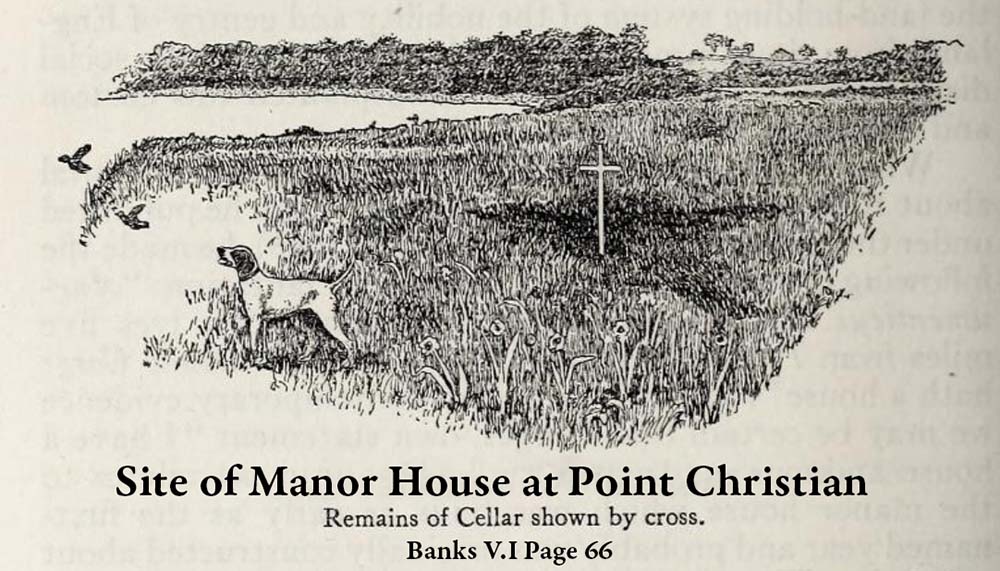
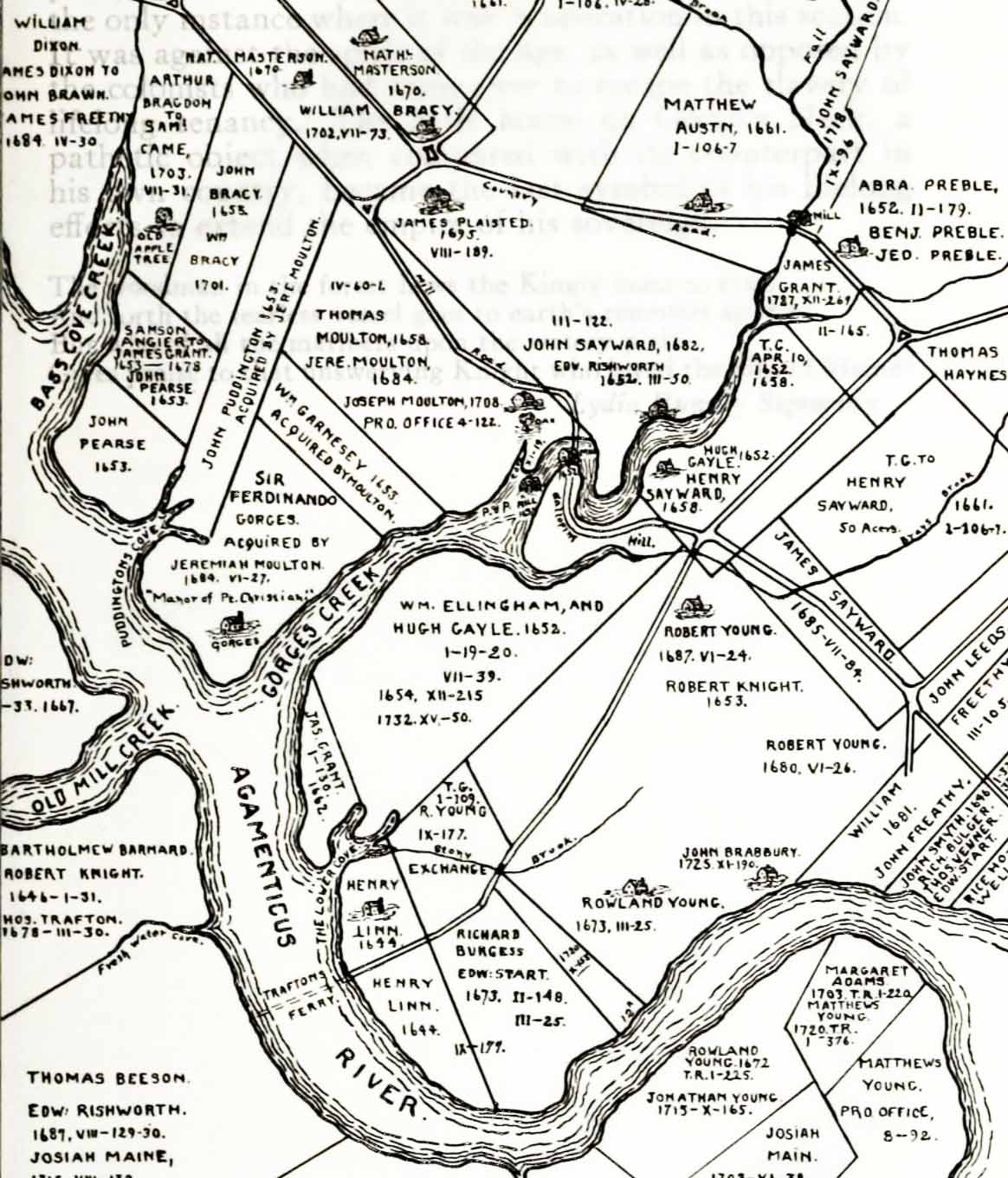
Ferdinando Gorge hath a house”. From this evidence we may be certain that Gorges’ own statement “I have a house and home there,” relates to the manor house which was built as early as the first named year and probably was originally constructed about 1634 when Thomas Bradbury came here as his representative and steward of his Manor of Point Christian. That such a manor existed, the only one known in Maine, is amply established on the authority of Gorges himself. In a deed to Francis Williams (1642) the conditions of tenure were thus specified: “To be holden of the said Sr Ferdinando Gorges as of his Honour, Mannour, Lordshipp, or house within the said Province of Maine commonly knowne by the name of Poynt Christian”. The location of Point Christian was on the north side of the York River on a tongue of land that extends out from Cider Hill. Just upriver from the I-95 bridge is a tidal river known as New Mill Creek (or Gorges Creek) and on the upstream side of that was Point Christian.
It may be supposed that the house may have measured twenty by thirty feet and possibly slightly larger. It was occupied at first by Thomas Bradbury and his family from 1634 to 1636 when he moved to Salisbury. Its subsequent tenants for the next four years, until the arrival of Thomas Gorges, are not known, and may have been unoccupied, unless it was used by William Gorges, Deputy Governor (1636). When Thomas Gorges (cousin of Ferdinando Gorges), reached here in the summer of 1640 to take possession, he found it “in a state of great dilapidation and its furnishings missing; — nothing of his household stuff remaining but an old pot, pair of tongs and a couple of cob-irons ’’. Cob-irons being the supports that were used to hold a roasting spit.
Such was the forbidding aspect of the Manor House which Thomas had expected to become the official residence of the Deputy Governor of Maine and the prospective Mayor of Agamenticus. It is expected to imagine a Manor House as a picturesque building with elaborate interior decorations and furnishings appropriate to its character. However close this one approached that conception in style and furnishings originally, we can assume that the young Deputy Governor, astonished at its neglected condition, promptly restored it to a habitable state as it was his home for the following three years. When he in turn left it in the summer of 1643, its subsequent occupancy is not known from any existing record.
On October 18, 1647 the Court ordered that Robert Nanney should have “an extent upon the house and land of Sir Ferdinando Gorges as two indifferent men shall judge it untill his debt of eleaven pounds starling be payd.” By this date, Sir Ferdinando had been buried for 5 months in England. This property was placed in the care of Edward Rishworth by Nanney as his agent. Nanney died in 1663 and Rishworth remained in technical control of the house and land, which he presumably managed for the benefit of the widow. In 1678 Massachusetts acquired by purchase the legal title to the Province of Maine, and thus became heir to the Gorges property in York and a party to this unsettled claim, now thirty years old. The land belonging to the Manor House was entirely surrounded by the holdings of Jeremiah Moulton by this time, with no legal access to it, except from the creek or river. Undoubtedly Moulton refused a right of way through his property, and desired to force sale of it to himself, but the Nanney title was not perfect.
On December 27, 1684, Deputy Governor of Massachusetts, Thomas Danforth, sold it to Jeremiah Moulton, describing it as “Land on Gorges Poynt, which Land formerly belonged to Sir Ferdinando Gorges as Proprietor”. As no mention was made of the house, it may be assumed that it had fallen in ruins, as it was then half a century old, and probably uncared for during many years past. Thus passed out of sight, and almost out of memory, the Manor House of Point Christian.