17th Century | 18th Century | 19th Century | 20th Century
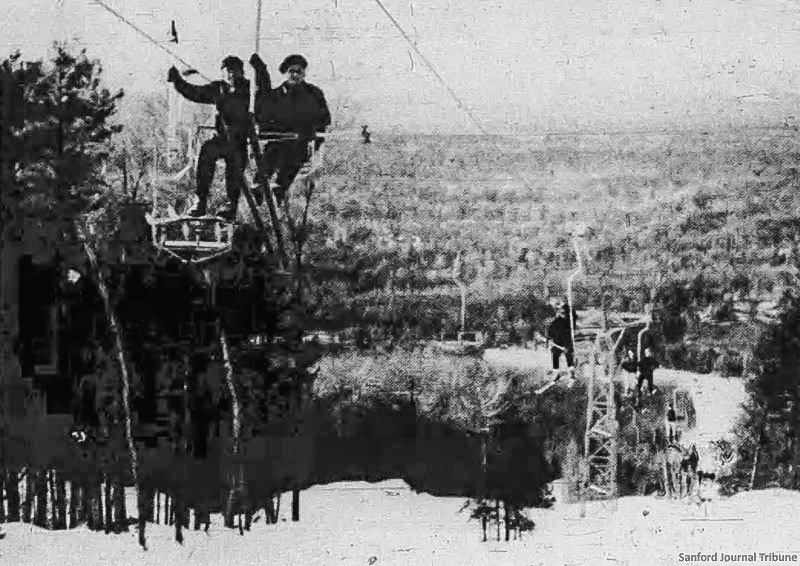
The early years of development on Mt. Agamenticus centered around detection. The first Mt. Agamenticus fire tower was constructed in 1918, standing for some two decades. Circa 1940, the mountain was scheduled to be turned into a recreational area, however the onset of World War II resulted in the construction of an army radar installation on the summit.
Leveraging the summit road, buildings, and water and sewer infrastructure constructed by the Army, a $300,000 winter sports development was proposed on Mt. Agamenticus in 1948. A "skimobile" (possibly similar to Cranmore) was reportedly planned for lift service. Sperry H. Locke was initially manager of the development group, which included owners Cato R. Philbrick (a York realtor), Roger Lucas (a York undertaker), James H. Lucas (superintendent of the York Water District), and William Foster (a York florist).
The group announced they had $100,000 of capital in late 1949 and were moving forward with plans to have television communications equipment on the summit. Plans for a ski area remained, though the group had not settled on what type of lift would be installed. Plans reportedly stalled due to poor winters, as the Portsmouth Herald reported "there wasn't enough snow on Agamenticus to follow a cat's track.”
With lift-served skiing exploding in popularity and snowmaking technology advancing as the 1960s arrived, Frederick Wakelin and A. Guilford Tobey (both of Marblehead, Massachusetts) decided to move forward with a development on Mt. Agamenticus. Word emerged in 1962 that a holding corporation was attempting to acquire land on the top and west side of the mountain. Agamenticus Mountain Corporation was formed on January 2, 1963 with Wakelin serving as president. Roger Lucas and William Foster from the previous development group served as directors. The group hired Sel Hannah to design the $250,000 development.
Initial plans called for an upside-down area with a summit lodge and parking area. Proposed lifts included a 2,500 foot long, 500 foot vertical chairlift or T-Bar and a 900 foot long novice T-Bar. Snowmaking equipment was planned, as "heavy snow is not to be expected at this relatively low elevation and proximity to the coast," according to the Sanford Journal Tribune. Off-season sightseeing possibilities were also included in the business model.
Trail clearing likely started in early 1963. In early April, the group reported that it measured 45 inches of snow on the mountain on March 23, which it said was comparable to major areas to the north. In July 1963, the group announced that it had ordered a Mueller chairlift and, if $95,000 could be raised by August 15, the area would open that winter. Meanwhile, the group settled on the nickname "the Big A," after "Mt. Aggie" didn't catch fire in the papers. Unfortunately, not enough funds were raised and construction was halted that fall. At that point, three of the five trails had been cleared.

On early May 1964, "Agamenticus Mountain Day" open house was held, with door prizes and free ski passes offered to attract visitors to the development.
In July the corporation announced that construction had started on the chairlift and that Ralph Amsden had been hired as general manager. Prior to being hired at Agamenticus, Amsden worked at the Carroll Reed Ski Shop in North Conway, Mt. Whittier (ski area closed in 1985), and served as area manager at Pats Peak (still in operation).
Work ramped up as October came to a close. The summit road was resurfaced, while snowmaking pipeline installation was commenced on three trails. Kilgore marsh was dammed to form a snowmaking reservoir, while a second dam was planned. Pumping infrastructure consisted of two Caterpillar D-6 diesels, while three 600-CFM air compressors were planned. Meanwhile, worked continued on the installation of a chairlift, a T-Bar, and a rope tow. Night skiing was also announced.
Tragedy struck on October 29, as Paul Tart was killed when a Bombardier tractor installing a tower on a ski trail flipped. The 22-year-old from Essex, New York left behind his wife, who was expecting their first child.
Further issues were encountered in November, when the chairlift towers were shipped to Haystack instead of Agamenticus. Meanwhile, construction of the lodge continued.
Though Mt. Agamenticus saw snowfall in early December as its planned grand opening neared, heavy rain and fog zapped the mountain of snow, with the Waterville Morning Sentinel dismissing it as "typical Maine weather.” Nevertheless, work continued at a feverish pace in advance of the planned December 19, 1964 grand opening, with Ralph Amsden telling the Portsmouth Herald, "It'll be close, but we'll be ready."
Unfortunately, the snowmaking system malfunctioned, resulting in no skiing for the area's grand opening. Nevertheless, Governor John Reed officially dedicated the area, declaring that it would "take its place among the giants of the ski world." The Portsmouth Herald reported that "The view from the lodge alone is worth the trip up the Mountain Road and the big picture windows give everyone a fine vantage point from the warm confines inside."
Warm, wet weather persisted. After assistance with the troubled snowmaking system was received from Lost Valley and Poland Spring, Big A finally opened with limited surface-lift-served terrain on January 17, 1965. The Portland Press Herald described conditions as "scratchy," but Ralph Amsden noted, "It's a start." Night skiing debuted a few days later, limited to the T-Bar (plans were announced to add lighting to the chairlift for the second season). The chairlift reportedly opened for day skiing before the end of the month.
A core part of Big A's early business was high school groups and racing teams, which arrived by the busload on weekday afternoons. Initially a majority of the high school students at Big A were from New Hampshire, not Maine, leaving Ralph Amsden to surmise, "They're more ski minded in New Hampshire than they are in Maine." At the time, Portsmouth High School had the largest ski program at the area.
Skiing continued into February, though rain disrupted the season before the second weekend. The season likely melted out before the first weekend in March.
The business may have been reorganized in early 1965 pursuant to Small Business Administration funding. Off season events were held in the lodge, such as Easter church services and dance parties with live music.
Improvements for the 1965-66 season included cutting the top-to-bottom intermediate Wampum trail, constructing a 200-car parking lot at the base, and rebuilding the snowmaking system. Patten "Pat" White took over as general manager, as Ralph Amsden departed to become assistant general manager at Crotched Mountain. Ski school director Neil Robinson also departed, filing a lawsuit against Agamenticus Mountain Corporation. John Parkhurst took over as ski school director.
The 1965-66 season likely kicked off a few days before Christmas on manmade snow. Though Big A relied on manmade snow, the season was buoyed by some natural snow mid-winter. March was ushered in with an inch of rain, leaving Big A as the only operating ski area in the state at one point. The season likely lasted until at least mid-March.
Night skiing was expanded to the chairlift and a new ski shop opened for the 1966-67 season. In addition, the Wampum Trail was reworked, as it "never really opened to full-scale operation last year," according to the Portsmouth Herald. The season kicked off on manmade snow in mid-December, making Big A one of the only Maine ski areas to operate before Christmas that year.
On January 22, 1967, a chair slid down the haul rope and fell 20 feet to the ground. Two skiers, one of which was the mayor of Haverhill Massachusetts, were hospitalized with multiple broken bones. Compounding the issues, a warmer than normal January resulted in a multi-day closure at the end of the month, with the Portland Press Herald noting, "what was good for the beach [activity at York Beach] was bad for the nearby "Big A" ski area where warm weather raised havoc with the slopes."
Conditions improved as March arrived, with base depths advertised as 1 to 3 feet. The season likely ended at the start of April. Patten White told the Portland Press Herald that "It was our best season, and thanks to successful snow making to supplement the natural snow we even got some of the Christmas holiday business, which we never had before." Despite record revenue of $104,422, the area posted a net loss of $22,005.
Meanwhile, the Portland Press Herald publicized plans to install a new T-Bar "three-quarters of the way up the mountain, where there is extensive terrain to develop." The project was contingent upon Maine Recreation Authority funding.
In June, corporate president Matthew Murtha informed shareholders that the company faced "almost certain" bankruptcy if it was unable to obtain a $250,000 loan guarantee from the Maine Recreation Authority, noting "since we are gradually reducing the large debts incurred during the first two seasons and struggling with high interest payments on our initial loans, it has been almost impossible for us to show any profit."
Murtha added, "directors can no longer continue to make annual contributions of many thousands of dollars per year - just for the privilege of working long hours without pay for the corporation." The corporation criticized the state for allocating much of its money to the Bigelow Mountain Development rather than southern Maine. The Bigelow Mountain Development was touted as “the Aspen of the East” but it never came to fruition and instead became a preserve.
In July 1967, James Talcott, Inc. foreclosed on Agamenticus Mountain Corporation relating to a $100,000 loan issued at 11.5% interest issued in 1964. Despite the financial woes, the area remained operational, with Ralph Amsden returning as general manager and ski school director John Parkhurst working on developing additional racing programs. A snowcat was acquired to improve slope conditions.
The 1967-68 season likely kicked off just after Christmas, seeing near capacity crowds during the weekend preceding New Year's Day. The season likely came to a close on St. Patrick's Day, with overall skier visits improving despite a 30% reduction in operating days.
Rumors of Big A's demise swirled during the 1968 off-season, however in September Ralph Amsden announced, "The financial outlook is much better this year than it has been in the past." American Resorts Consultants, Inc. was hired to create financial and development plans for the area. Amsden told the Portland Press Herald of plans to construct another chairlift, cut new trails, and improve snowmaking, adding "if we don't do it this year, chances are good we'll do it next year."
Agamenticus Mountain Road was improved by the state during the 1968 off-season. That fall, the Cumberland Motor Club staged its first hillclimb on Mt. Agamenticus, with Steve Pesce winning the 0.7 mile race in his Camaro with a time of 43.5 seconds.
Tom West was named ski school director for the 1968-69 season. The name "Big A" began to be co-marketed as "Mt. Agamenticus." Around this time, York Corner Holding Company was integrated into the financial structure. Skiing likely kicked off just before Christmas. While some areas to the north benefitted from multiple large snow storms, Big A struggled with multiple rain and thaw events. Nevertheless, the area was able to report base depths of 1 to 3 feet by mid-February. In order to drum up more business, the area offered midweek rates during February vacation week. Base depths reportedly grew to nearly 3 to 4 feet by early March before quickly melting at the end of the month.
In March 1969, Ralph Amsden told the Biddeford Saco Journal that a new chairlift would be installed that year, and that the corporation was planning to turn the Big A into a year-round resort with a motel, golf course, and swimming pool. Amsden told the paper, "The three months or so we get from skiing aren't enough to run a big outfit economically."
A new expert trail was cut for the 1969-70 season (possibly to skier's left of the chairlift), while the T-Bar base terminal was relocated 100 feet downhill to improve loading. A cross country ski trail was also reportedly cut and John Parkhurst returned as ski school director. Operations were scaled back to Wednesday through Sunday. The season started when a snow storm hit a few days before Christmas. Warm torrential downpours arrived just after Christmas, putting a damper on the holiday weekend. Ralph Amsden told the Portland Press Herald, "I've never seen an ice storm like it," noting the area lost $10,000 in business and sustained damage to its lighting and snowmaking infrastructure.
The area managed to have a record January, however rains shut down Big A for the first half of February. Ralph Amsden told the Biddeford Saco Journal, "The year had the makings of a real good season...but along came the rains," adding, "Unless the weather changes, we may be in for a disastrous year." The area reopened in mid-February, with the season running through the end of calendar winter.
Big A continued its Wednesday through Sunday schedule for the 1970-71 season while trying to appeal to non-skiers with offerings such as Saturday night lobster bakes. A new trail was reportedly being cut as the season started in mid-December. As Christmas neared, there was enough snow to reportedly open the Wampum trail for the first time in two years. A Christmas Eve blizzard further boosted base depths to nearly two to four feet. Ralph Amsden told the Portland Press Herald, "We've never had such good business or skiing," adding that the area was seeing 500 to 600 skiers a day. The season lasted through the end of calendar winter.
Meanwhile, in December 1970, Joseph Briley foreclosed on a mortgage he had issued to the Agamenticus Mountain Corporation in 1963. In February, Briley, Agamenticus Mountain Corporation, and York Corner Holding Company reached an agreement to pause foreclosure proceedings in exchange for a payment schedule.
Big A enjoyed rare November operations in 1971 before reopening for Christmas week with a small base.
In January 1972, the area announced it was shedding the "Big A" moniker in favor of "Mt. Agamenticus." Ralph Amsden told the Bangor Daily News, "It may be a little harder to say Agamenticus, but it's a bit more distinctive. There are enough big "A's" around including a race track in New York State but only one Agamenticus."
Despite the early opening, the 1971-72 season was a struggle at Mt. Agamenticus. An early February snow storm gave way to high winds, wiping out snowpack. Ralph Amsden was quoted in the Associated Press as lamenting, "I just wonder why the buildings didn't take right off the mountain," adding, "It's just a question of how much money we're going to lose," noting that 1971-72 was worse than the 1964-65 season.
Lighting was improved for the 1972-73 season, with Mt. Agamenticus maintaining a Wednesday through Saturday night skiing schedule. The season likely kicked off a week before Christmas on a thin base with bare spots. Weekday rates were $4 for an adult, $3 for a junior. Weekend was $6.50 for adult, $4.50 for junior and a season pass was $60 for adult or junior.
On the evening of January 17, 1973, the chairlift reportedly dropped, resulting in an evacuation. During the process, the haul rope dropped off a sheave train, dropping four skiers 20 feet to the ground. The four were sent to the hospital, two of whom were held overnight due to their injuries.
Spring came early in 1973, likely melting out the season at the start of March. Around this time, a proposed 500-acre development called "Agamenticus Park" was advertised by American Agamenticus Resorts.
Meanwhile, word emerged of a proposed 4,000 to 5,000 acre development involving Mt. Agamenticus. Initial plans included a Robert Trent Jones championship golf course, a convention center, real estate, and an expanded ski area. Representatives did not indicate who was behind the project, or if it was connected with the American Agamenticus Resorts development.
Financial woes were becoming apparent as the 1973-74 season arrived. In part due to the energy crisis, Mt. Agamenticus moved to a Friday-Sunday operation. The mild season likely didn't start until mid-January, coming to a close only a few days later.
On August 14, 1974, Agamenticus Mountain Corp. transferred its holdings to American Agamenticus Resorts, Inc.
Despite the devastating 1973-74 season and rumors of its demise, Mt. Agamenticus managed to open just after Christmas in 1974. The season, and Mt. Agamenticus's lift-served skiing history, likely came to a close in late February.
Following the 1974-75 ski season, owner F. Anthony Zahn, an Oklahoma Democratic politician and financier, proposed a massive real estate development on Mt. Agamenticus. By May of 1975, Zahn reportedly owned 500 acres and had 3,500 more under contract with hopes of building up to 3,500 homes. As part of a $5 million project, Zahn planned to add more lifts and expand snowmaking at Mt. Agamenticus, as well as to build a golf course and riding stables.
Local opposition from York and South Berwick residents quickly emerged. Zahn indicated that he would not proceed with the plans if the towns opposed the project, but noted that he would not "denude the land" and would not be involved "in any project that would tarnish my reputation," particularly since the 35-year-old politician was planning to run for Congress.
In May 1975, voters of York and South Berwick overwhelmingly voted no to referenda about developing Mt. Agamenticus. In addition, residents voted in favor of purchasing and preserving Agamenticus area land. Following the vote, Zahn said he was willing to sell the land to the towns, provided that he could recover his costs incurred, estimating the price tag at $556,000 for his direct investment and $1.3 million in purchase options that would be assumed. Zahn also floated an alternative plan of developing 500 homes on 500 acres of land in conjunction with expanding the ski area.
Zahn set a target of September 1975 for a sale to the towns. After that goal was not met, one of Zahn's partners, Clinton Nangle, proposed constructing a 150-site recreational vehicle campground on the summit.
In the summer of 1977, York Corner Holding Company foreclosed on the ski area property, scheduling an auction of the 175-acre tract and buildings. As the date approached, potential uses for the property were suggested, such as an alpine slide operation or a mountaintop hotel or restaurant. In the end, York Corner Holding placed the high bid for property at $325,000.
Weeks after the auction, Mt. Agamenticus was announced as a potential location for the United States Strategic Petroleum Reserve. Noting the mountain's potential rock cavern, the site was submitted to the federal government by the Maine Department of Conservation.
On January 13, 1978, F. Anthony Zahn's Algonquin Corporation, formerly known as American Agamenticus Resorts, Inc., transferred property to York Corner Holding Company.
Talks of a town acquisition of the former ski area property continued in late 1979, as York Corner Holding Company's principal shareholder Matthew Murtha said, "The mountain is going to be sold darn soon, either to the town or not. We're giving the town first crack at it because we would rather see the town buy it."
In the spring of 1980, the town of York acquired 300 acres on Mt. Agamenticus from York Corner Holding Company.
In 1988, 3,000 acres of land on and around Mt. Agamenticus were identified as a priority for the Land for Maine's Future Board to purchase and preserve. In the fall of 1990, the state entity announced it would be purchasing a 280-acre tract on the mountain from the Amoskeag Development Corporation for $210,000. The state announced additional purchases in subsequent years, increasing its holdings to over 1,000 acres. Meanwhile, the town of York renovated the summit area, possibly removing the chairlift. The old ski lodge became a wedding and event venue, while a network of hiking and mountain biking trails became popular.
Today, the 10,000 acre Mount Agamenticus Conservation Region features multi-use trails that weave through the abandoned ski area.

By James Kences
"Do you want the Zahn holdings in the Agamenticus wilderness to be developed?" On a Saturday morning 46 years ago, in May 1975, 1,260 York voters collectively answered "no" to the question that appeared as Article 4 on the ballot. Admittedly, this was not a large vote, as there were more than 5,000 registered voters in town. Still, it was decisive, and was many times larger than the 273 who had taken the affirmative position.
And next to Article 5, which asked voters whether they favored purchasing the Zahn holdings, 1,033 residents offered support for the acquisition of the property — though, at the time, nothing had been determined how the land was to be used. The real importance of the episode was that it had instilled an awareness of the vulnerability of a unique environment that for far too long had by many been taken for granted.
F. Anthony Zahn, or Tony Zahn, was part of a small consortium who had purchased the controlling interest in American Agamenticus Resorts Inc. This was the company that operated "the Big A Ski and Recreational Area." As a promotional advertisement proclaimed, "New England's newest, best-equipped ski area!" Robert Trent Jones, famed as a designer of golf courses, served on the board of directors of the company and figured in the story as the acquaintance who introduced Zahn to the opportunity in Maine.
Need a news break? Check out the all new PLAY hub with puzzles, games and more! The Zahn family fortune was derived from close relationship with a western department store franchise, the C. R. Anthony Company, comprised of 325 stores located in 21 states. Zahn, who was frequently described in the newspaper articles as an Oklahoma City Council member and candidate for Congress had also been engaged in prior real estate investment, and his interests included property in Costa Rica.
During the spring of 1975 and frequent visits to the region, Zahn was accompanied by Daniel Coleman, who headed Coleman Associates, a San Francisco firm that "specialized in the planning, engineering, and design of entire cities." The future site of the complex that was to occupy a part of the 6,000-acre tract at Agamenticus was designated the "Sasanoa Study Area."
Noticed inconsistencies and what seemed to some as a lack of full disclosure of intentions provoked suspicion. While Zahn offered assurances that his actions would comply with popular expectations and demands, the project was on a scale almost certain to be disruptive. "If the development is in the 2,000 to 3,000 unit range," he told an audience, "we will probably have to have our own water source, our own sewage treatment plant and provide a shopping area."
His prospective holdings extended from York into South Berwick. The 4,000 acres frequently mentioned required clarification; of this total, he possessed only 475 acres, and he was in the process of obtaining the rest. There was clear title to 1,200 acres, and lawyers working on his behalf would assist in providing the additional 2,100 acres.
Within a week of Zahn and Coleman's meeting with the members of the Agamenticus Advisory Committee on Saturday April 5, at the mountain, a group of residents of the two impacted towns held first organizational meetings of what they named The Citizens Save Agamenticus Committee, who sought to have the wilderness protected. Already, a petition had been circulated, and brandished more than 1,000 signatures."Let's not encourage a large-scale development of one of our most precious natural resource areas ... VOTE TO KEEP AGAMENTICUS FOREVER WILD." This was the mission statement of the Save Agamenticus Committee on the eve of the May 10 vote. Undoubtedly, Zahn's appearance in town at a moment of heightened environmental awareness had not helped his cause. And then, of course, there was the bicentennial and all that it embodied.
Only a month after the Portsmouth Herald prominently displayed the front-page headline, "Voters Oppose Agamenticus Plan," yet another headline in the York County Coast Star served as a prelude to the next phase: "Big A Price is $1,850,000." This was the price Zahn had imposed upon his holding, the equivalent of $460 per acre.
For York, the creation of a five-member fact-finding committee under the leadership of Mrs. Lily Kendall came next. The committee was directed to not only determine the specifics of Zahn's properties, which until that time had been rather vague, but also "to explore and evaluate all possible sources of funds for purchase..." A second important action occurred in early autumn, when the town secured the services of a team of environmental attorneys, Jon Lund and Clifford Goodell.
As 1975 drew to a close, while Zahn's threat to the mountain area seemed to have diminished, another danger suddenly emerged in the guise of Clinton Nangle, an investor in the old Mount A ski operation, who sought to install a 15-acre camping area at the summit, with 150 spaces for campers, and even tennis courts. Perhaps after having sensed popular opinion was against his project, Nangle acquiesced and withdrew.
Far more promising were the initial contacts with state and federal government agencies that seemed to offer a path toward a future of conservation. It was a protracted, gradual process, but in the end, success was achieved. In 2002, partly in response to these initial efforts, a coalition of 10 conservation organizations formed together as Mount Agamenticus to the Sea, was organized, with the mountain and the unfragmented tracts as a focus of attention. Their goal: 19,000 acres of conserved natural lands and protected watersheds in the Mt. Agamenticus region to benefit people and wildlife.
James Kences writes the "York in American history" column, which appears monthly in The York Weekly.
Used with permission of James Kences