17th Century | 18th Century | 19th Century | 20th Century
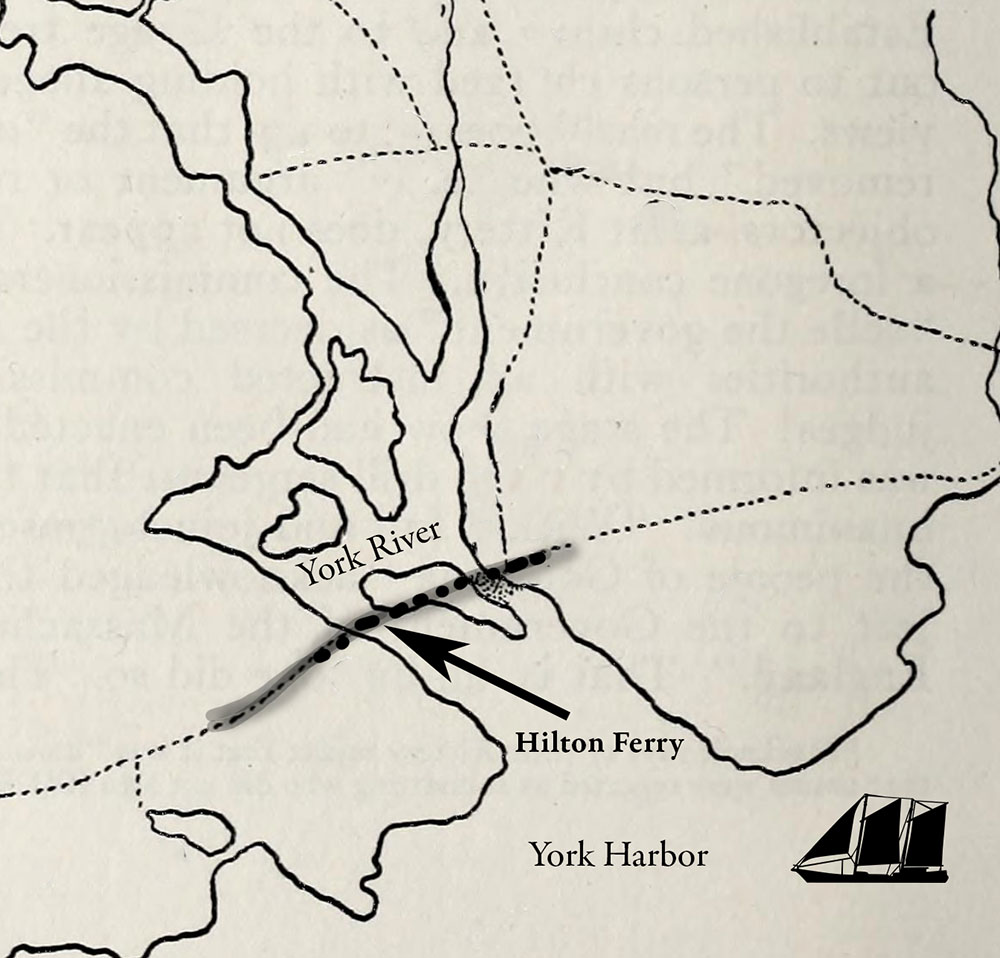
The river of Agamenticus presented the main obstacle to the traveler and across it the first ferry must have been established. What is now known as Stage Neck was the natural location for ferriage, being the narrowest part of the river, and the establishment of a tavern at that point strengthens this argument. Action by he town on this subject to provide a ferry across the main river was taken December 8, 1652, and is as follows:
“It is ordered that Mr. William Hilton is to have the use of the ferry for the term of one & twenty years, Lying betwixt the house where he now liveth & the Town of York, and he is duly to attend the said ferry with Cannoes sufficient for the safe transportation, both of Strangers & Townsmen, if occasion requireth. If time & tydes be seasonable, he is to pass persons, over to & from the Stage Island: If not, he is & must provide a Canoe to Lye ready at the point of land, on his own side the River, upon all such occasions to transport people without danger. In consideration whereof the said William Hilton is to have allowed him two pence apiece every stranger & four pence a piece for every beast or horse which he swimmeth over, or that are sworn over by any strangers themselves, he, or his servants being ready to attend, and one penny a time for every Townsman he fetcheth or carrieth over: unless the said Inhabitant go over in his own Cannoe, which Liberty remains to every Townsman, being made use of to Exempt him or them from the payment of any ferriage.” A pence being worth about 45 cents in 2025 U.S. money.
The ferry over York river was conducted by Hilton until his death about 1656 and the franchise was probably retained by his family. When Arthur Beal came to York about 1663 and married Agnes Hilton, daughter of the late ferryman, it is probable that he kept up the family occupation. The loss of town records prevents definite statements on this subject as in all other similar matters prior to the Massacre. From the next existing record it appears that the ferryman succeeding Hilton had been attending to it in an irregular, desultory way, and in 1671 a new ferryman was appointed as shown in the following order:
“Wee the Select Men of the Town of York being Informed of the frequent Neglecting of the ferry, whereby people are hindered In their Necessary occasions, for Preventing hereof, do hereby give License unto William More & order for keeping the passage over the River to the Town to Transport passengers as occasion serveth, & to Receive due paiment for the same, according to order, till the Town Sll meet otherwise to dispose hereof. 20: October: 1671.”
William More was still conducting the ferry in 1683, when it was voted that he should “continue for the keeping of the Ferry In that place and Station as formerly until further order.”
Evidently Arthur Beal undertook a revival of the old Hilton franchise and started a competition ferry. More sued him the next year for “trespass done by takeing away all the Benefitt of the Ferry” and judgment was rendered in favor of the plaintiff. More continued his ferry without further interference until his death in 1691 when his son Thomas must have taken over his father’s franchise. At least in 1695 and 1696 Thomas was granted the license to maintain this ferry “to transport horses & men and to give good attendance” under a bond to insure satisfactory performance. He operated it until 1698 when Arthur Beal again sought a franchise in his own name. In that year he was granted a license to keep a ferry for one year “where Thomas More formerly kept it.” The rates of ferriage allowed were six pence for man and horse and four pence for a horse and two pence for a man. Beal, dying in 1711, was succeeded by his son Edward who carried on for the next quarter of a century until his death. His successor, appointed in 1735, was William Pearce.