17th Century | 18th Century | 19th Century | 20th Century
by Kevin McKinney
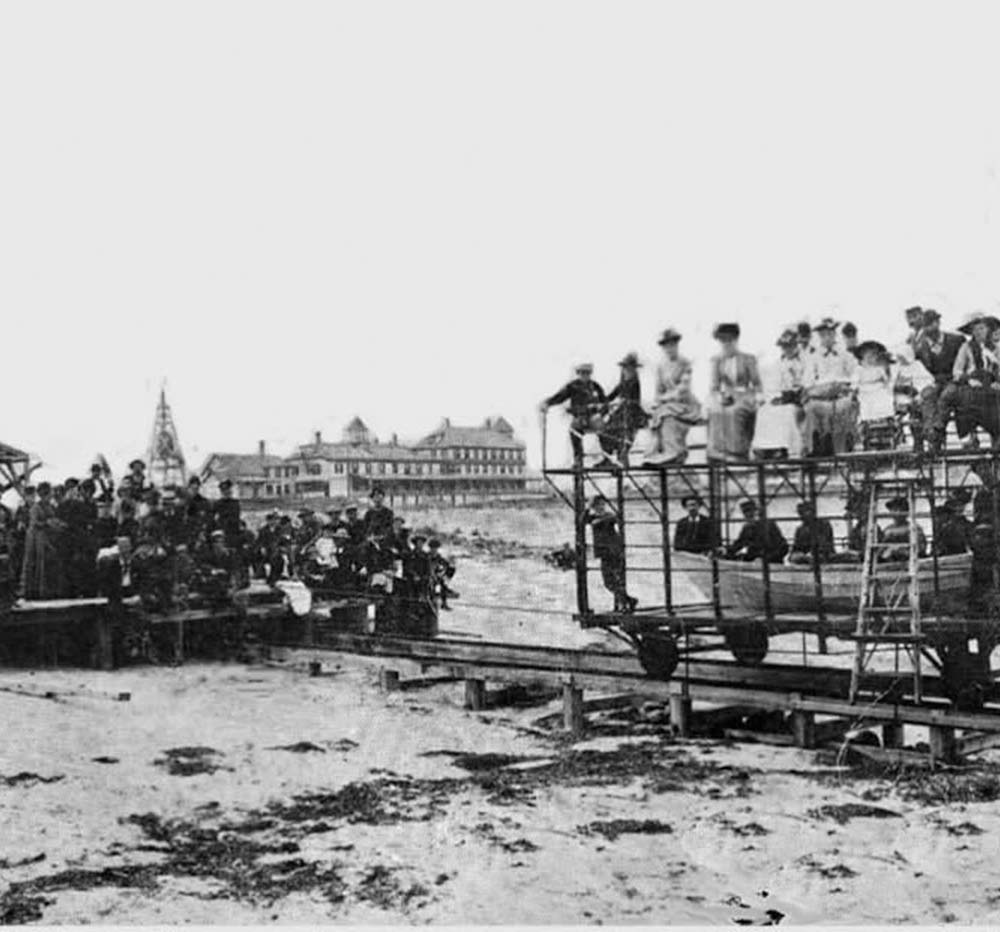
Known as "The Comet"—though no written record of this nickname has been found—the York Marine Rail Car Company was located at the far east end of what is now Short Sands Beach. This innovative yet short-lived venture was the brainchild of local businessmen E.S. Marshall, S.W. Junkins, W.M. Walker, and J.E. Staples. Notably, Marshall and Staples had previously been instrumental in bringing the railroad to York in 1887. It is plausible that leftover materials from the railroad—ties, rails, and other equipment—played a role in sparking the idea and fueling its creation.
The concept was ambitious: a rail car elevated above the surf, capable of carrying 30 passengers through the waves, offering a thrilling and unique experience. In addition to transporting passengers, the rail car carried a small rowboat, used to ferry guests to waiting vessels involved in fishing and sailing charters.
While visionary, this was not a new idea; similar projects had been attempted with limited success in other locations, including Old Orchard Beach. However, the men behind this endeavor, with a track record of successful ventures, likely saw it as a promising boost to York's growing tourism industry.
Despite the excitement, the project faced numerous challenges. The rail car operated for just three seasons, ending after the 1892 summer. Harsh winter storms, shifting sands, high maintenance and insurance costs, and the relentless wear of the ocean environment likely made the operation unsustainable.
By the spring of 1893, the York Courant announced that the company would not reopen for the season. The following year, it was advertised that all equipment would be removed by July 1, 1894. The directors maintained an optimistic tone, declaring the experiment a "proven success" and expressing hope for its application in larger seaside resorts. In December 1894, two landowners—Carlos Moseley and W.H. Garmon of Manchester, NH—visited York to finalize compensation agreements with the York Marine Rail Car Company, marking the end of the venture. Today, the only visible reminder of this unique enterprise is a small stretch of cable at the far end of Short Sands Beach, a faint echo of the ambition that once drove this bold idea.
As with so many coastal endeavors, Mother Nature—unyielding and ever-changing—proved to be the ultimate authority.