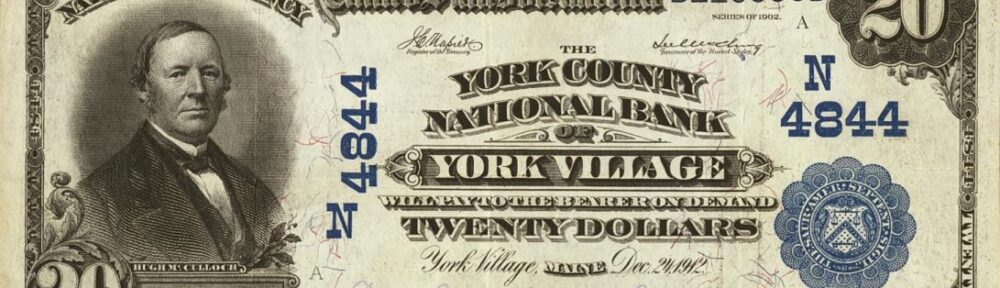
The Story of the York County National Bank of York Village, Maine
By: Thomas M Prince for the York History Group – 1/14/2026
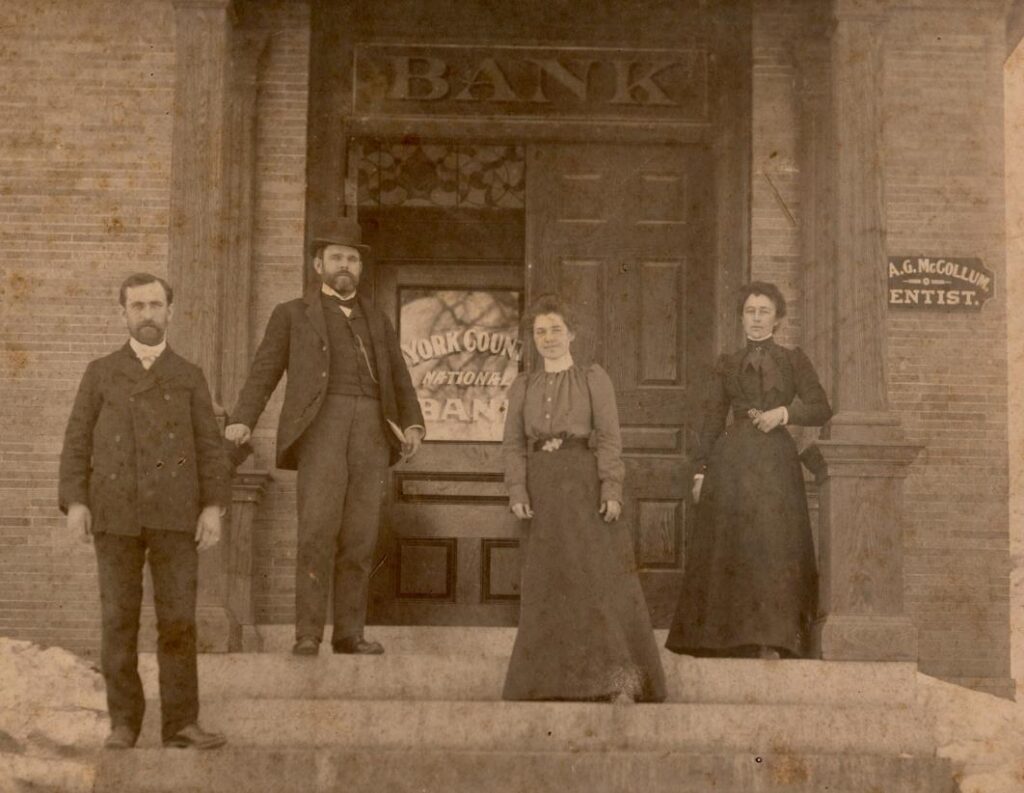 Photo Credit: Old York Historical Society
Bank President James T Davidson with tellers of the York County National Bank – January 1900
Part I
The first section of this narrative is an in-depth look at York’s first financial institution – the York County National Bank of York Village founded in 1893.
The focus will be on its founder and President James T Davidson and his wife Elizabeth B Davidson. I’ll discuss the bank’s Board of Directors, mention the operations of a “national” bank, and then explain the role Mrs. Davidson undertook in management. I will wrap up with a discussion of the closing chapter for the bank in 1919.
Part II
In the second section I’ll give a less detailed overview of the successor banks which later occupied the same York Village location at 207 York Street from 1920 to 1975. Those banks include the York County Trust Company and Community Trust Company.
Part I – York County National Bank
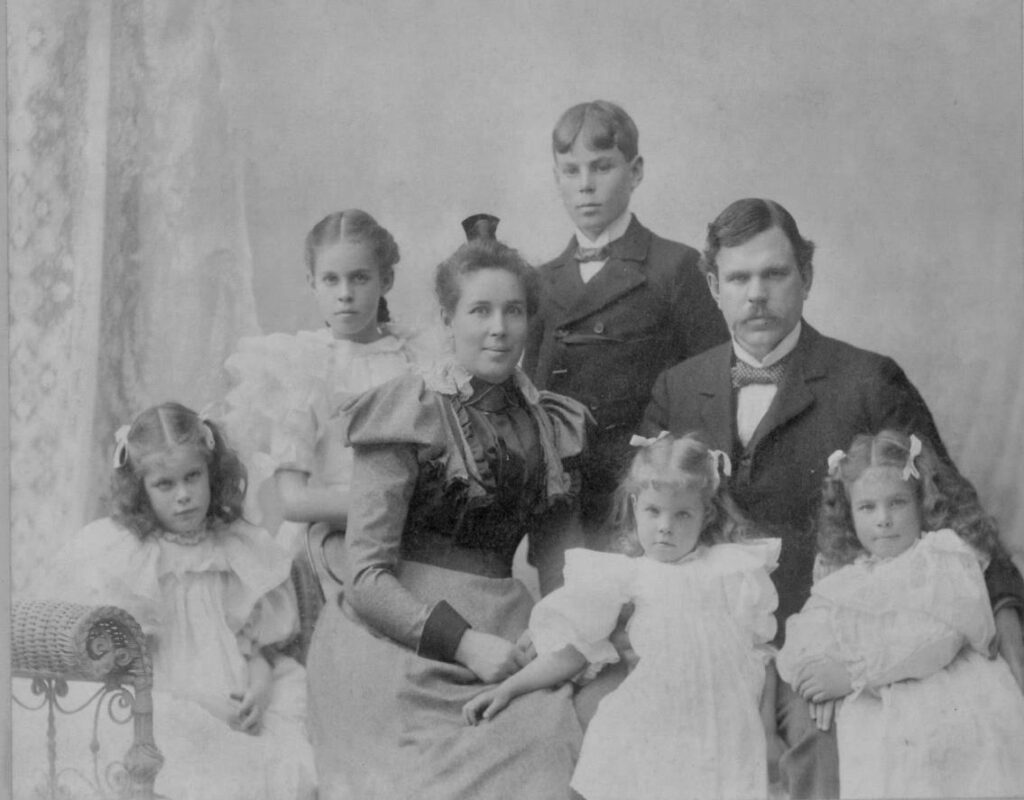 Photo Credit: Helen (Lennie) Ogden
James and Elizabeth Davidson with their children – 1896
Family background
This photo was taken around 1896 soon after James T Davidson founded the York County National Bank. He appears here with his wife Elizabeth B Davidson and five of their six children. The children here are (l-r) Elizabeth, Helen, Edward (referred to as Burleigh,) Mary, and Ouillma*. Their sixth child, a son named Thomas, would be born in 1898.
James T Davidson was born in Ohio on July 28, 1856. His early years were spent in Indiana where his father was a lawyer. Davidson graduated from Bowdoin College in Brunswick, Maine in 1878, then studied law for two years under the direction of his father. He was admitted to the bar in 1880 and elected district attorney for a circuit district in Indiana, a position he held for four years. During the summers he spent time vacationing in York, Maine where he met his future wife Elizabeth Burleigh of South Berwick, Maine. They married in July 1883 and first lived in Indiana before moving to South Berwick about 1889. He was admitted to the bar in Massachusetts where he conducted legal business two days a week from an office in Boston.
Elizabeth Burleigh Davidson was born in South Berwick on August 5, 1862. Her grandfather, William Burleigh, was a lawyer and prominent citizen of South Berwick who founded the Burleigh Bank in South Berwick in 1817 and represented the first district of Maine in the U.S. Congress. Elizabeth’s father, John H Burleigh was born in 1822 and followed in the father’s footsteps. Early in John Burleigh’s life he was a sailor and sailed seven years on foreign voyages. In 1855 he abandoned the sea and invested his accumulated earnings in the Newichawannock Woolen Mill in South Berwick. The venture was highly successful and over time he built new mills. He became president of the South Berwick National Bank, served four terms in the Maine Legislature, and was elected to two terms in the 43rd and 44th U.S. Congress. He was considered a leading capitalist in Maine. He died at age 55 in a tragic carriage accident on the Salmon Falls River bridge. At the time of her father’s death in 1877, Elizabeth was 15 years old. She attended Berwick Academy and following graduation she traveled abroad for a brief time, then returned home and worked with her mother, Matilda Burleigh, with the family’s business affairs.
This family photo is courtesy of Helen (Lennie) Ogden. Lennie is the great granddaughter of James and Elizabeth Davidson. Lennie lives in Maine and is a summer resident of York Harbor. She shared other points of interest about her great grandmother and the Davidson family which are woven into this paper.
*According to correspondence with the Davidson family (2025), Elizabeth B. Davidson’s son carried the full legal name Edward Burleigh Davidson but was universally known as Burleigh. Early press items occasionally spell the name “Burley,” consistent with multiple historical variants of the Burleigh/Burley family surname, The same correspondence confirms that Elizabeth’s daughter Ouillma is correctly spelled with an initial O (not “Quillma”); newspapers and digitized texts frequently misread the unusual name. The name persisted in later generations, including Ouillma Davidson Beecher (1923–2023).
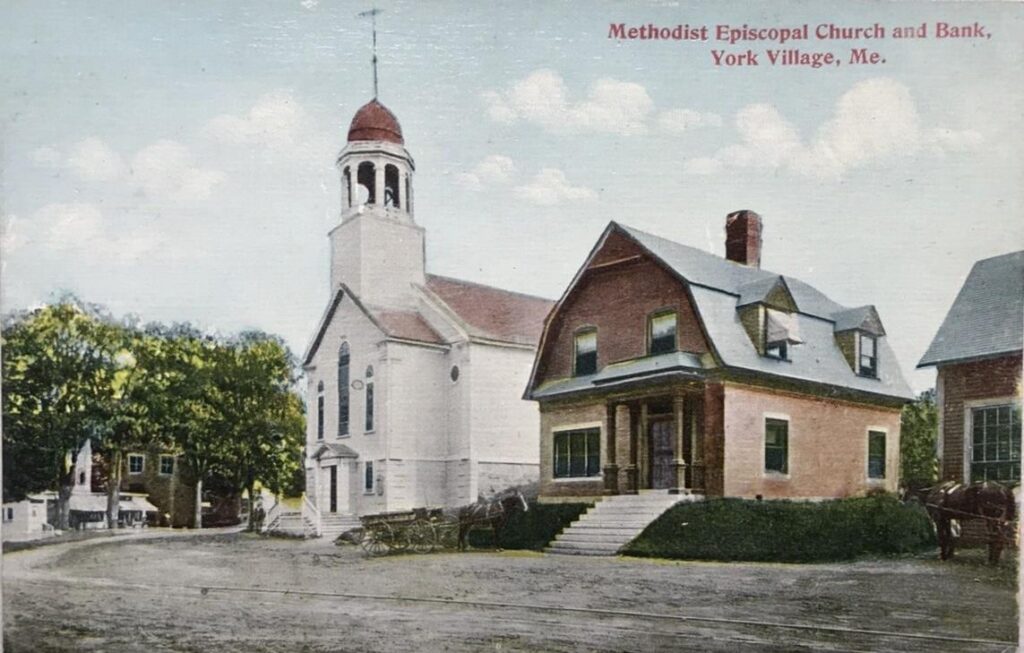 Photo Credit: Post Card from the Public Domain
Bank building completed in 1894
James Davidson entered York town affairs and became acquainted with several business professionals in York in the late 1880’s through his legal practice.
Starting in 1887 the York Harbor and Beach Railroad provided service for summer residents and year-round citizens of York by connecting York with rail service to New England and major cities across the northeast. This opened the door for much new business in York with the construction of new hotels and accommodations across town. At the same time, many fine coastal “cottages” were being built for the more affluent summer residents who gravitated to York Harbor.
By 1890, Davidson and others recognized the need for a bank to provide financial services to York as the closest banks to York were in Portsmouth and South Berwick which were not convenient for York’s growing population of year-round and summer residents. The idea of forming a bank in York Village to service the entire town quickly materialized. During 1892, Davidson led the effort along with Wilson M Walker and Edward S Marshall to raise sufficient capital and apply for a federal charter to establish a national bank. The name selected for the bank was ‘York County National Bank’ rather than simply ‘York National Bank’ to promote recognition covering a wider geographic area in southern Maine.
With $60,000 of capital raised, the bank was approved and a charter issued on February 1, 1893 by the federal Office of the Comptroller of the Currency (OCC) under charter number 4844.
Soon thereafter, plans were drawn to erect a bank building in the center of York Village. E. B. Blaisdell of York was selected as the architect and general contractor. Construction began in October 1893 with completion in 1894. The postcard view shows the completed building located next to the Methodist Church in the village center. The bank building was designed as a two-story structure which would fit well with the prevailing architecture of historic structures in York. The first floor was for bank operations and the second floor for rented office space. Davidson kept one of the second-floor office rooms for his part-time legal business.
This building was enlarged and modernized in 1914 which I will detail later in this paper.
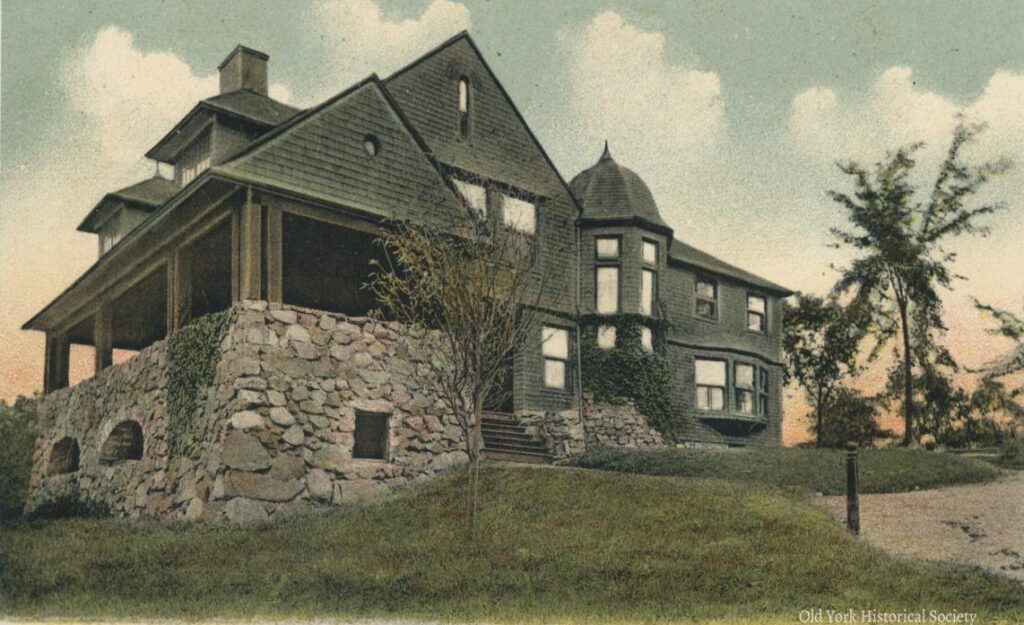 Photo Credit: Old York Historical Society
Family home for James and Elizabeth Davidson
As the bank was being organized, James and Elizabeth Davidson bought about ten acres of land in York Village where they planned a new home for their family. This property was located behind the bank extending down to Barrells Millpond. The Davidsons named their home “Breezy Knoll” after its completion in 1894, shown above. Upon moving from South Bewick to York, the Davidsons were pleased with the ample space for their growing family. Additionally, the home’s location was quite convenient for James to walk to work at the bank.
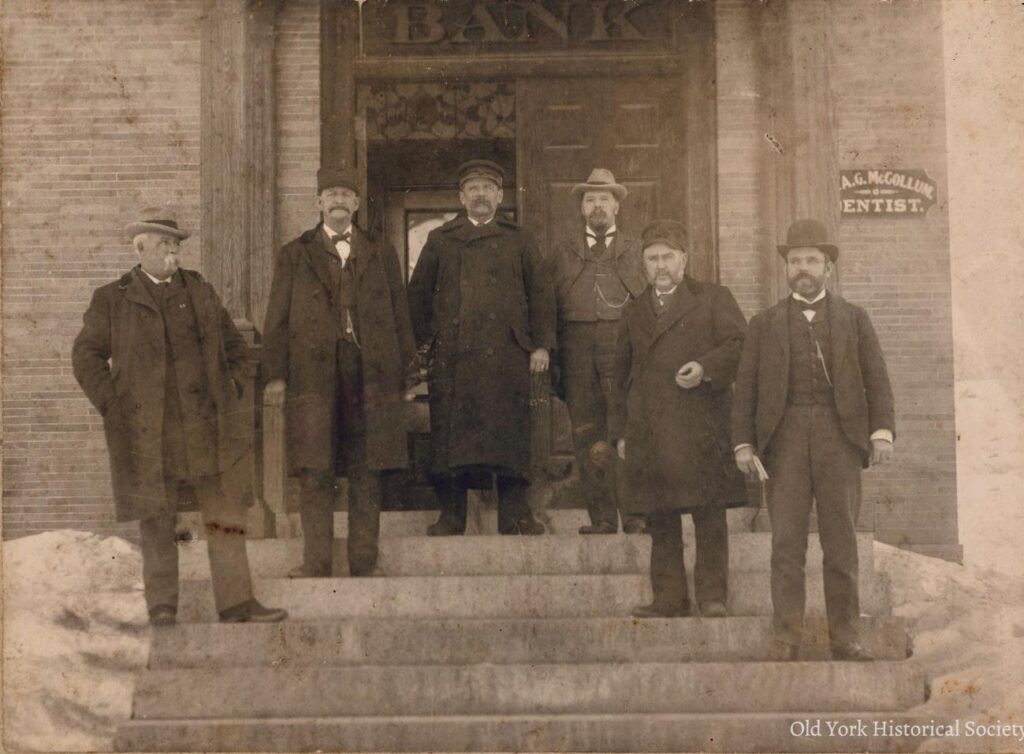
Photo Credit: Old York Historical Society
Board of Directors for the York County National Bank of York Village
Standing on the steps of the bank’s front entrance, left to right: Edward S. Marshall, Charles A. Grant, George M. Simpson, Wilson M. Walker, Jeremiah P. Simpson, James T. Davidson.
The directors of the York County National Bank fit the profile of directors for most small-town banks being local citizens, nearly always men, who were respected and trusted throughout the community. They had the financial means to provide capital for the formation of the bank. As with all banks, local trust and confidence in the officials associated with a bank was critical in attracting deposits and promoting business.
Here is a brief description of the York County National Bank’s first directors.
Edward S. Marshall – Educated at Berwick Academy, Marshall initially worked in Portland before returning to his hometown in 1870 to assist his father Nathaniel G Marshall in building of the Marshall house in York Harbor in 1871. He became the sole owner of the Marshall House in 1875. In 1895, he formed York’s first power company to generate electricity for the Marshall House. He was a key supporter, financial contributor, and first president of the York Harbor and Beach Railroad Corporation, He worked closely with James Davidson in the formation of the York County National Bank in the early 1890’s.
Charles A Grant – Owner and operator of Sea Cottage at Long Sands in York Beach. Sea Cottage, constructed in 1871, was one of the first major hotels in town, built in the same year as the Marshall House in York Harbor. Sea Cottage was located where the present-day Anchorage Motor Inn is now found.
George M Simpson – Resident of Cape Neddick who for many years was a merchant of groceries, meats, and provisions. He was a good friend and business partner of Edward Marshall in real estate matters. He served as a director of Edward Marshall’s light and power company.
Wilson M Walker – A resident of York Harbor, hotel developer, and one of the founders of the York Harbor Village Corporation. In the early years of the York County National Bank, he was a director and for one year (1902) served as the bank’s president.
Jeremiah P Simpson – York Harbor resident who in 1884 was an organizer, financial backer, director, and treasurer of the of York Harbor and Beach Railroad Corporation. Later in 1895, he was an incorporator of the York Shore Water Company, formed to provide water service from Chase’s Pond to the town of York.
James T Davidson – Attorney. York resident. Founder and first president of the York County National Bank. His early years are mentioned at the beginning of this narrative.
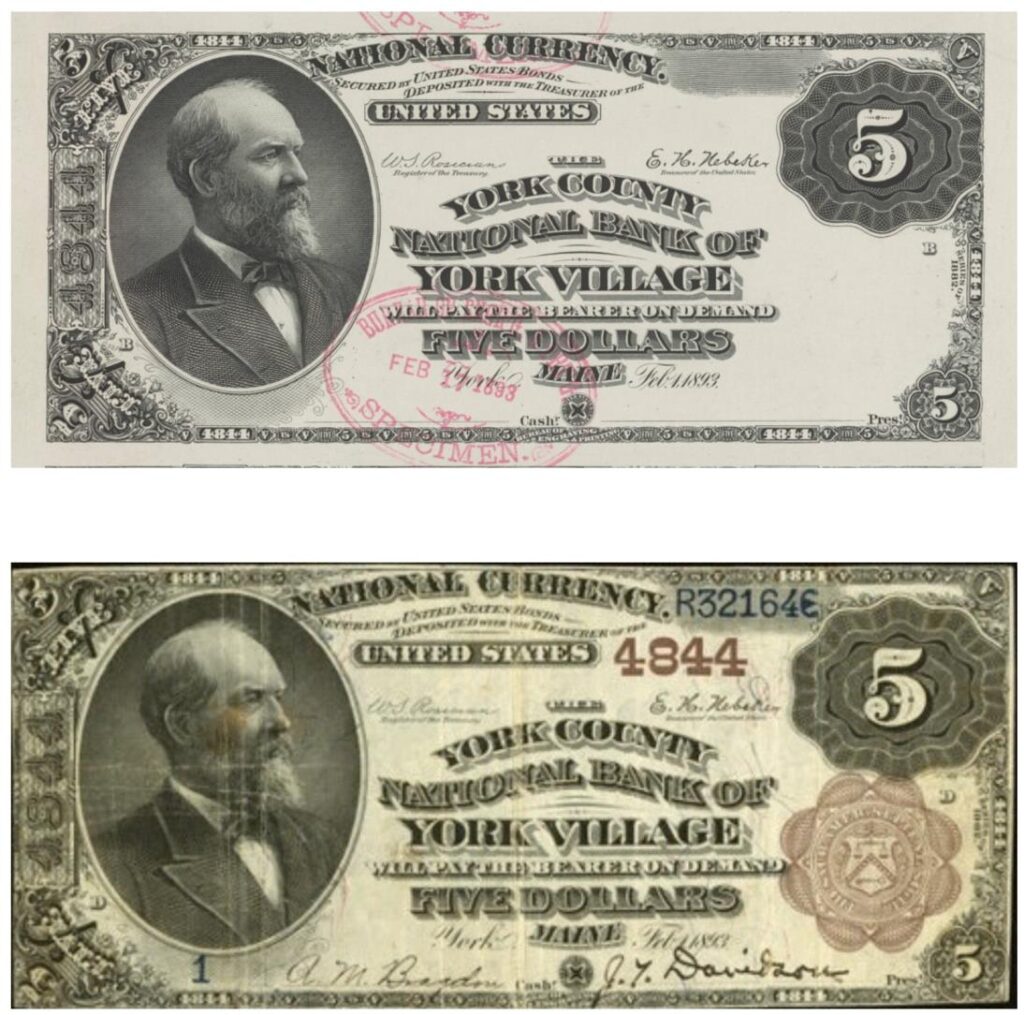 Photo Source: Smithsonian Institute (top) Heritage Auctions (bottom)
Currency of the York County National Bank
Here is back story about currency (paper money) in the United States. Prior to the Civil War, banks were chartered only by the state in which they were located. Many of these banks issued their own, uniquely designed currency. The U.S. government did not issue currency prior to the Civil War. The problem with this was many of these state banks were financially unstable and failed resulting in their currency to be worthless. This led to a volatile situation in the economy with worthless paper money floating about the country.
So, in 1863 the U.S. Congress set up a system of national banks and a uniform national currency to replace this chaotic state-chartered banking system. With a federal charter, national banks were allowed to issue currency so long as they purchased government bonds as collateral. Notes could be issued up to 90% of the value of the deposited bonds. The currency would be uniformed in design and printed by the U. S. Department of Engraving and Printing. This provision assured public confidence in currency in circulation. This system worked well.
Chartering as a national bank became the preferred way of establishing commercial banks in the country. Savings banks, which were not allowed to issue currency, continued to be chartered at the state level catering to individuals by offering interest bearing savings accounts and loans.
In 1892 when Davidson and his Board of Directors were organizing their new bank, they chose it to be a national bank as their focus was commercial customers offering business loans and checking accounts. These commercial banks also offered checking accounts to individuals.
As a result, the York County National Bank issued currency printed with bank’s name which was then circulated locally. This was helpful for the bank as its name became widely recognized in York and the surrounding communities.
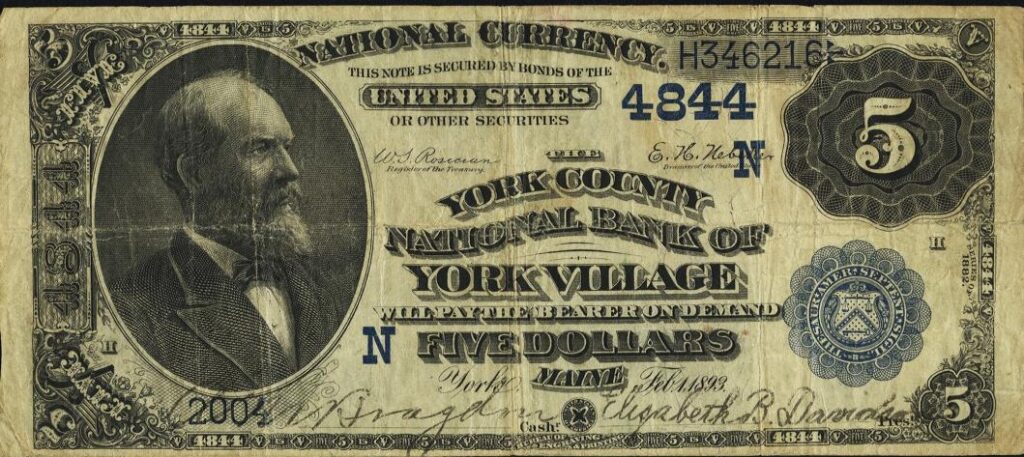
Currency pictured above
Top – National Currency with no printed seal, serial number, or charter number were proof copies used by the U.S. Bureau of Engraving and Printing for design and quality control before the final currency was produced. They served as a final check to ensure the design, colors, and layout were correct. These early proof copies were not intended for public circulation and would have their final components including seal, charter number, and serial number added later in the production process. When government printing was complete, the notes were shipped to the bank in uncut sheets for signatures of the bank’s president and cashier. Only after the notes were signed by bank officials did the notes become legal tender.
Bottom – This is the very first $5 note issued by the York County National Bank as shown by serial number 1 on the bottom left. Also appearing on the note is a seal, charter number 4844, a Treasury sequence number, and finally the signatures of J.T. Davidson as president and A.M. Bragdon as cashier. These notes were then circulated in York or anywhere in the country as an obligation of the bank and backed by the United States. National Currency was prevalent across the United States from 1864 until 1935 when it was discontinued and replaced by Federal Reserve Notes, United States Notes, and Silver Certificates.
While you cannot determine from looking at these photos, National Currency notes were larger in size compared to the size of U.S. currency in circulation today. Large size National Currency was printed from 1863 – 1928.
Currency like this $5 note issued by the York County National Bank is quite valuable and sought after by collectors of old paper money. And since this is serial number 1, it is especially desirable.
 Newspaper Credit: Biddeford Saco Journal
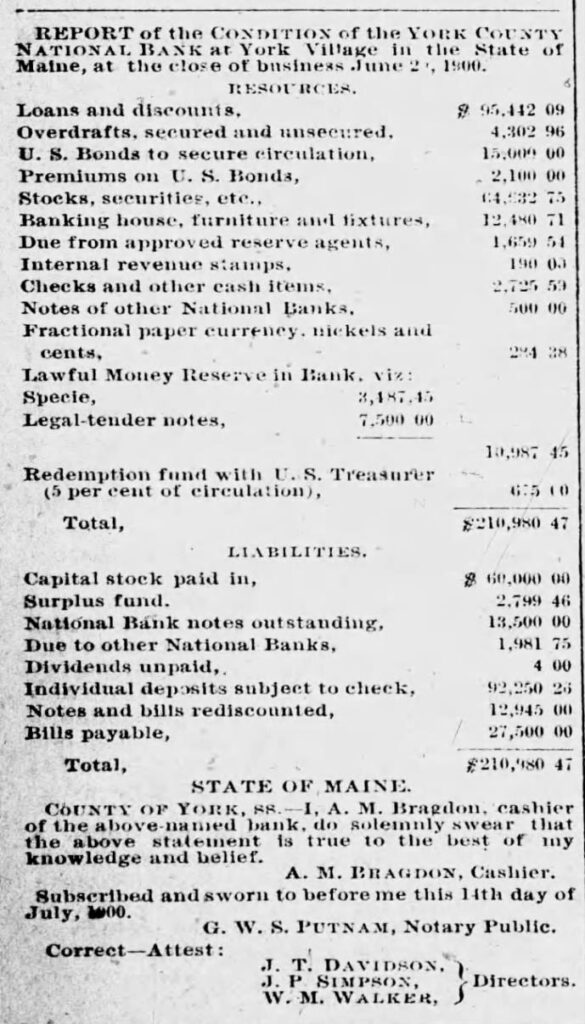
Financial Statement as of June 1900
In looking over the bank’s financial statements from its start through1900, they show an example of a conservative, competently managed, and locally trusted rural national bank.
- The bank kept ample liquidity, avoided speculative lending, and maintained a consistent capital base.
- Its steady deposit growth and absence of losses or asset write-downs indicate strong public confidence.
- Rising cash balances and stable surplus confirm ongoing profitability and careful management.
- The rise in bills payable in the year 1900 suggests temporary funding—a sign of active business, not stress.
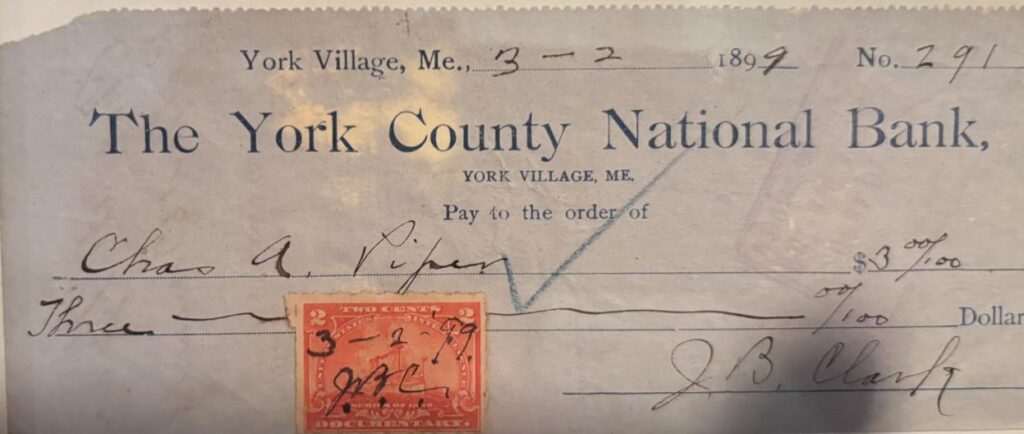 Photo Credit: Joseph Szeniawski
Check drawn on the York County National Bank
The York County National Bank offered checking accounts to businesses and to individuals. This check was recently found in the attic of the bank building during a 2023/24 renovation of the building.
The two-cent stamp appearing on the check is a revenue stamp. These stamps were part of a federal taxation system used to raise money during national emergencies – especially wars. The tax was collected by requiring revenue stamps to be affixed to certain documents including bank checks, stock transfers, and legal documents. The two main periods when checks were taxed was during the U.S. Civil War (1862-1872) and the Spanish-American War era (1898-1902.) This 1899 check falls squarely in this period. For bank checks, the fee was 2 cents, regardless of the amount of the check. So, this check drawn on the York County National Bank helped finance, in a small way, U. S. military actions during the Spanish-American War.
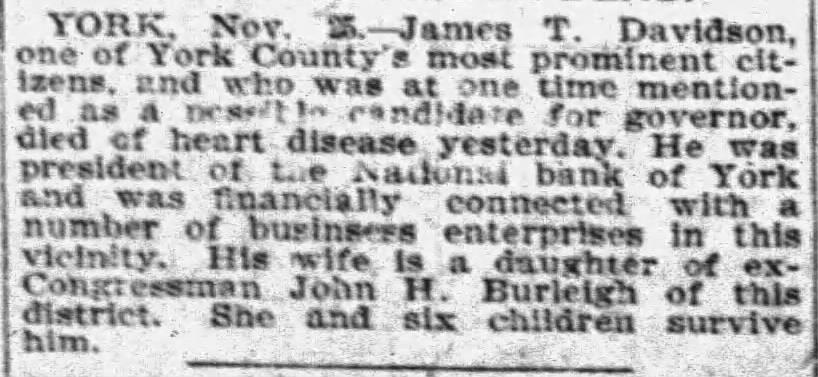 Newspaper Credit: Portland Evening Express
Death of James T Davidson
On November 24, 1901, Bank President and noted York citizen James T Davidson died unexpectedly from heart failure. He was 45 years old. This news was a shock to the citizens of both York and South Berwick.
To support continuity of management of the York County National Bank, the Board of Directors held a meeting and named Mr, Davidson’s wife, Elizabeth Davidson, as a director of the bank and Wilson Walker as vice president. The position of president was held open for two months until the annual meeting of stockholders in early 1902.
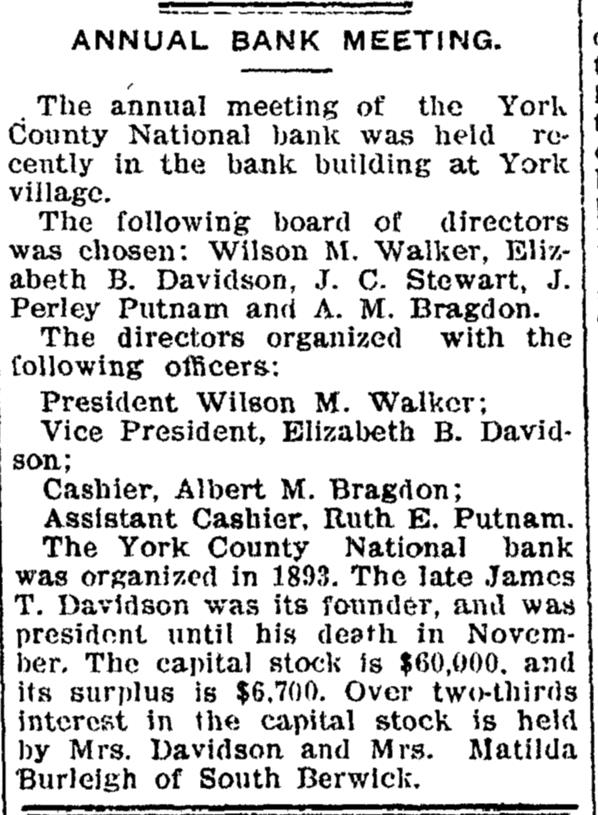 Portsmouth Herald notice of Annual Meeting held in February 1902
At the annual meeting of the Board of Directors and shareholders held in early 1902 at the York County National Bank, a new president, vice president, and slate of directors was chosen to carry on the bank’s affairs. This news was favorably received by bank customers and citizens as the new list of bank officials were all familiar and trusted in York. This was important as the citizens were accustomed to a well-run and safe bank serving York.
The new president would be Wilson M Walker, one of the bank’s original directors. He was well known and respected in York and quite familiar with the bank’s business.
Elizabeth Davidson was elected director and vice president. Her position as director guaranteed she had voice in the short and long-term direction of the bank. Her position as vice president insured her interactions with deposit and loan customers. In the three months since her husband’s death, Elizabeth had taken an active role in bank management which was key to the stability of the bank’s day-to-day operations. The directors recognized the importance and value of Elizabeth Davidson’s role with customer facing responsibilities.
Also, it should be noted, Elizabeth Davidson and her mother Matilda Burleigh in 1902 owned two-thirds of the capital stock of the bank. Following the death of her husband, Mrs. Davidson was now the majority stockholder of the bank and the key person responsible for setting the strategic direction of the bank.
Also elected as a director of the bank in February 1902 were three individuals who were prominent in York’s affairs and known to Elizabeth Davidson and to the other members of the Board. They were:
Dr. John C. Stewart – At age 52 in 1902, Stewart was held in high esteem by York’s business, legal and medical communities. Dr. Stewart was originally from Vermont. He received an undergraduate degree from Dartmouth in 1873 and went on to receive a medical degree from Dartmouth Medical School in 1876. He then established a medical practice in York which he kept for many years. He then took up the study of law and became an attorney under the Maine bar in 1895. He was a member of the York County and Maine Bar Associations and well as various medical associations concurrently for many years. He was one of the incorporators as well as a director and clerk of the York Harbor and Beach Railroad Corporation. He held various town and state offices and was a State Senator in 1899.
J Perley Putnam – was widely known in York having served as treasurer of York, a town selectman, and at various times as Chairman of the Board of Selectmen. Around the time Putnam was named to the bank’s board he was also named chairman of the executive committee for York’s 250th anniversary celebration. His visibility in the community was high. In addition, Mr. Putnam’s wife, Sophia, was the sister of Edward S. Marshall who was an original director of the bank. At age 60 in 1902, Mr. Marshall decided it was time to leave the bank’s board and pass the torch to his younger brother-in-law J. Perley Putnam, age 35.
A M Bragdon – Albert M Bragdon, a York resident, had served continuously as the cashier of the York County National Bank since its inception. Back in those days, the cashier of a national bank was the officer who handled the bank’s internal operations including maintaining the bank’s accounting records and filing reports to the federal and state authorities. Bragdon knew the York County National Bank as well as anyone. Placing him on the Board of Directors was a sign the other board members valued his current and future contributions to the organization. Of note, Mr Bragdon was also active in the community. Around 1900 he formed an insurance and real estate company called A M Bragdon Insurance, which was successful throughout the 20th century. When the York Hospital was formed in 1905, he was a tireless participant in organizing its business matters. In addition to his cashier’s desk on the first floor of the bank, he conducted his insurance business in a second-floor office room.
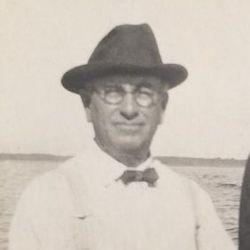
Here are some personal notes about Albert M (McIntire) Bragdon. Albert was born in York in 1864. He was married to Emeline Baxter from Plymouth, England from 1893 until her early death at age 30 in 1901. You’ll note on the previous page, the bank hired an assistant cashier named Ruth Putnam to work alongside Cashier Bragdon in 1902. Ruth was the sister of J Perley Putnam who was elected director of the bank in that same year. Apparently, Ruth and Albert worked well together as they were married in 1903 and would remain married until her death in 1934.
Albert passed away in 1946.
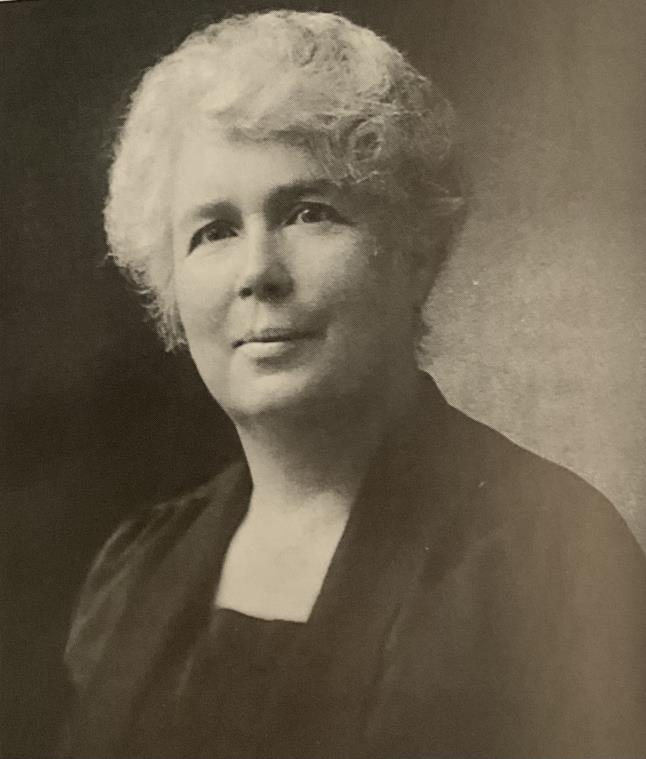
Photo Credit: James S Erwin family
Elizabeth Burleigh Davidson
During 1902, the York County National Bank did well under President Wilson Walker and Vice President Elizabeth Davidson and guided by its new slate of directors. Loan and deposit business was strong.
However, during the year Walker had extended periods when he was unable to work because of serious health issues. In the second half of 1902 it was quite common for Elizabeth Davidson to step in and temporarily assume the role of president in Walker’s absence. She quickly and effectively learned the operations of the bank including making commercial loans which was a key service to the business community.
In early 1903, Walker agreed with the Board it would be best if he stepped down as president and concentrate on improving his health. As such, at the bank’s annual meeting in early 1903, the Board of Directors named Elizabeth Davidson President and Chief Executive Officer. Mr. Walker would pass away in February of 1904.
With Mrs. Davidson now the senior executive officer and the majority stockholder of the bank, she would take primary responsibility of the destiny of the organization.
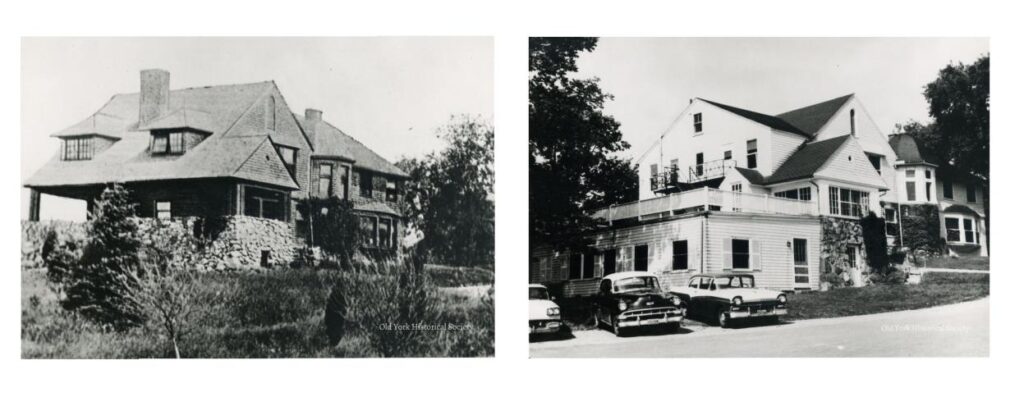
Photo Credits: Old York Historical Society
Davidson home – 1904 Same building, as York Hospital – 1958
In 1904, Mrs. Davidson made the personal decision to vacate her York home and move to South Berwick. She had her plate full caring for her six children, some being minors, and at the same time being a full-time president of an active national bank. She felt it best to move to South Berwick where there was a network of family, including her mother, who could help with family care. While it was a big decision, Elizabeth and her children left their York home and relocated. The Davidson home was left vacant.
About this same time there was growing need to establish a proper medical facility to service the public in York. The only health facility that existed was a three-room building located near the town’s Home for the Poor. Recognizing the need for a general medical and surgical hospital, seven physicians joined forces and applied to the town health officer for the right to incorporate under the name of York Hospital. The request was approved, and a board of trustees was set up. The next step was to raise money to either purchase and/or build a hospital. In 1905 Mrs. Mary Perkins and her daughter Elizabeth led the campaign to raise the funds.
Sitting on a hill in the center of York Village was the fine, vacant home of the Davidsons on ten, beautiful sloping acres. The home had all the important attributes to convert it to a hospital including sanitary plumbing and drainage, a pure water supply, a functional heating system, electricity and lighting, and ample room. On September 19, 1905, the Davidson estate was bought by the York Hospital Board for $15,000. On July 23, 1906, the York Hospital opened for business with 11 patient rooms.
Postscript- The Davidson home was expanded and upgraded over the years and used by the York Hospital until 1958 when it was torn down and replaced by a modern building which would become the core of today’s York Hospital complex. The photo above, taken in 1958, shows the old “cottage” hospital building as it appeared just prior to demolition. You can see the general features of the past Davidson home.
 Paper Money Source: Heritage Auctions
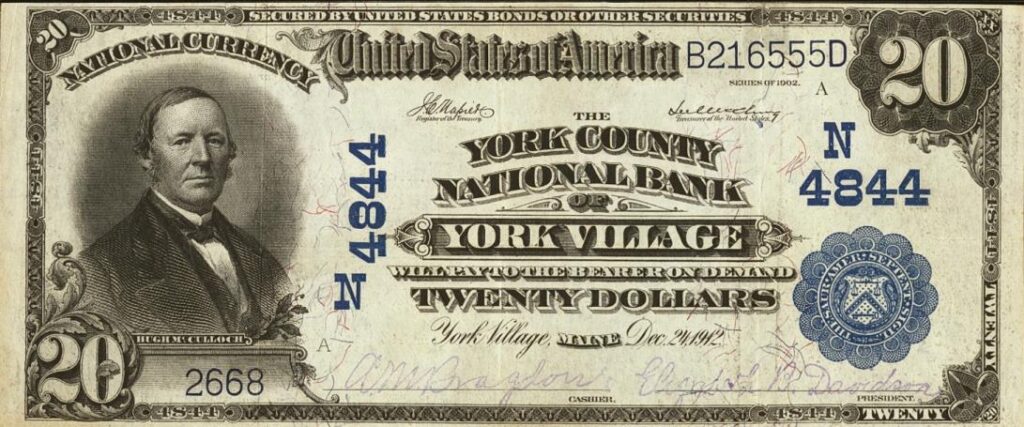
National Currency bearing the signature of Elizabeth B Davidson as President
During the early years of Elizabeth B. Davidson’s presidency at the York County National Bank, women held the top office at only a handful of the nation’s approximately five thousand national banks. Historians have named just fifty-nine women who ever served as presidents of national banks during the entire National Bank Note era (1863–1935). Cross referencing those names to the early 1900’s shows that only about nineteen of those women were serving as president during the years 1903–1906.
In New England, the phenomenon was even more extraordinary. Research confirms that during the years 1903 -1916 there were only two female presidents of national, note-issuing banks anywhere in New England: Frances E Moulton of the Limerick National Bank (Limerick, Maine) and Elizabeth B Davidson of the York County National Bank.
Thus, both in national and regional context, Elizabeth Davidson’s presidency stands out as an exceptionally rare example of a woman leading a federally chartered, currency-issuing national bank in the early twentieth century.
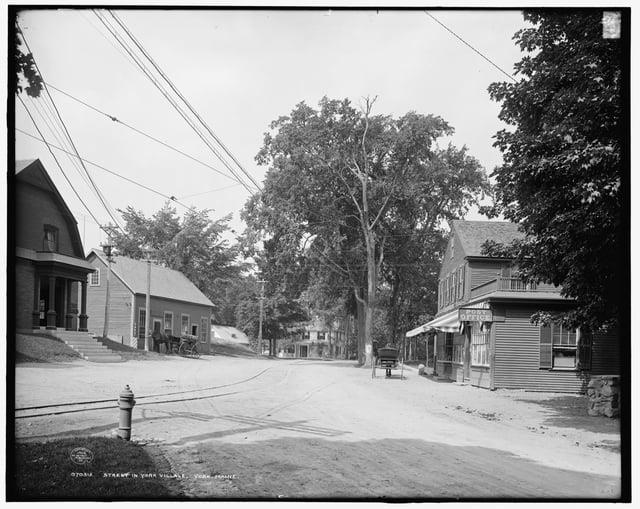 This is the center of York Village in a 1908 Library of Congress, Detroit Publishing photo. York County National Bank is seen on the left with its steps leading to street level. The tracks running through town were for the Portsmouth, Dover & York Street Railway
When Elizabeth B. Davidson assumed the presidency of the York County National Bank in 1903, she stepped into a role that few women had ever held. At the time, she was one of only two female presidents of national, currency-issuing banks in New England. Quiet skepticism followed her appointment. Banking at the turn of the twentieth century was considered an exclusively male domain, and few observers imagined that a woman would thrive in the financial world, let alone lead a federally chartered institution.
Any doubts evaporated quickly. Contemporary newspaper accounts make clear that Elizabeth Davidson entered the bank’s executive office with remarkable confidence, decisiveness, and an unusually sharp grasp of banking operations. One article observed that she “stepped into the active life of the institution as though she had worked in the world of finance for many years,” and that every day she spent “several hours in her office, consulted the directors on investments, and even ventured to suggest many avenues for profitable use of the funds.” Her judgment was repeatedly praised, and she quickly earned the full confidence of the board of directors.
The bank flourished under her hand. Assets grew steadily, the institution gained a strong rating, and other bankers in Maine who had initially “smiled” at the idea of a woman president began to speak of her with genuine respect. The York County National Bank became known for sound management and shrewd decisions during these years, and much of that credit belonged to Davidson directly. She was present, engaged, and firmly in charge. One Boston Herald report summarized the general consensus: the bank had become “more successful than ever under Mrs. Davidson’s management.”
Her professional accomplishments are even more striking when placed alongside the demands of her personal life. During these early presidential years, she was the mother of six children, several still at home, and she stayed active in community service in both South Berwick and York. After moving her family back to South Berwick in 1904—returning to the support of her extended Burleigh family—she undertook a daily commute to the bank in York Village. This was made possible by the newly completed Portsmouth, Dover & York Street Railway whose electric streetcars linked South Berwick to York.* The line passed directly in front of the bank’s entrance on York Street, allowing her to step off the car and into her office with unusual convenience for the era. Still, it was a long, structured, weather-dependent commute, and her willingness to undertake it every day speaks to her discipline, sense of duty, and commitment to both her home and her profession.
Customers respected her, directors relied on her, and fellow bankers—initially amused by the notion of a woman at the helm—came to recognize her shrewdness and capable leadership. By 1908, Elizabeth B. Davidson had not only mastered the responsibilities of the presidency but had also reshaped community expectations of what a bank leader could be. Far from being a symbolic or honorary figurehead, she was a working president: analytical, present, and deeply involved in the day-to-day operations of the York County National Bank. These early years for Mrs. Davidson in bank management established the foundation for nearly two decades of effective leadership and left a legacy of competence and respect that endured long after her tenure.
*The electric streetcar trolleys of the Portsmouth Kittery & York Street Railway began operations in 1897 and merged with the Dover, Eliot & South Bewick Railway in 1903. Soon thereafter, the line was extended from Dover and South Berwick into York. At that point, the name of the line changed to the Portsmouth Dover & York Street Railway. The section of the line between South Berwick and York ran through the Beech Ridge section of York.
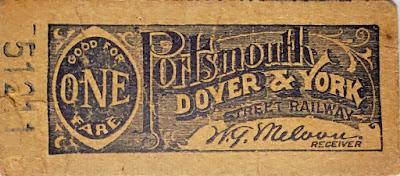
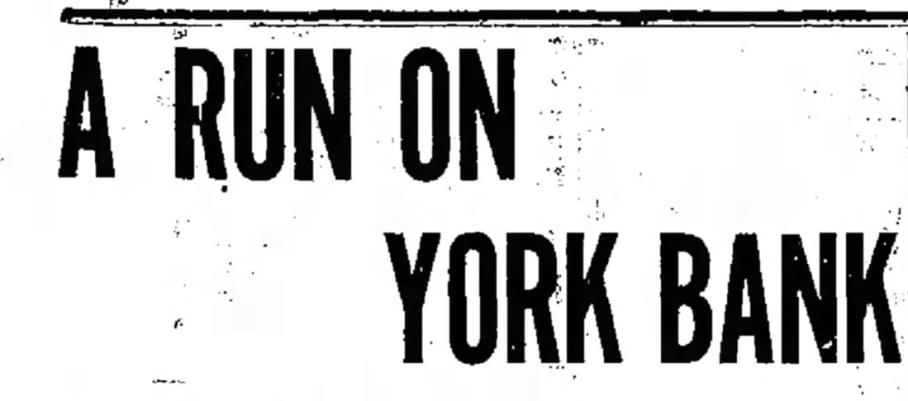
Portsmouth Herald Headline – April 6, 1909
The story of the 1909 “Run” on the York County National Bank
The episode commonly remembered as the “run” on the York County National Bank in April 1909 did not arise from financial weakness, but from civic bitterness. York was embroiled in an unusually fierce political controversy over whether to divide the town into two towns—creating a new municipality to be called Gorges, separating York Harbor, the Beach, and a section of the Village from the rest of York.
The origins of the conflict lay in the long-running dispute over the $50,000 lower bridge at York Harbor. Harbor residents felt they were being forced to bear costs for a project that primarily benefited inland residents; inland residents believed Harbor interests were pushing improvements that favored summer business over the rest of the town. Tempers rose when the Maine Legislature unexpectedly passed the division bill in early April 1909.
This legislative action split the community sharply. Families divided against themselves, old political alliances shattered, and prominent citizens—among them Edward S. Marshall and Joseph W. Simpson, both directors of the York County National Bank—were viewed either as protectors of local autonomy or as villains intent on tearing the town apart.
In this climate of anger and rumor, a symbolic act on April 3, 1909—the town treasurer, against the town division, withdrawing $9,000 of town funds from the bank—triggered a cascade of fear. The withdrawal was quickly read not as political theater but as a sign that the bank might be in trouble. And although no such weakness existed, the political fight over division created the perfect conditions for exaggerated stories of the bank in trouble.
The Pseudo-Run: What Actually Happened
By Monday morning, April 5, several dozen citizens appeared at the steps of the York County National Bank intending to withdraw deposits. Newspapers later called this a “run,” but every first-hand report—and the bank’s own end-of-day ledger—shows that the withdrawals were modest and fully manageable. In fact, more money was deposited on April 5 than withdrawn. The stability of the situation was largely due to the calm, decisive actions of Cashier Albert M. Bragdon.
Bragdon met the situation head-on:
- He placed $30,000 in gold and currency openly on the counting table so customers could see the bank was more than able to meet any demand.
- He accepted immediate offers of assistance from regional institutions—National Shawmut Bank of Boston, Portland National, Limerick National, First National of Portsmouth, and Portsmouth Savings Bank—though he ultimately declined to draw upon that aid because it proved unnecessary.
- He spoke directly with citizens standing in line, explaining the bank’s strong condition, and urging them to inspect the books themselves if they wished.
The bank’s president, Elizabeth Davidson, maintained the professional neutrality expected of a senior bank officer during a politically charged moment. Unlike some directors who were publicly associated with the division controversy, Davidson kept the bank above partisan conflict. Sources from the period note her quiet steadiness, resisting pressure to take sides while ensuring the bank continued to operate normally and conservatively.
By Tuesday, April 6, the situation had completely reversed. Only a handful of citizens withdrew money; two men who had traveled from Ogunquit intending to withdraw their funds instead left additional deposits after seeing the bank’s true condition. The newspaper reports—especially the Portsmouth Herald on April 6 and 7—acknowledged that the attempt to create a run had failed, and that the bank was “in the best possible condition.”
Aftermath and Resolution: A Town Reunited, a Bank Untouched
Despite the bitter rhetoric of the spring of 1909, the episode left no lasting financial scar on the York County National Bank. The bank emerged from the incident with its reputation strengthened and no further disturbances occurred in the years that followed.
As for the town’s political crisis, the effort to divide York was ultimately defeated. Although the Legislature had authorized the creation of “Gorges,” York citizens—led by Josiah Chase and others—mounted a successful statewide petition drive. More than 13,000 signatures were gathered, forcing the question to a referendum. The people of Maine voted 31,722 to 19,692 to keep York intact. The anger gradually subsided, the division movement faded, and York continued on as a single community.
Within this calmer climate, the bank returned to what it had been before the episode: a conservative, well-run village institution. Neither Elizabeth Davidson nor Cashier Bragdon ever again had to face anything resembling a run. In retrospect, the 1909 event was less a financial crisis than a political storm spilling into the bank lobby. Yet it provides a revealing window into the deep passions stirred by the division movement—and a testament to the professionalism of the York County National Bank’s leadership, who steered the institution confidently through a uniquely turbulent moment in York’s history.
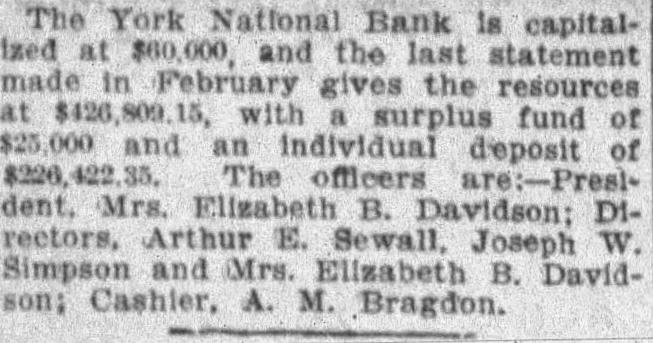 Newspaper clipping from the Lynn, MA The Daily Item on April 7, 1909
This newspaper article points to an earlier change in the York County National Bank’s Board of Directors in 1909 with the addition of two new Board members:
Arthur E. Sewell was born in York in 1882 and graduated from Portsmouth NH High School, Dartmouth College, and Harvard Law School. He started a successful law practice in York and Portsmouth in 1907. At age 27 in 1909, he joined the Board of Directors of the York County National Bank where his intellectual capacity was highly valued.
Joseph W. Simpson was a well-known hotel man who was active in the development of York Harbor as a summer resort. His father, Jeremiah P Simpson, was one of the original directors of the bank. The election of Joseph Simpson to the Board was effectively a replacement for his father who was in failing health (he died in 1913.) Joseph had a good financial mind which was welcomed by Elizabeth Davidson and Albert Bragdon.
Continuing into the following years, the bank achieved steady growth. In mid-1912, President Davidson and the Board determined the bank building was not adequate in size or functionality to properly serve the public. As such, planning began for expansion and renovations to the building.
Similar to when Mrs. Davidson began her duties as president in 1903, the bank’s success continued to be recognized in York and across New England. In a featured article published by the Rutland (Vermont) Daily Herald on September 4, 1912, the following was said: “Mrs Davidson modestly disclaims any credit for the success of the bank. She says the directors, Cashier A. M. Bragdon, who has been connected with the bank since it was founded, the loyal employees and the public are the ones to whom credit is due. But the directors and townspeople tell a different story. They say their president is really the backbone of the institution as she has always been and is justly entitled to much of the credit for the success of the bank.”
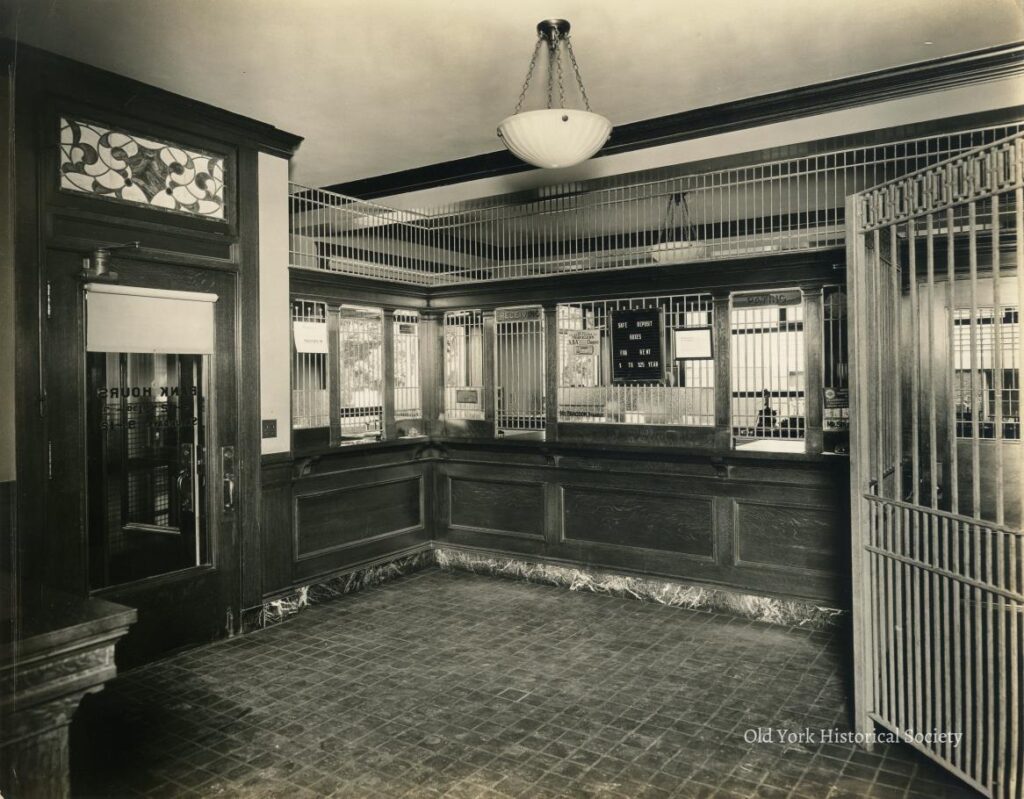 Photo Credit: Old York Historical Society
Upgraded teller lobby after the 1914 bank building renovation
As mentioned on the previous page, planning got underway in 1912 for expansion and upgrades to the bank building. Construction began in March 1914 and continued during that year.
The interior photograph above shows the completed teller lobby after the 1914 project. The modernized lobby, with new oak panels, was secured by tall iron grillwork extending entirely to the ceiling. These bars formed a protective cage around the tellers controlling every point where money or documents passed across the counter.
In 1914 there were no cameras and decades before bullet-resistant glass; instead, security was achieved through heavy materials, narrow openings, and the assurance that burglars would face multiple locked barriers before reaching anything of value. The renovation also included updated wickets—small, lockable metal windows within the grillwork. Placed at the ends of the teller counter, these allowed staff to open or close service points as needed, easing congestion during busy hours and separating different kinds of transactions. What looks like simple hardware today was, in 1914, a genuine improvement in efficiency and customer flow.
The iron bars, vault door, and teller cages of 1914 symbolized state-of-the-art security for their time. Today, of course, those physical defenses have been replaced by digital ones—firewalls, encryption, and cybersecurity systems that electronically protect information rather than cash. Yet the goal remains unchanged: to safeguard what the community entrusts to the bank. The 1914 renovation at York Village expressed the bank’s commitment to security with the best physical safeguards of the day.
The bank also expanded and modernized its vault facilities, addressing a growing demand from customers in York Village and particularly from York Harbor’s wealthier seasonal residents. The existing vault, though not enlarged, was reconfigured with new rows of safe-deposit boxes. A new vault was added to the rear of the main vault for secure storage space for trunks, chests, and larger personal items. Many families left their summer homes shuttered for months at a time, and the bank’s ability to safeguard valuables through the winter became an important service that strengthened its relationship with the community.
These interior improvements were part of a broader, carefully planned expansion of the original 1893-94 building. By 1914, daily foot traffic was higher, bookkeeping had become more complex, and the old rooms no longer matched the needs of a busy national bank. The addition constructed on the side near the Methodist Church nearly doubled the usable interior workspace and freed the staff from the cramped conditions of the earlier design. New offices were created for the cashier and officers, and the bookkeeping area was better organized.
The main entrance was also reconfigured. The new steps and entry platform created a clearer approach from York Street and offered a more welcoming and functional vestibule. The finished improvements were transformative. The bank’s interior became more secure, more orderly, and more efficient. Its storage vault capacity was expanded. Its offices and public spaces were reorganized to reduce congestion and improve workflow. The renovations reflected a maturing financial institution preparing for many more years of continued service.
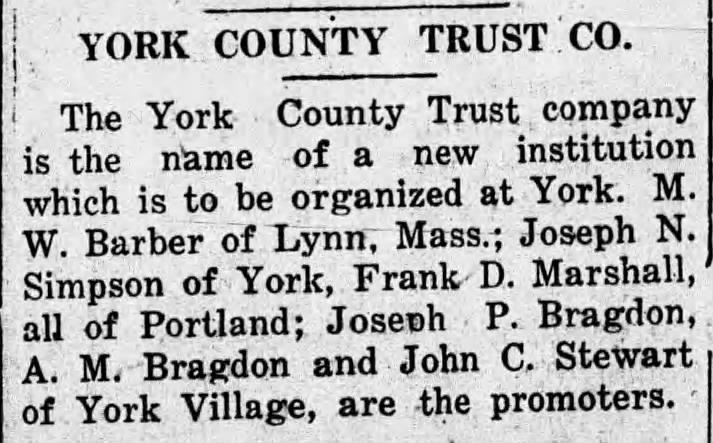 Biddeford Saco Journal September 4, 1919
The final days for the York County National Bank
The following is the last chapter of the York County National Bank. Even though other banks would follow to occupy the building at 207 York Street, the national bank founded in 1893 by James Davidson would relinquish its national charter at the end of 1919. Here are the details.
In early 1919 Elizabeth B. Davidson had every reason to feel she had accomplished her mission: successfully steering the York County National Bank over the past 18 years after the death of her husband in 1901, upgrading it premises, and expanding its services. The bank was not in financial distress. Its published condition statements from the late 1890s into the 1900s showed stable deposits and conservative loan ratios. The bank’s surplus and undivided profits—built up over years—reflected a sound organization.
About the same time some officials from the York County National Bank including Director Joseph Simpson, Cashier Albert M Bragdon, and Director John C Stewart along with other associates including M. W. Barber, and Frank D. Marshall began exploring the advantages of a state chartered trust company as opposed to a national charter.
At this juncture, Elizabeth Davidson was faced with a personal decision – continue her banking career with a newly structured organization or consider a transition toward retirement. Elizabeth opted for retirement.
Elizabeth Davidson: A transition toward retirement
By 1919, Elizabeth Davidson had fulfilled a remarkable eighteen-year chapter in York’s financial history. After her husband’s sudden death, she stepped forward to guide the York County National Bank with a steadiness and integrity that won universal respect. The bank grew methodically, its customer base expanded, and contemporary accounts consistently emphasized both its stability and the quiet competence of its president. The Rutland Vermont newspaper account mentioned earlier captured the community’s view: although Elizabeth modestly declined credit for the bank’s success, townspeople insisted she was its “backbone,” the central figure who held the institution together.
Yet while her public role was significant, Elizabeth’s private world had always been her anchor. By 1919, all six of her children had reached adulthood. Four daughters—Helen, Elizabeth, Ouillma, and Mary—had attended Smith College, reflecting Elizabeth’s determination to provide her daughters with the finest education available to women of their generation. Her two sons, Burleigh and Thomas, had completed their studies at the University of Maine and Dartmouth respectively, and were advancing toward careers in law. Four children had married and were living in Massachusetts, New Jersey, Indiana, and New York. Seven grandchildren had joined the family. Her family was scattering geographically at the very moment they were forming the next generation.
The family correspondence preserved today—including a handwritten 1920 birth attestation for her youngest child—shows a mother who remained closely connected to her children long after they left home. Additional family recollections indicate that Elizabeth devoted substantial time after 1919 to visiting her children and their growing families, and she even traveled to Europe again in 1923 with her youngest daughter and a Davidson cousin. In these years, she no longer had the support of her own mother, who had died in 1911, and her siblings were dispersed across several states. Her emotional center remained with her children, who were now setting up homes of their own away from South Berwick.
Viewed in this context, Elizabeth’s decision in 1919 to withdraw from the daily responsibilities of running the bank appears less a move driven by business considerations than by the natural evolution of her family life. She had guided the bank through nearly two decades of quiet prosperity, fulfilled the trust the community had placed in her, and had the personal financial security to step back. What she did not have—if she continued working every day—was the time to remain actively involved in the lives of her children and grandchildren.
Thus, 1919 marks a turning point: the moment when the president of the York County National Bank, having completed the work she felt called to do after her husband’s death, allowed herself to return fully to the role she cherished most. Elizabeth’s transition was not a retreat from leadership but a return to family—an opportunity to share in milestones, travel with her daughters, welcome new grandchildren, and enjoy the independence she had long deferred. Her legacy in York banking is substantial, but her legacy within her family is equally clear. The strong connections among her descendants today speak to the same commitment to family that shaped her choices in 1919.
During 1919, after much discussion, a plan was developed by the group of promoters to buy Elizabeth Davidson’s majority ownership of the York County National Bank, officially close the bank under its national charter, and open a trust company under a new State of Maine charter. The rationale of a trust company was its abilities to have expanded services which were not available under a national charter. Those services included:
- Trust powers: Estate management, guardianships, and fiduciary services were increasingly important in prosperous York and surrounding towns.
- Branching ability: Maine’s trust-company charter allowed branch banking, which the promoters envisioned.
- Savings products: Passbook savings, Christmas Club accounts, and more flexible interest-bearing deposits were strongly associated with state institutions.
- Decline of national bank notes: After the creation of the Federal Reserve System in 1914, small national banks no longer needed to issue their own currency. Liquidating the national charter freed them from the obligation to maintain U.S. bond portfolios for note backing.
Although no detailed sale documents survive, the transition plan appears to have been orderly and mutually beneficial:
- Mrs. Davidson and family would receive the value of their shares plus their proportional claim on York County National Bank’s accumulated surplus and undivided profits.
- New capital would be raised by the promoters providing the necessary financial footings of the new bank.
- The trust company would assume the assets and liabilities of the national bank.
- A key asset was the recently upgraded bank building in York Village
- Liabilities included all checking and savings deposits
- Joseph W Simpson would transition to director and president of the trust company.
- Albert M Bragdon would transition from cashier of the national bank to treasurer of the trust company.
- Director John C Stewart would transition as director to the trust company.
- Much of the national bank’s operational staff would keep their positions with the trust company.
On September 27, 1919 the York County Trust Company received its charter and was legally established. On Friday October 31,1919, the York County National Bank went into voluntary liquidation and relinquished its national charter. This was the end of its 26-year history.
On the following Monday, November 3, 1919, the York County Trust Company began operations in the same location under a charter issued by the State of Maine.
A new era of banking thus began at 207 York Street in York Village.
Part II — Successor Banks at 207 York Street (1919 – 1975)
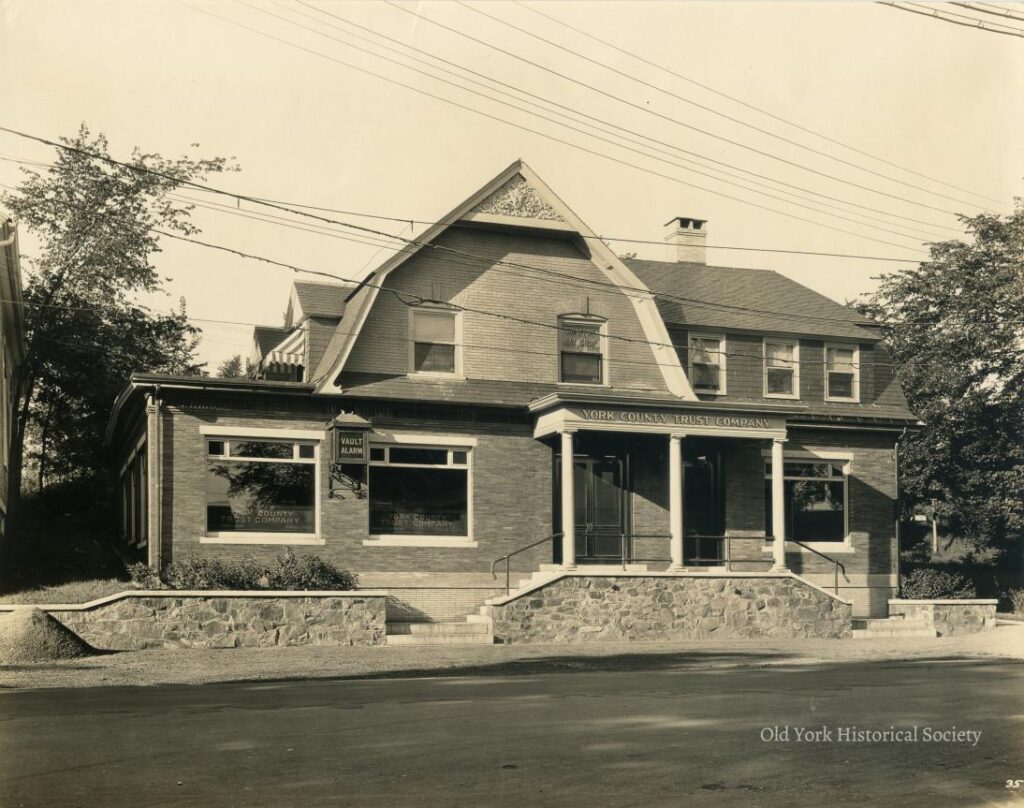 Photo Credit: Old York Historical Society
The newly formed York County Trust Company occupied the same premises as the York County National Bank.
The only visual change for customers was the name of the bank above the front entrance as seen in this photo. This view shows the building in 1923 with its 1914 entrance and expansion on the side near the church. This is the familiar appearance of the building to the present day.
York County Trust Company (1919 – 1933)
Following the closing of the York County National Bank on October 31, 1919, a new institution, the York County Trust Company, opened its doors. Although the new trust company occupied the same building, kept much of the staff, and absorbed the assets and liabilities of the former national bank, it was — legally and structurally — a wholly new bank with a broader set of powers than national banks enjoyed.
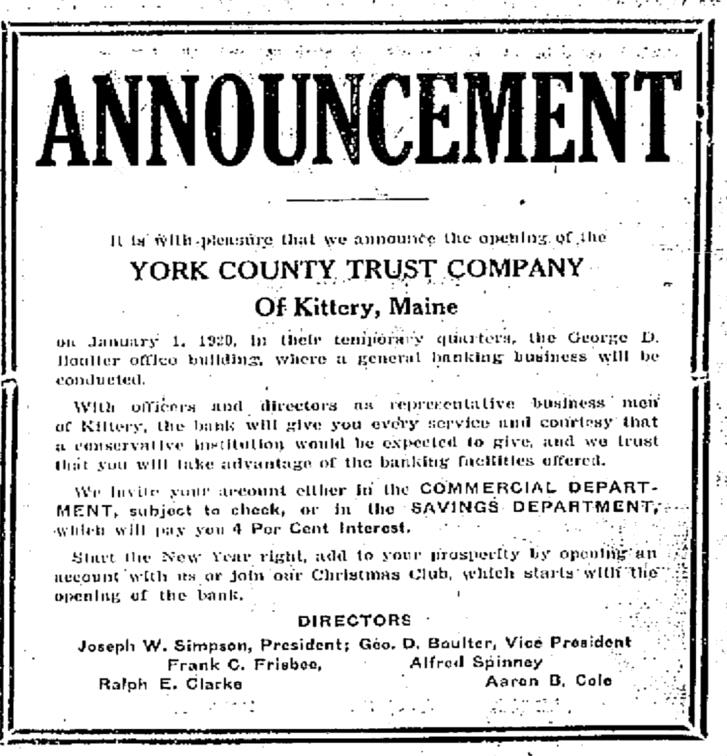
One of the Trust Company’s earliest achievements came on January 2, 1920, when a new branch opened in Kittery — the first branch bank in the community’s history. The Kittery branch was quickly embraced by residents of Kittery and Eliot. Many Kittery residents working in Portsmouth switched their checking and savings accounts over to this home-town bank because of the added convenience. A 1920s newspaper clipping notes that the bank experienced a dramatic rise in deposits in its first year.
 Portsmouth Herald – December 31, 1919
The first Kittery office opened in George D Boulter’s business office on government Street. It was primarily set-up for paying and receiving activity such as teller transactions of accepting deposits and check cashing. Boulter’s office offered the Trust Company an immediate and credible presence in the business district while the Fraternal Building was still under construction.
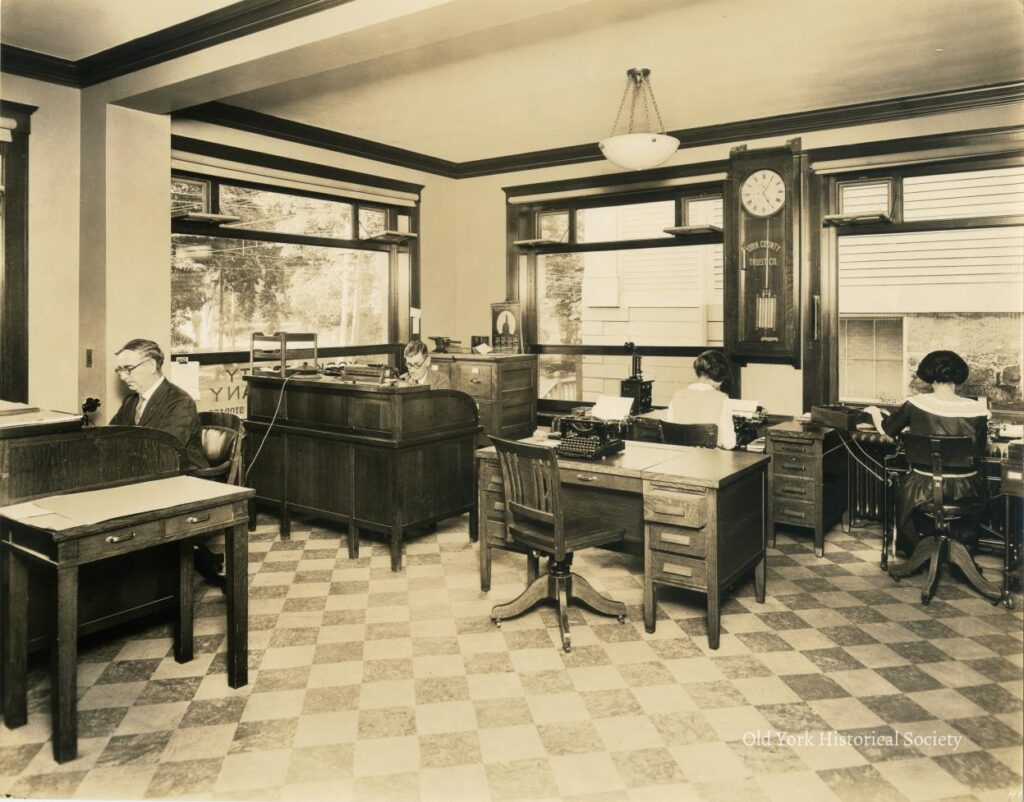
Photo Credit: Old York Historical Society
Bookkeeping Department of the York County Trust Co. in York – 1923
All back-office operations for the York County Trust Company, supporting Kittery and York, occurred at its head office in York. This included the maintenance and posting of transactions in ledgers for customer’s checking, savings, and loan transactions. The above photo is the Trust Company’s bookkeeping department in the York office. This is the section of the building added in 1914 on the side near the Methodist Church.
President Joseph Simpson had his primary office in York. He would travel often to Kittery to promote business and reassure its citizens he was connected and supported the needs of the Kittery community. Treasurer A. M. Bragdon conducted his duties in York, including keeping the Trust Company’s general ledger accounting, paying the Trust Company’s bills and and providing reporting to the Board and to Maine’s Bank Commissioner.
The Board of Directors continued to meet in York much as they did as a national bank. As time went by in the 1920’s, the York County Trust Company added trust and probate services which were now allowed under the State charter.
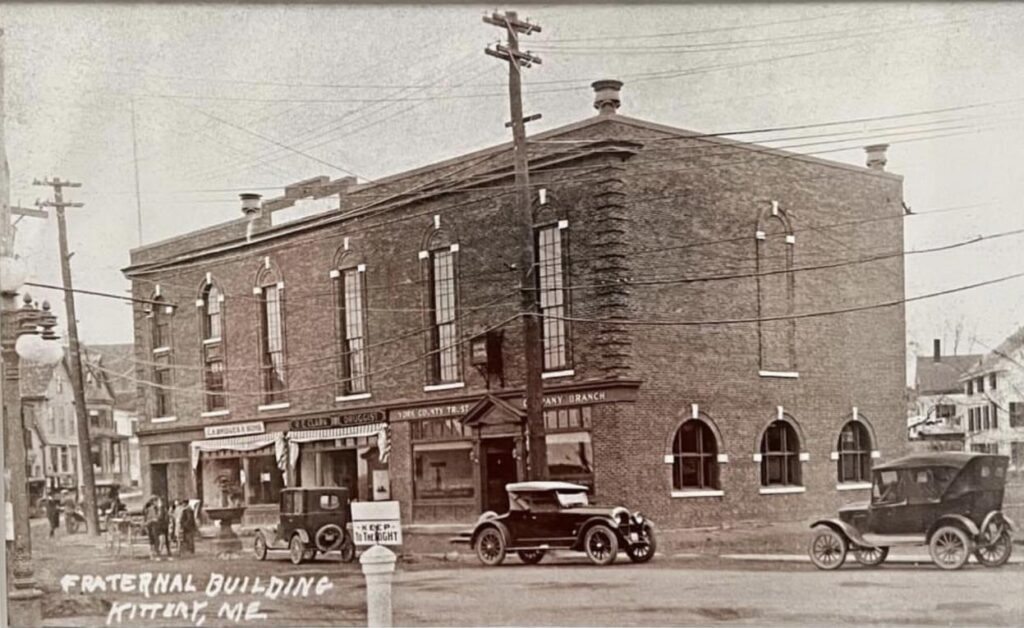 Photo Credit: Author’s Collection
The second Trust Company’s Kittery office opened in Wallingford Square in 1923. Note the sign above the doors, “York County Trust Company Branch” on the lower right side of the building.
Before the York County Trust Company moved into the newly built Fraternal Building, its first Kittery office used space in the business office of George D. Boulter, a well-known local entrepreneur. Boulter had long been one of Kittery’s “movers and shakers”—first in the coal and kerosene trade and later expanding into oil distribution and insurance services. In 1922 when he was first associated with the York County Trust Co., he was chair of the Kittery Water District and Chair of the Kittery School Committee. Well respected and deeply embedded in local commerce, Boulter became branch manager, vice president, and director of the Trust Company. His reputation made him a natural intermediary as the bank sought to establish a foothold in Kittery.
As the 1920’s continued, the Trust Company was stable and had favorable financial results. In 1924 another branch for the Trust Company was set up in Ogunquit. The Maine Bank Commissioner’s reports in 1929 show combined deposits for the York County Trust Company approaching $2.2 million — a significant figure for a small-town Maine institution. Reports also consistently listed the senior officers as: President J.W. Simpson, Treasurer A.M Bragdon, and Kittery Branch Manager G.D. Boulter.
But the prosperity of the 1920s was about to collide with the economic catastrophe of the 1930s. The final dark chapter for the York County Trust Company
The York County Trust Company entered the Great Depression already exposed to forces far beyond York Village. When the stock market collapsed in October 1929, the shock did not immediately shut the bank’s doors, but it quietly weakened the very foundations on which it rested. Securities held by the bank declined in value, borrowers began to struggle to meet obligations, and the seasonal flow of deposits that had always sustained a coastal bank became less predictable. Confidence mattered more than ever, and small independent banks across New England suddenly found themselves vulnerable not to rumor or scandal, but to systemic fear.
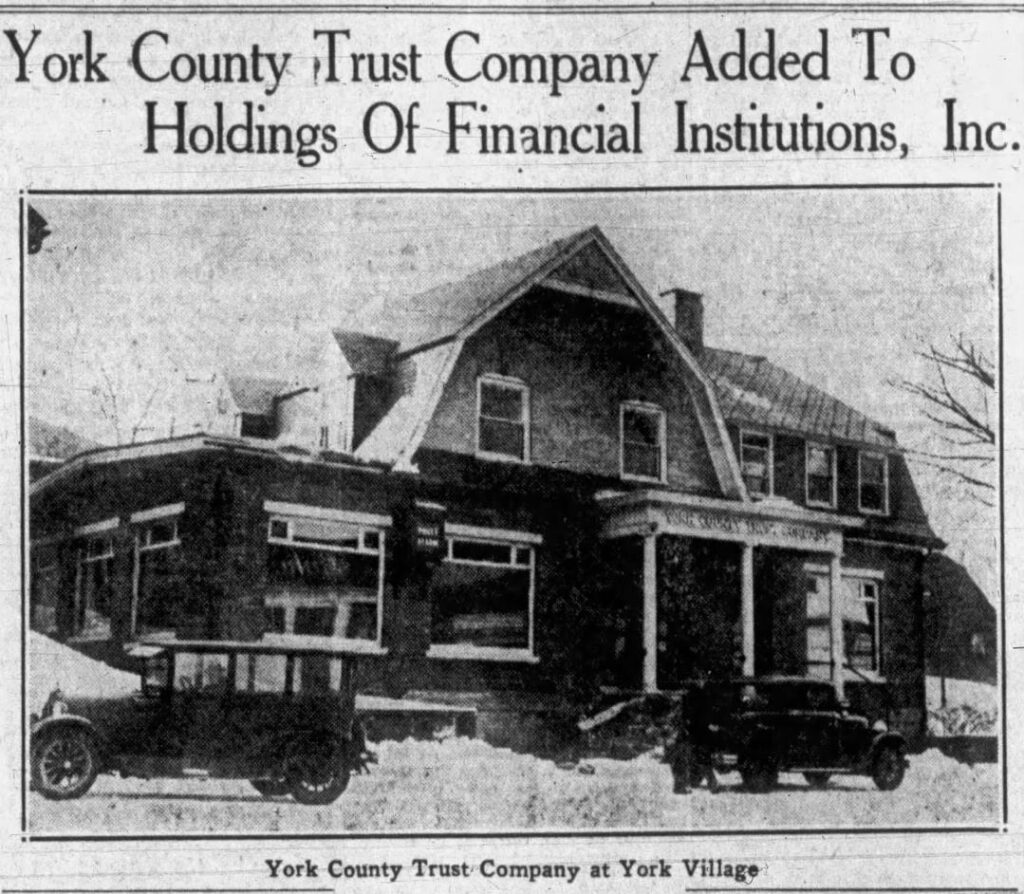 Portland Press Herald – January 9, 1930
Just three months after the crash, on January 8, 1930, the York County Trust Company took what its directors clearly believed was a forward-looking and protective step. As announced publicly by President Joseph W. Simpson, the bank was sold to Financial Institutions, Inc., a Maine-based banking holding company, and became part of a statewide group that included Fidelity Trust of Portland, Augusta Trust, State Trust Company, People’s National Bank of Waterville, Rockland National Bank, First National Granite Bank of Augusta, National Bank of Gardiner, Brunswick National Bank, and Maine Trust & Banking Company of Gardiner. At the time of the announcement, York County Trust held deposits exceeding $2.2 million, and the combined resources of the holding company group were reported to exceed $68 million, with combined capital of $7 million. Importantly, Simpson assured the public that no change in management or personnel was planned.
The intent of this move was clear. By joining a diversified holding company, York County Trust could share risk across many communities, obtain stronger access to interbank liquidity, and reassure depositors that it now stood behind a much larger financial structure. At the outset of the Depression, this was viewed nationally as a modern and stabilizing strategy. Instead of standing alone, York County Trust would be backed by a network of banks whose combined strength could absorb temporary losses and smooth out local disruptions. For Simpson and the directors, this was not a surrender of independence so much as an insurance policy against a storm that few yet understood.
But the storm did not pass. Through 1930 and into 1931, economic deterioration accelerated rather than easing. Business failures spread across southern Maine, real estate values fell sharply, and loan portfolios weakened as interest went unpaid. What had seemed in early 1930 to be a temporary collapse of market prices began to reveal itself as a deep and prolonged contraction of the entire economy. The holding company structure that had promised strength now became a shared burden, as weakness in one subsidiary bank strained the others. Rather than isolating risk, the holding company increasingly transmitted it.
By 1931 the problems faced by York County Trust were no longer merely cyclical. The quality of its assets — mortgages, commercial loans, and other investments — continued to erode. Cash became scarcer. Correspondent banks grew more cautious. State examiners watched closely as overdue loans increased, and reserve cushions thinned. Simpson and fellow director A. M. Bragdon would not have needed any single dramatic event to know the bank was in danger; the warning signs would have appeared steadily in monthly and weekly condition reports: shrinking liquidity, rising delinquencies, falling earnings, and increasing dependence on borrowed funds just to meet daily obligations.
Throughout 1931 and into 1932 the bank struggled to avoid outright failure. Like many similar institutions, it attempted to protect itself by tightening credit, pressing for repayment on weak loans, selling liquid securities at whatever prices the market would bear, and relying more heavily on correspondent balances secured through the holding company network. The very existence of Financial Institutions, Inc. suggests that internal capital transfers or emergency support may have been attempted, but by 1932 even large banking groups were under stress. What had begun as a method to share strength now meant that weakness could no longer be contained within a single town.
By mid-1932, York County Trust had effectively entered a liquidation posture under state supervision, even though its doors continued to operate for a time. This meant that regulators already understood that the bank’s capital structure had been critically impaired and that survival would require either extraordinary new capital or an orderly wind-down. No newspaper accounts describe a wild local “run,” and that absence is meaningful. York County Trust did not collapse overnight because depositors stormed the counters; it slowly suffocated as asset values shrank and the flow of dependable cash dried up.
The final weeks came in early March 1933, at the very climax of the nationwide banking panic. Across the country, withdrawals surged, state governments began issuing emergency banking holidays, and the federal government prepared to shut down the entire banking system in an attempt to stop the hemorrhage. York County Trust Company closed in early March 1933, preceding when President Roosevelt declared the national banking holiday on March 6, 1933. That timing is critical. It shows that the bank did not close because of the holiday; it closed because, by that point, there was no realistic path left to solvency. Whatever support the holding company might once have offered was no longer sufficient, and the directors and regulators alike understood that reopening after a federal inspection would not be possible.
Once the national banking system was frozen on March 6, and then selectively reopened under the Emergency Banking Act, only banks judged fully solvent were permitted to resume operations. York County Trust was not among them. Instead, a conservator — and shortly thereafter a receiver was appointed to take control of the bank’s assets, collect outstanding loans, sell real estate and securities, and distribute proceeds to depositors as dividends over time.
The liquidation that followed was not a single event, but a slow, methodical process that extended across several years as assets could be converted into cash. Depositors eventually recovered part but not all — of their funds through those distributions. Liquidation reports show staged dividend payments to depositors (e.g., 60% on Christmas Club accounts in Dec. 1933; additional percentages on savings and commercial accounts through 1937). By mid-1936, savings depositors had received about 70% and commercial accounts about 25%; liquidation continued into 1940. A final decree was entered Aug. 19, 1943, with $1,103.99 in unclaimed deposits turned over to the State Treasurer.
In the end, the failure of the York County Trust Company was not caused by a single reckless act, a sudden scandal, or a dramatic run. It was the product of systemic economic collapse, compounded by declining asset values, prolonged borrower distress, and the inability of even a multi-bank holding company to shield the institution from the cumulative weight of the Depression.
The last banks to occupy 207 York Street, York Village
Community Trust Company 1934-1963, First National Bank Portland 1963-1968, Maine National Bank 1968-1975
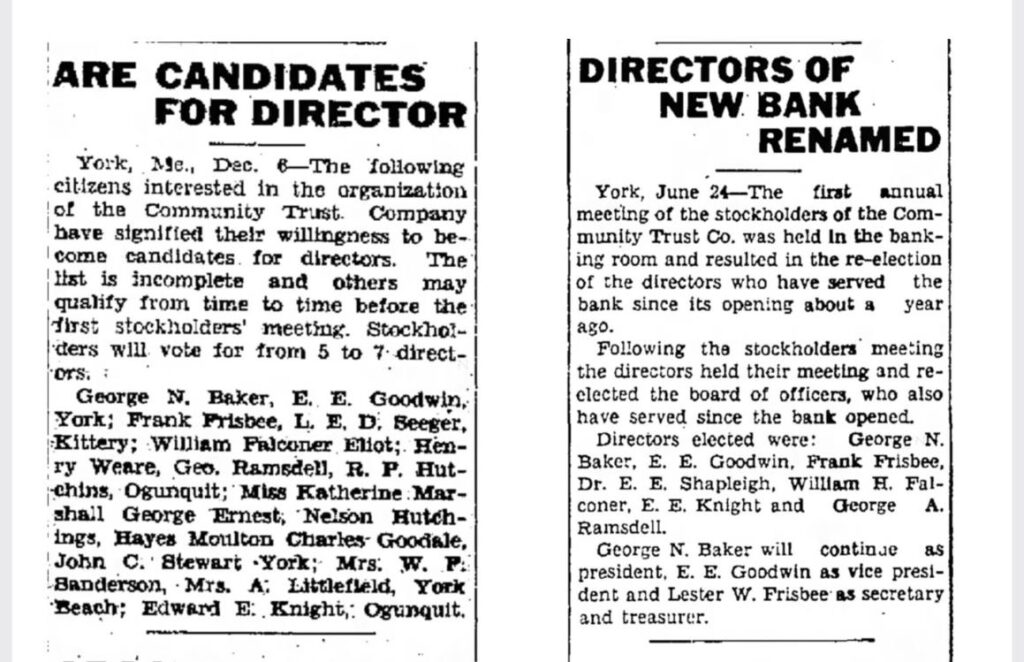
Portsmouth Herald – December 6, 1933 Portsmouth Herald June 24, 1935
After the closure of York County Trust Company in March 1933, a new banking organization was being considered. In December1933, several local citizens signified their willingness to join a new bank as directors, to invest personal funds for the required capital to support the new entity and help with the purchase of the building on York Street for bank operations. See above, left.
A new bank—Community Trust Company (York Village)—was chartered by the State of Maine on July 18, 1934, with its head office in York and branches in Kittery and Ogunquit. This was a newly chartered institution, not a legal continuation of York County Trust. The new company would occupy the premises at 207 York Street as did the earlier York County National Bank and York County Trust Company. All the officers and directors of the Community Trust Company were new and did not carry over from the former banks. The only person considered for a director previously connected with the National Bank and York County Trust was 84-year-old John C Stewart. Unfortunately, he passed away in June 1934 just a month prior to Community Trust’s start.
The following officer were chosen to lead the new organization: President – George N Baker, York; Vice President – E. Everett Goodwin, York; Treasurer – Lester W Frisbee, Kittery. When George N Baker died in 1944, E. Everett Goodwin became president until his death in 1958 at which time Lester W Frisbee became president.
First National Bank of Portland 1963 – 1968
Community Trust Company merged into First National Bank of Portland on Apr 26, 1963, under the First National Bank of Portland’s charter & title. The York Street location now became a branch of the much larger Portland based bank. This was the end of the building housing the main office of a bank. Only branch banks from this point on.
Maine National Bank 1968 – 1975
First National Bank of Portland was retitled Maine National Bank after its 1968 merger with Rumford Bank & Trust Co. (name change approved mid-1968.)
Under its new name, Maine National Bank now operated the branch. Signs were changed on the façade and on internal documents to reflect the bank’s new identity. This branch would continue occupying this location until November 24, 1975 when the Maine National Bank branch moved to a newly constructed building across York Street at 10 Long Sands Road.
That marked the end of national banks or trust companies occupying the 207 York Street location.
After 1975
Since 1975 there has been a few tenants in the original bank building. In the early 1990’s a branch of Sanford Maine’s York County Teachers Federal Credit Union occupied a portion of the building. The tenants with the longest duration occupying the building were Central Maine Power’s business office and Old York Historical Society’s research center and business office.
The building is currently under private ownership with space available for rent.
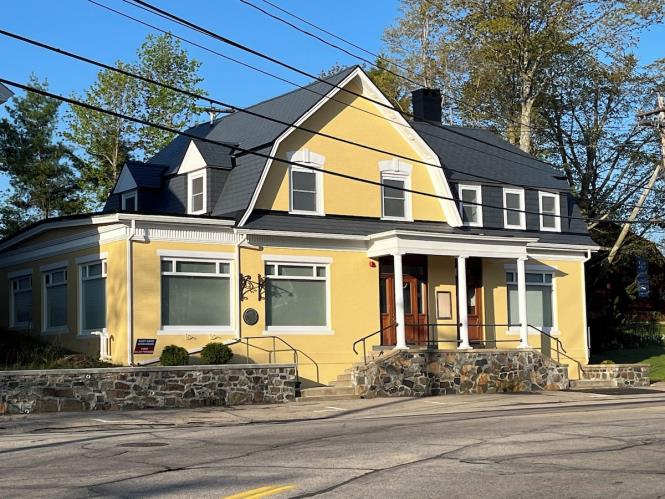
Legacy
From its founding in 1893 to the departure of Maine National Bank in 1975, the banks housed at 207 York Street played a central role in the civic and economic life of York Village. Though their charters and names changed—from York County National Bank to York County Trust Company, to Community Trust, and finally to the Portland and statewide successors—the building remained a constant presence for more than eight decades.
The York County National Bank established a tradition of careful management and community trust under James T. Davidson and, later, under the remarkable leadership of Elizabeth Burleigh Davidson. Her presidency, nearly two decades long, was exceptional not only for its effectiveness but also for its rarity in American banking. At a time when almost no women held senior financial roles, she guided a federally chartered, currency-issuing national bank with competence, steadiness, and respect from customers and peers alike.
The 1919 transition to the York County Trust Company marked a shift to broader financial services, including trust work, savings programs, and branch banking. The Trust Company’s expansion into Kittery and Ogunquit reflected York’s growing commercial life before the Great Depression reshaped banking statewide. Though the Trust Company ultimately succumbed to the economic pressures of the 1930s, it remained a significant institution in York County during the interwar years.
Banking returned to the building in 1934 with the creation of the Community Trust Company, and for the next four decades the structure continued to serve as a familiar and reassuring place for generations of York residents—first under Community Trust and later as a branch of First National Bank of Portland and Maine National Bank.
Even after banking operations moved elsewhere in 1975, the building continued its civic life as the home of Central Maine Power’s local office and later the research headquarters of the Old York Historical Society. Today, the building is still a visible link to York’s commercial past.
The story of these banks—especially the pioneering leadership of the Davidson family—reflects the growth, challenges, resilience, and character of York itself. Their legacy is one of community service, steady stewardship, and deep local roots that continue to shape how residents remember the history of York Village.
The End
Sources
Federal & Regulatory Sources
Office of the Comptroller of the Currency (OCC) – National Bank Charter Records
Charter #4844 (York County National Bank), original chartering documents, amendments, and liquidation filings.
https://occ.gov/publications-and-resources/tools/national-bank-lists/
OCC Annual Reports of the Comptroller of the Currency (1893–1920) National bank balance sheets, officer listings, and condition reports. https://fraser.stlouisfed.org/title/annual-report-comptroller-currency-56
United States Treasury – National Currency Bank Note Data Production records, large size note issues, and signer documentation. https://www.moneyfactory.gov/
State of Maine Banking Sources
Maine Bureau of Financial Institutions – Historical Bank Charters & Annual Reports (1860s–present) Includes charter filings, examiner reports, trust company registrations, and liquidation actions for:
York County Trust Co. (1919 charter)
Community Trust Co. (1934 charter)
https://www.maine.gov/pfr/financialinstitutions/
Maine State Legislature – Session Laws & Special Acts Particularly for the 1909 York/Gorges division legislation. https://legislature.maine.gov/
Numismatic & Currency References
National Bank Note Census (NBNC / Kelly Census)
- Plate letters, serial #1 notes, engraver details, and bank issuance volumes.
- BankNoteHistory.org – Charter #4844
Historical summaries of note issues, surviving notes, and officer signature data. https://banknotehistory.spmc.org/
Society of Paper Money Collectors (SPMC). www.spmc.org
Research articles on national currency systems and the role of women signers/bank officers. Karl Sanford Kabelac, Journal of the Society of Paper Money Collectors, vol 51, No 6 December 2012. Article about Elizabeth Davidson. Compiled list of 59 women known to be presidents of
national banks and names a small subset in the early 1900’s.
Books on local history
350 Years as York, Edited by Virginia S Spiller. Published by the Old York Historical Society, 2000
York Then and Now, Published by the Old York Historical Society, 1976
Trolleys to York Beach, O.R. Cummings, New England Historical Society, 1964
Historical Newspapers & Archives
Library of Congress – Chronicling America
- For comparisons of bank runs, early 1900s banking norms, and women in banking. https://chroniclingamerica.loc.gov/
Local, Regional, and other Newspapers
York Weekly
Edward S Marshall by John Bardwell
11/15/1989
York Weekly
Elizabeth Davidson by Peter Moore
12/1/1993
York Weekly
Edward S Marshall by Peter Moore
10/11/1995
York Weekly
Article on YCNB by Peter Moore
2/14/1996
York Weekly
YCNB building enlarged by Peter Moore
2/21/1996
York Weekly
Article on York Hospital by Pat Lee
1/1/2006
Portsmouth Herald
YCNB Annual Meeting
2/22/1902
Portsmouth Herald
Run on the Bank
4/6/1909
Portsmouth Herald
Run on the Bank
4/9/1909
Portsmouth Herald
YCTC Announcement Kittery Branch
12/31/1919
Portsmouth Herald
YCTC branch opening
12/29/1923
Portsmouth Herald
CTC Director Candidates
12/6/1933
Portsmouth Herald
John Stewart Obituary
6/5/1934
Portsmouth Herald
CTC Officers and Directors
6/24/1935
Portsmouth Herald
George N Baker obituary
11/25/1944
Portsmouth Herald
CTC Lester Frisbee President
1/9/59
Portland (ME) Evening Express
Death of James T Davidson
11/25/1901
Portland (ME) Press Herald
Death of John H Burleigh
12/7/1877
Portland (ME) Press Herald
YCTC Financial Institutions Inc
1/9/1930
Portland (ME) Press Herald
Joseph W Simpson Obituary
6/14/1944
Biddeford Saco Journal
YCNB Statement of Conditions
12/31/1897
Biddeford Saco Journal
YCNB Statement of Conditions
3/5/1898
Biddeford Saco Journal
YCNB Statement of Conditions
7/16/1900
Biddeford Saco Journal
YCNB Savings Department
10/18/1907
Biddeford Saco Journal
YCTC Promoters
9/4/1919
Biddeford Saco Journal
Death of John C Stewart
6/5/1934
Kennebec (ME) Journal
OCC Notice EB Davidson Election
1/1/1902
Kennebec (ME) Journal
Town of York Divided
4/8/1909
Lewiston (ME) Daily Sun
Death of Joseph W Simpson
6/12/1944
Boston Globe
Death of James T Davidson
11/25/1901
Boston Globe
Town of York Divided
4/9/1909
Forney’s Sunday-Washington DC
John H Burleigh obituary
12/9/1877
Advertiser Democrat (ME)
Death of John H Burleigh
12/11/1877
Lafayette (IN) Weekly
James Davidson Obituary
11/26/1901
The Daily Item (Lynn MA)
YCNB Officers & Directors
4/7/1909
Red Deer News (Alberta Canada)
Discussion of Elizabeth Davidson
6/5/1906
Rutland (VT) Daily Herald
Article about Elizabeth Davidson
9/4/1912
Trenton (NJ) Advertiser
Article on Elizabeth Davidson
11/3/1912
Cemetery Records
Burial Records of First Parish Cemetery in York, Maine. https://www.findagrave.com/cemetery/89899/first-parish-cemetery
Note: Along with several other people mentioned in this paper, James and Elizabeth Davidson are interred in the First Parish Cemetery
Interviews & Correspondence
Lennie Ogden – Lennie is the great granddaughter of James and Elizabeth Davidson. Discussions and correspondence concerning the Davidson family were quite beneficial and much appreciated.
Kaitlyn Fitzgerald – Archivist at the Old York Historical Society. Kaitlyn’s help gathering photos and associated documentation was invaluable to this project.
Joseph Szeniawski – current owner of 207 York Street. Joe gave Kevin McKinney and me from the York History Group a tour of the building. Joe pointed out the renovations he made to convert the building for residential and possible commercial use. Several features from the past have been masterfully preserved and incorporated into the interior design including the bank’s original 1894 vault with its massive door and the 1914 oak wainscoting paneled stairway leading to the second floor. We thank Joe for the tour and his commitment to preserve the rich character of the building.
Author: Thomas M Prince Date: January 14, 2026 York, Maine tomprince326@gmail.com
Please contact the author by e-mail if you wish to receive a printable PDF copy of this file entire paper.